Land Security Brings Together Judges, Notaries, and Lawyers to Address Real Estate Dispossession Cases
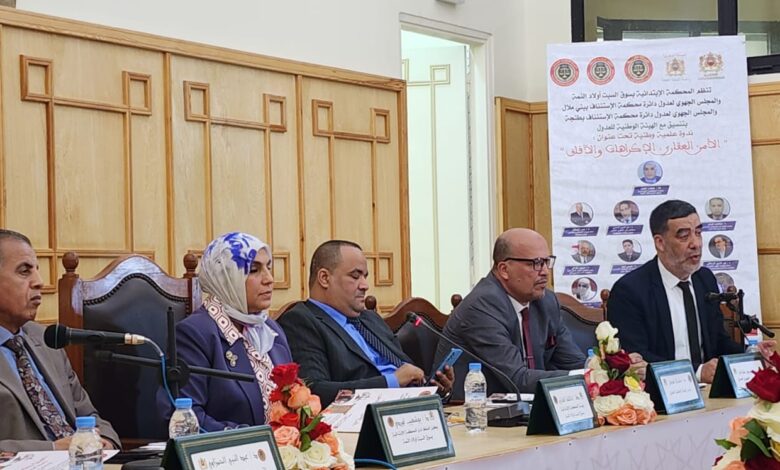
National Conference on Land Security: Challenges and Perspectives
A national conference was held under the theme "Land Security: Constraints and Perspectives," featuring participation from judges, adouls (local notaries), lawyers, judicial officials, local authority representatives, and experts in documentation and land law. The event took place at the Court of First Instance in Souk Sebt Oulad Nemma, part of the Béni Mellal-Khénifra judicial district, on the morning of Wednesday, April 30, 2025.
This scientific and professional meeting highlighted the range of issues concerning land security in Morocco, especially within the context of rapid urban transformations, particularly in rural areas facing increasing urbanization. This phenomenon has led to unregulated developments, further complicating transactions and their legal documentation.
In her opening speech, Mrs. Aïcha El Aazem, President of the Souk Sebt Court of First Instance, emphasized the significance of this initiative that brought together various actors from the judicial system. She asserted that the relationship between people and land extends beyond a mere material aspect; it forms a foundation for social and economic stability, necessitating rigorous organization and an evolving legislative framework.
For his part, Master Driss Trali, President of the Regional Council of Adouls near the Appeals Court of Béni Mellal, stated that ensuring land security requires effective urban planning and a clear land policy. He highlighted that land is a critical component of the success of public policies, particularly in areas such as investment and land development.
Master Saïd Saroukh, President of the Regional Council of Adouls near the Appeals Court of Tangier, praised the professional cooperation between adouls and the judicial institution. He recalled that justice has evolved beyond merely resolving disputes to becoming an administrative and societal player through what is now referred to as local justice, urging the reinforcement of this role in service of land security.
Similarly, Master Bouchaïb Louardi, the Prosecutor-General at the Souk Sebt Court of First Instance, noted that "the multitude of legal regimes and the rise in acts of dispossession necessitate a more rigorous approach to transactions." He affirmed that "the current land system requires legislative restructuring to restore trust and reduce disputes," advocating for enhanced coordination among various stakeholders, an integrated national vision based on complementary roles, and ongoing training for adouls and notaries to keep pace with legal and technical developments.
The conference featured various presentations from lawyers, land experts, and administrative officials, who highlighted obstacles to documenting property titles, the multitude of legal references, and the challenges faced by citizens in land registration processes—leading to a complex legal environment detrimental to trust and investment.
The conference concluded with several recommendations put forth by speakers, including:
- Unifying the documentation system between adouls and notaries to ensure legal coherence and simplify contractual procedures.
- Clarifying the content of circulars from the General Conservator to prevent divergent interpretations that could jeopardize land security.
- Rewriting Article 4 of the Real Rights Code, which presents practical issues affecting the documentation of legal acts.
- Revising provisions of the finance law related to compensation for expropriation for public utility, considering legal equity.
- Requiring solely the payment certificate for property taxes related to the transaction, without extending this to other properties owned by the seller.
- Amending Article 109 of the Land Registration Dahir to include the possibility of extraordinary appeals in addition to regular appeals and cassation.
- Strengthening the legal framework governing experts, particularly regarding land valuation in judicial expertise.
- Avoiding the drafting of legal texts under crisis pressure to ensure legislative stability and quality.
- Reformulating certain legal concepts in land texts, distinguishing between substantive and procedural matters.
- Unifying legal texts into a comprehensive and simplified land code.
- Defining methods of property proof for collective lands and ensuring their legal protection.
- Establishing legal mechanisms for consumer protection in real estate contracts.
- Simplifying land registration procedures, especially for lands within readjustment perimeters, and expanding the powers of the public prosecutor to protect possession.
- Amending Article 570 of the Penal Code to criminalize any act that undermines possession or obstructs the enjoyment of real estate without justification, and enabling justice to restore the prior situation automatically.
These recommendations were warmly welcomed by participants, who stressed the necessity of enhancing coordination among various actors in the land sector, developing ongoing training for professionals, and consolidating the role of justice as a guardian of land security and social balance.
In closing, attendees commended the efforts of the organizing committee and the commitment of participants in enriching the debate, calling for the continuation of such scientific gatherings to meet the growing challenges within Morocco’s land sector.