
Opening of “The Cultural House of Carpets”: A Tribute to the Art of Weaving and the Legacy of Berber Women
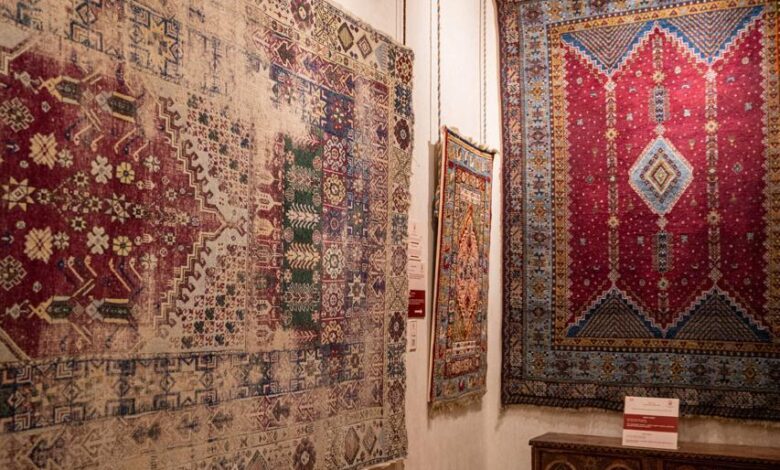
Marrakech – Nestled in the prestigious Laksour district, a new cultural venue has opened its doors: The Cultural House of the Carpet. More than just an exhibition space, this Riad—built from the ground up in strict adherence to authentic Moroccan architecture—offers a unique museum-style exploration of Moroccan carpets. Here, the carpet is not merely a product, but a heritage, a coded language, and a genuine work of art.
The Cultural House of the Carpet: An Immersive Museum Journey Through Morocco
The Cultural House of the Carpet invites visitors on a 45-minute initiatory journey through a meticulously crafted scenography. Each room represents an iconic region of the Kingdom: from the High Atlas to the Middle Atlas, passing through Rabat and the Haouz.
Far from just a collection of displays, each piece is accompanied by captivating storytelling and precise descriptions. The selected carpets, part of a private collection built over 50 years, were chosen for their invaluable historical significance (the oldest piece dates back to the 1850s), their symbolism, the complexity of the techniques used, and sometimes their rare dimensions. Visitors can admire silk carpets, black wool, goat hair, square carpets, and wool kilims woven with silk and silver thread, as well as others crafted by men. The journey concludes with a Modern Room and a “Masterpiece” Room, a true sanctuary dedicated to exceptional collectible carpets.
Also showcased are babouches, cushions, bags, saddle bags, books on carpets, and tools used by weavers (spindles, wool combs, shuttles…).
A Tribute to Weavers: The Vision of an Heir
At the heart of this project is Nasser Ksikes, a fourth-generation representative of a family of merchants and collectors. This place is the culmination of a family passion and a commitment to preservation.
“After studying abroad, I returned to Morocco to continue my family’s work. For me, the importance of this museum lies in honoring the memory of the weavers. It’s about paying tribute by revealing the hidden stories they weave into their carpets,” confides Nasser Ksikes.
As a Berber proverb puts it: “A carpet is an open book where women’s hands have written the soul of a country with wool and time.”
A Dive into the History of the Carpet
The cultural dimension is bolstered by a screening room showcasing a rare French documentary produced in the 1940s. Complementing these archival images, the walls feature lithographs from the same era by Jean Besancenot, an ethnologist, painter, and photographer who authored the seminal work “Costumes of Morocco”, revealing a selection of urban and rural costumes from Berber, Arab, and Jewish cultures. These artworks provide essential visual context, illustrating how Berber women were dressed at the time.
From Contemplation to Creation of Carpets
The experience doesn’t stop at observation. The Cultural House of the Carpet aims to be a vibrant space: