Ahmed Naser Al-Raisi: Morocco, under the enlightened leadership of His Majesty the King, is a recognized model of openness and security cooperation.
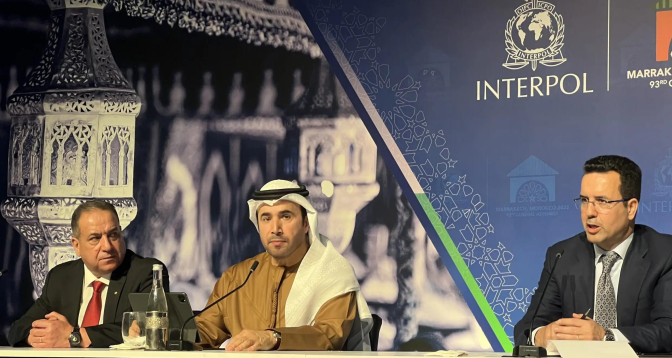
International Criminal Police Organization’s General Assembly Opens in Marrakech
General-Major Ahmed Naser Al-Raisi, President of Interpol, commended Morocco on Monday in Marrakech for its unwavering support of international security. He emphasized that under the enlightened leadership of His Majesty King Mohammed VI, Morocco stands as a recognized model of openness and security cooperation.
Speaking at the inauguration of Interpol’s 93rd General Assembly session (November 24-27), General-Major Al-Raisi expressed profound gratitude to His Majesty King Mohammed VI for his support in the success of this international event.
Highlighting Morocco’s advantages and its rich cultural heritage—a tapestry woven from Amazigh, Arab, Andalusian, and African influences—he noted that the Kingdom continues to thrive as a bridge between East and West, and North and South.
“This 93rd General Assembly is not merely an annual dialogue meeting but a platform aimed at strengthening international cooperation in policing and safety, allowing us to outline a future vision for this organization,” he added. This gathering also provides an opportunity to review past achievements and adopt a joint security plan for the next five years.
In presenting an overview of his tenure, marked by the modernization of policing operations and techniques at Interpol, strengthening of information exchange mechanisms, and fostering trust between member states, General-Major Al-Raisi elaborated on the significant success in data exchange. He emphasized that these mechanisms have played a decisive role in the organization’s operational successes.
He acknowledged the celebration of the 10th anniversary of Interpol’s Innovation Centre, which he described as a “fundamental pillar” in advancing digital and cyber innovation. He pointed out that this structure has enabled the organization over the last decade to bolster its support capabilities for law enforcement agencies, equipping them to address complex threats and anticipate future risks.
“Today, Interpol embraces a culture of innovation,” he remarked, noting that this is the first time in history that the General Assembly is being held entirely in a digital format.
On his part, Interpol Secretary-General Valdecy Urquiza praised the "significant support" that Morocco provides to Interpol—"not only by hosting this General Assembly but also as an active and engaged member state" in the organization’s activities.
“On behalf of Interpol and the entire community of law enforcement agencies present here today, we wish to express our gratitude to the Moroccan authorities for their invaluable support,” he stated in a press declaration.
Participants will spend the next four days discussing priorities for law enforcement services, including cybercrime, combating criminal organizations, and addressing organized and emerging crime.
This General Assembly, which opened Monday in Marrakech with senior officials and police chiefs from 196 Interpol member countries in attendance, will examine major global crime trends, such as dismantling transnational criminal networks, combating international fraud hubs, enhancing global policing capabilities, and promoting the role of women in law enforcement.
As the supreme governing body of Interpol, the General Assembly serves as the largest global gathering of law enforcement leaders and provides an opportunity for member countries to forge connections and share best practices.