Celebrating Women’s Hassani Poetry at the 18th Edition of the Tan-Tan Moussem 2025
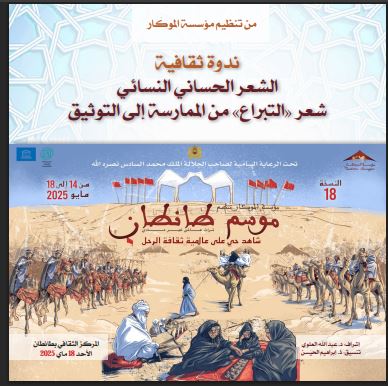
Al Mokar Foundation to Host Cultural and Scientific Conference on Hassani Poetry
The Al Mokar Foundation is set to organize a cultural and scientific conference titled "Hassani Poetry: The Tebraî, from Practice to Documentation," on Sunday, May 18, 2025, at 6:00 PM at the Tan-Tan Cultural Center. This event, which coincides with the Tan-Tan Moussem, is held under the High Patronage of His Majesty King Mohammed VI, may God assist him. The Moussem will take place from May 14 to 18, 2025, under the theme: "The Tan-Tan Moussem: A Living Witness to the Universality of Nomadic Culture."
The cultural gathering, moderated by Hassani culture researcher Aazza Beyrouk, will bring together several poets, poetesses, and researchers in Hassani literature from the region. They will discuss the "tebraî," a Saharan poetic form crafted exclusively by women, with the aim of enhancing its recognition and highlighting its expressive, symbolic, and aesthetic dimensions. The conference will also include recommendations for preserving and safeguarding this unique poetic genre from oblivion and disappearance.
Among the speakers is poet Khadija Laabid, who will address "Innovation in Tebraî Poetry," alongside Hassani culture researcher Aziza Aakida, who will present a paper titled "The Tebraî: A Hassani Creation Marked by Uniqueness."
Poet and Hassani literature researcher Taher Khneibila will discuss "Semantic Density and Poetic Imagery in Tebraî Art," while poetess Oum El Fadl Ma El Aïnine will explore the theme "The Tebraî Between the Speakable and the Unspeakable." Additionally, poet Abdellah El Hamel will provide an analysis titled "Hassani Women’s Poetry Between Past and Present: Its Impact on Society and the Poetic Elite."
It is important to note that the "tebraî" is a type of popular oral poetry composed exclusively by Saharan women. It consists of poetic verses expressing romantic feelings toward men in a strictly private setting, steeped in discretion due to codes of modesty, reserve, and the social pressures exerted by traditions and tribal taboos.
The "tebraî" is characterized by its linguistic simplicity and symbolic nature. It follows a metrical form with a single rhyme across its two hemistichs. There is an ancient form marked by modesty and enigma, as well as a more recent form that is more explicit, direct, and grounded in contemporary social realities.