
Floods in the Gharb: 300 Million Dirhams to Revitalize Agricultural Activity
Meeting on Agricultural Impact of Recent Floods Held in Kénitra
On Friday, Ahmed El Bouari, the Minister of Agriculture, Maritime Fisheries, Rural Development, and Water and Forests, convened a meeting in Kénitra with members of the Agricultural Chamber and professionals from the sector within the Gharb region (Rabat-Salé-Kénitra). The meeting focused on evaluating the impact of recent floods and the measures being taken to revitalize agricultural activity.
During the session, significant emphasis was placed on resuming agricultural activities in affected areas, restoring hydro-agricultural infrastructure, supporting impacted farmers, and protecting livestock to restore normal operations on farms as swiftly as possible.
In a statement to the press, Mahjoub Lahrach, the regional director of agriculture for Rabat-Salé-Kénitra, noted that the meeting provided an opportunity to assess the support program for farmers in the affected provinces, namely Kénitra, Sidi Kacem, and Sidi Slimane. The program aims to rehabilitate hydro-agricultural infrastructures, including rural roads, pumping stations, and irrigation and drainage networks.
Lahrach further revealed that this support, amounting to 300 million dirhams, pertains to the Gharb and Loukkos regions. It includes assistance with seeds and fertilizers, as well as support for distressed farmers to enable effective crop recovery, taking into account the unique needs of the affected areas.
Concerning livestock, Lahrach mentioned that the Gharb Regional Office for Agricultural Development (ORMVA) has launched a distribution initiative for barley and compound feed benefiting breeders, which will continue for the coming months.
Hassan Askkour, president of the Gharb Association for Sustainable Agricultural Development, highlighted that the meeting allowed farmers and professionals to propose ideas and be informed about emergency measures implemented or planned to mitigate the impact of this disaster on production and operations.
He also noted that the sector is now facing the challenge of managing water abundance after a period marked by drought, expressing the commitment of civil society associations to support farmers.
Following Royal High Instructions, the government is rolling out a program to assist and support communities affected by recent floods. This initiative aims to help impacted farmers through the launch of a spring crop program tailored to the specific needs of affected regions, including oilseed, cereal, and forage crops, with support for the purchase of seeds and fertilizers to expedite the recovery of the season.
In terms of support for affected breeders, the distribution of barley and compound feed is ongoing, along with enhanced health monitoring of livestock by mobilizing veterinary services to provide necessary consultations, treatment, and preventive interventions, all aimed at protecting animal health and ensuring the continuity of milk and meat production.
Regarding the rehabilitation of hydro-agricultural infrastructures, a program has been adopted that includes dredging and sanitation, along with the repair of pumping stations and agricultural roads to ensure continuous irrigation.
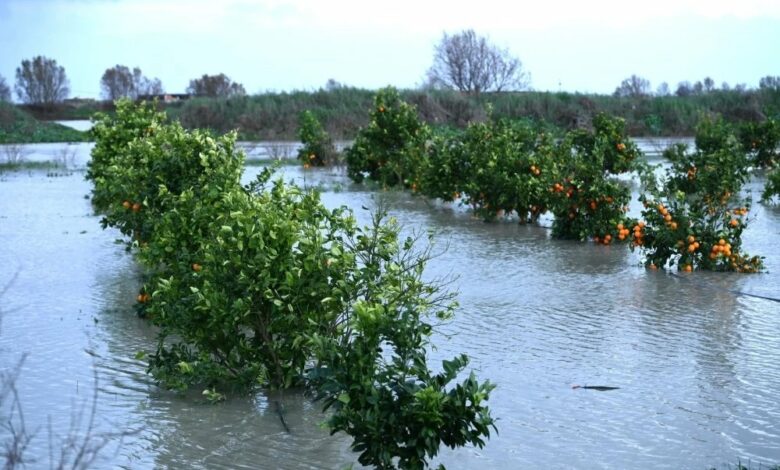
In the Gharb region, nearly 85,000 hectares have been affected by floods, while 20,000 hectares were impacted in Loukkos. These areas primarily concern cereal, sugar, barley, and legume crops, in addition to fruit trees. Livestock activities have also been adversely affected by the floods, which caused damage to hydro-agricultural infrastructures.