Morocco: “Water Highways,” a Strategic Project to Secure Water Resources
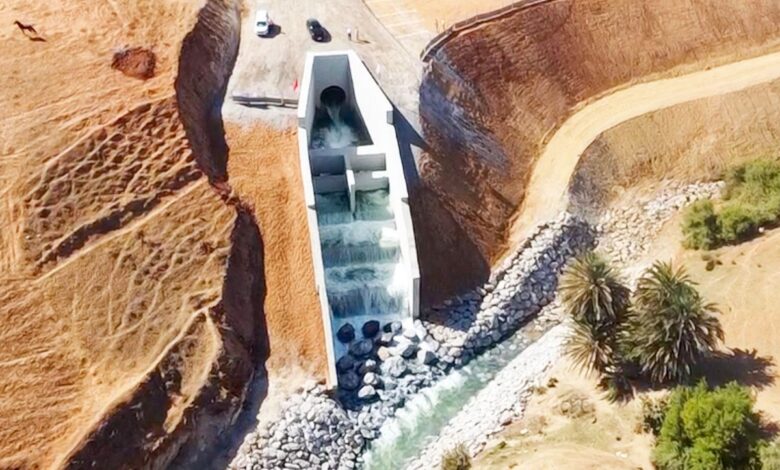
In response to the uneven distribution of water resources, Morocco is launching an extensive hydraulic transfer program called the “water highways”. This initiative aims to enhance the country’s water security and mitigate regional imbalances.
While nearly 7% of the territory accounts for over 50% of the rainfall, these infrastructures enable the transportation of water from surplus areas to those most affected by water stress.
Phase 1: Sebou – Bouregreg, now operational
The first phase of the project, connecting the basins of the Sebou and Bouregreg, is now operational.
It includes:
- 66.5 km of 3.20 m diameter steel pipelines
- 2 pumping stations
- An estimated investment of 6 billion dirhams
- A rapid completion in less than 8 months
Since its commissioning, this system has facilitated the transfer of nearly 953 million m³ of water between August 2023 and December 2025, helping secure the water supply for the Rabat–Casablanca corridor.
Phase 2: Bouregreg – Oum Er-Rbia in progress
The second phase involves the transfer from the Bouregreg basin to the Oum Er-Rbia basin, covering approximately 209.6 km of pipelines, linking the Sidi Mohamed Ben Abdellah dam to the Al Massira dam.
With a target flow rate of 30 m³/s, this project aims to:
- Achieve an annual transfer of approximately 800 million m³
- Enhance water supply for Marrakech
- Support agricultural areas in Doukkala, Béni Amir, and Béni Moussa
Phase 3: Oued Laou – Loukkos / Sebou under study
A third phase is currently under study. It plans for the transfer of an estimated flow between 20 and 30 m³/s to further extend the redistribution network to the northern part of the country.
A national project for water solidarity
Beyond its technical aspects, this program serves as a true tool for territorial solidarity, aiming to correct water imbalances between the regions of Morocco.
It is part of a comprehensive strategy to secure water resources in light of increasing water stress and the impacts of climate change.
A strategic infrastructure for the future
The “water highways” represent one of the most significant hydraulic projects in the Kingdom today, combining engineering, land planning, and sustainable resource management.
They exemplify a new approach to water management, founded on the interconnection of basins and the optimization of available resources at the national level.