
Artificial Intelligence: The Moroccan Job Market in the Era of Major Transformation
Sure! Here’s the translation of the article into fluent, high-quality English:
—
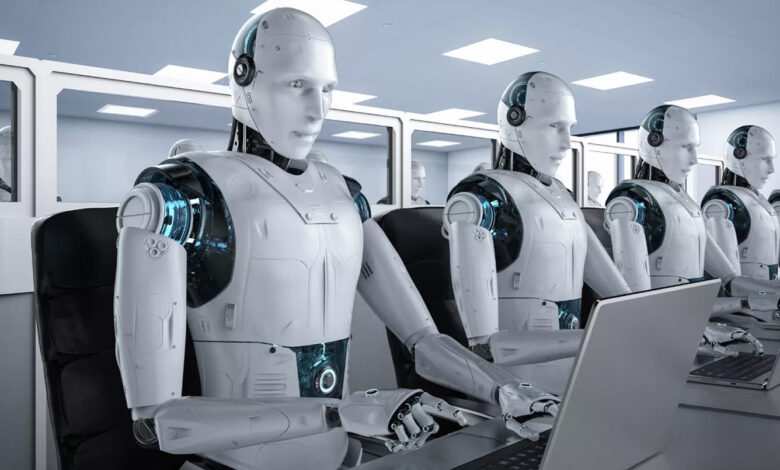
Once viewed as a distant technological revolution, artificial intelligence (AI) is now establishing itself as a direct transformative force in emerging economies. In Morocco, the rise of AI is beginning to reshape the contours of the job market, including promises of productivity gains, the creation of new professions, and real risks of social disruption. In the call centers of Casablanca, accounting firms, banks, editorial offices, and administrative services, generative automation tools are gaining traction. Instant translation, content creation, data analysis, automated customer relations, and document processing: tasks once performed by human teams can now be executed in seconds by AI-powered platforms. The phenomenon is still gradual in Morocco, but signs of acceleration are multiplying.
A Silent Transformation of Tertiary Professions
Unlike previous technological waves, AI no longer targets only industrial or repetitive tasks. It is now penetrating skilled professions in the tertiary sector, which represents an increasing share of the Moroccan economy. Professions related to data entry, translation, customer support, basic accounting, digital marketing, and content production are among the most exposed. In several Moroccan companies, initial budgetary adjustments already begin to incorporate the partial automation of certain support functions. The model of customer relationship centers, a significant pillar of Morocco’s offshoring industry, could be deeply reconfigured. Intelligent conversational assistants are gradually reducing the need for operators for standard requests, pushing industry players to reposition their activities towards higher-value services. For a country that has long capitalized on a competitive Francophone workforce, the challenge is strategic: how to maintain its attractiveness in a global economy where labor costs are no longer the decisive advantage?
The Risk of a Divide Between Skilled Workers and Others
Artificial intelligence doesn’t merely destroy jobs; it fundamentally alters the value of skills. And it is precisely here that one of Morocco’s major challenges lies. Profiles capable of using, supervising, or integrating AI will likely see their market value increase significantly. Conversely, workers in standardized roles risk accelerated precarity. Morocco is already facing high youth unemployment, mismatches between training and business needs, as well as a slow upward movement in certain sectors. The mass arrival of AI could amplify these imbalances if the educational system and public policies do not adapt quickly. Therefore, the real challenge is not solely technological; it encompasses social, educational, and economic dimensions.
The Moroccan Education System Confronts the AI Challenge
Beyond the labor market, the Moroccan educational model is now directly challenged. The students entering primary school today will join the job market in ten or fifteen years, in an environment where mastery of AI will become a prerequisite for many professions. This reality necessitates long-term reflection, which several Asian countries have already undertaken. China, Singapore, and South Korea have early on integrated digital skills, programming, algorithmic logic, and introductory AI into their national educational strategies. These countries, in particular, have opted for continuity in public policies, regardless of governmental changes.
In Morocco, the challenge often lies in the lack of stability in educational reforms. Each change in ministerial leadership brings new directions, pedagogical revisions, and sometimes contradictory priorities. However, AI demands precisely the opposite: a coherent, progressive, and sustainable national vision over at least a decade. The issue is not merely about adding a few IT modules to the school curricula. It involves rethinking learning around skills that will withstand automation: critical thinking, problem-solving, creativity, data analysis, digital literacy, and adaptability. Training a generation capable of working with AI, rather than being subjected to it, could become one of the Kingdom’s major strategic challenges.
Companies Facing Their Social Responsibility
Another significant challenge now concerns Moroccan companies. While AI promises substantial productivity gains and cost reductions, it cannot simply become a tool for wage compression. Increasingly, experts are sounding the alarm about the risks of a brutal adoption of AI motivated solely by financial logic. Massively replacing employees with automated tools could further destabilize the job market and intensify social tensions, especially in the administrative and tertiary sectors.
Thus, the challenge for Moroccan companies is to integrate AI as a means of support rather than a mechanism for systematic substitution of human labor. This requires ongoing training policies, internal retraining, and skill enhancement for employees. Workers must be prepared to use new digital tools to increase their productivity and evolve toward higher-value tasks. This approach could reconcile technological innovation with social stability, without abruptly undermining employment equilibrium within companies. In the most advanced economies, groups that successfully navigate their digital transitions are often those that invest first in their human resources before undertaking massive automation. For Morocco, this aspect could become crucial to avoid a divide between economic modernization and social cohesion.
A Historic Opportunity for Digital Morocco
However, reducing AI to a threat would be an incomplete analysis. For Morocco, this revolution could also become an accelerator of competitiveness. The Kingdom has several advantages: proximity to Europe, a growing startup ecosystem, relatively developed telecommunications infrastructure, and a gradual increase in digital training. Casablanca, Rabat, and Tangier are witnessing the emergence of a new generation of companies specializing in data, cybersecurity, automation, or digital services.
In finance, agriculture, logistics, and health, AI also opens considerable prospects. Optimization of supply chains, predictive maintenance, smart agriculture, assisted medical diagnosis, and fraud detection: the potential uses far exceed just the realm of tech giants. Morocco could position itself as a regional hub for AI services catering to Francophone Africa, provided it invests heavily in skills development.
The Urgency of a Coherent National Strategy
The real question is no longer whether AI will transform the Moroccan labor market, but at what speed and with what level of preparedness. Several experts are already warning about the risk of regulatory and institutional delays. Professional training, universities, innovation taxation, data protection, research support, and assistance for SMEs: the agendas are numerous.
The Kingdom will also need to balance economic attractiveness and social protection. For behind the productivity gains promised by artificial intelligence lies a fundamental question: how to distribute the benefits of this new economy without exacerbating inequalities? In a country where employment remains a central marker of social stability, the transition into the AI era cannot be driven solely by tech companies. It will require a long-term political vision.
Thus, Morocco enters a decisive decade—a decade where artificial intelligence could both become a driver of economic sovereignty and a factor of social fragmentation. Much will depend on the country’s ability to transform this technological disruption into a collective project.