Jorf Lasfar: OCP Accelerates Morocco’s Water Sovereignty
The Jorf Lasfar Seawater Desalination Unit: A Strategic Transformation in Morocco’s Water Management
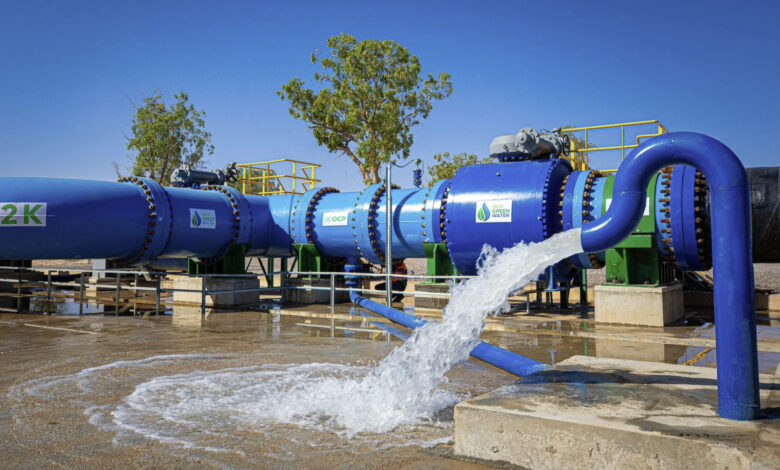
The seawater desalination unit at Jorf Lasfar, part of the OCP Group, stands today as a tangible example of Morocco’s strategic transformation in managing its water resources. Since its commissioning in 2023, this facility produces an annual output of 200 million cubic meters of desalinated water, making it the largest desalination unit in the Kingdom.
The installation primarily contributes to the potable water supply for southern Casablanca, providing 60 million cubic meters per year since December 2024, along with an additional 30 million cubic meters annually for El Jadida. It also ensures the water autonomy of the Jorf Lasfar industrial complex with a capacity of 65 million cubic meters per year.
Remarkably, the project was executed with exceptional speed, completed in less than a year using 100% Moroccan engineering, with only specialized technical components imported. The unit employs reverse osmosis technology, a heavily energy-intensive process. However, the integration of an energy recovery system allows it to cover between 40% and 50% of its energy needs, consuming an optimized 3 kWh, entirely powered by renewable energy sources.
This infrastructure is part of OCP’s green program, led by its subsidiary OCP Green Water, which specializes in sustainable water management solutions. This branch aims to achieve a total production capacity of 600 million cubic meters per year by 2027, up from the current 240 million distributed between Jorf Lasfar and Safi.
This momentum will be reinforced by the recently commissioned Jorf-Khouribga pipeline, stretching 200 kilometers, which will supply 35 million cubic meters annually for the industrial needs of the Khouribga site, along with 10 million cubic meters designated for the potable water supply of the local population.
Beyond desalination, OCP Green Water is also advancing the reuse of treated wastewater. Eight stations are now fully operational along a route connecting Safi to Marrakech via Fquih Ben Salah, with a total capacity of 35 million cubic meters per year. The Marrakech station, the latest addition to the network, came into service on June 17, 2024, with an annual capacity of 12 million cubic meters.
All these facilities operate under a strategic principle based on the exclusive use of green energies, illustrating an integrated model of the circular economy.
On a national level, the future Grand Casablanca desalination plant complements this water strategy. Launched on June 10, 2024, in the municipality of Lamharza Essahel in the El Jadida province, this infrastructure will become the largest desalination station in Africa. Developed as part of a public-private partnership, it fits into the national water supply and irrigation program for 2020-2027, aimed at strengthening water security in Greater Casablanca in response to increasing pressure on water resources.
These integrated projects reflect a profound shift in the role of desalination within Morocco’s water policy. Once regarded as an alternative solution, desalination is now a central pillar of the country’s water sovereignty, aligned with the Royal High Directions aimed at building a resilient Morocco in the face of climate change and ensuring the sustainability of natural resources for future generations.