The EIB mobilizes €365 million to strengthen Morocco’s road and rail infrastructure.
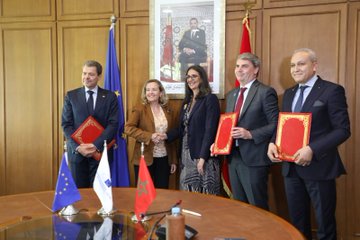
Morocco and the European Investment Bank (EIB) Sign Major Financing Agreements
On Tuesday in Rabat, Morocco and the European Investment Bank (EIB) signed two financing agreements totaling €365 million, aimed at modernizing the country’s rail and highway infrastructure. This funding is part of a broader initiative to strengthen the strategic partnership between Morocco, the European Union, and the EIB, promoting more sustainable mobility and resilient infrastructure.
The first agreement entails a €65 million financing package for the National Office of Railways (ONCF), which includes a €50 million loan from the EIB, supplemented by a €15 million grant from the European Union. This support will facilitate the rehabilitation of the railway network, enhancing safety, performance, and resilience of the infrastructure.
The second agreement involves a €300 million loan granted to Morocco’s Highways Authority (ADM) to finance a program aimed at bolstering the resilience of the national highway network, as well as adapting it to climate challenges and increasing traffic.
According to the EIB, these investments will improve the mobility of people and goods, strengthen the safety of transport infrastructure, and support Morocco’s economic competitiveness, while fostering closer economic integration between Europe and Africa.
During the signing ceremony, EIB President Nadia Calviño reiterated Morocco’s status as a key strategic partner for the European institution. She emphasized that this new financing underscores the evolving dynamics of relations between the Kingdom and the European Union, reflecting the Bank’s commitment to accelerate high-impact economic, social, and environmental investments.
In her remarks, Minister of Economy and Finance Nadia Fettah praised the robust cooperation between Morocco, the EIB, and the European Union. She highlighted that this partnership, built over nearly fifty years, has been instrumental in supporting the Kingdom’s major development projects and is currently backing initiatives aimed at creating modern, sustainable, and inclusive mobility solutions.
The Minister also noted that this relationship now transcends mere project financing; it is anchored in a shared vision focused on sustainable development, greater social cohesion, and the strengthening of economic ties between Europe and Africa.
Having been present in Morocco for nearly half a century, the European Investment Bank remains one of the country’s main financial partners, with significant contributions in the fields of transport, energy, infrastructure, education, innovation, and climate transition.