The Oldest Mosque in Morocco, a Neighborhood of Alaouite Habitat, Woodwork and Gilding, and the First Evidence of a Minting Workshop: Sijilmassa, a Medieval City in Tafilalet Revealing 10 Centuries of History. (Latest Results of Archaeological Excavations Conducted in 2024 and 2025)
Rediscovering Sijilmassa: A Significant Archaeological Campaign (2024-2025)
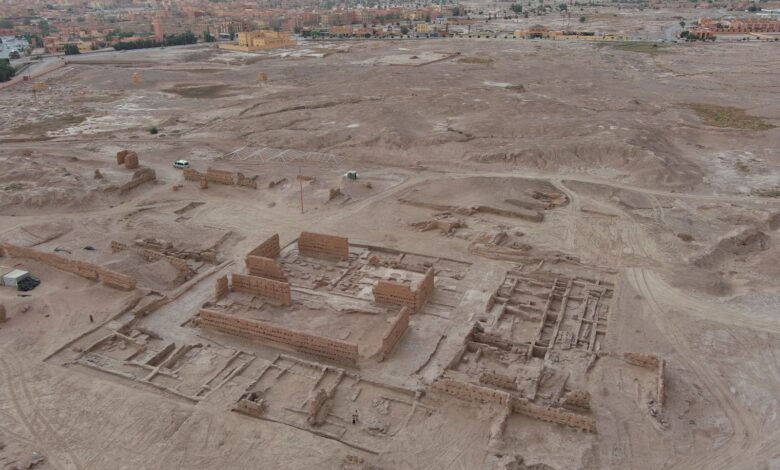
As part of its commitment to cultural heritage, the Ministry of Youth, Culture, and Communication has supported a major archaeological excavation campaign conducted between 2024 and 2025 at the Sijilmassa archaeological site in the Tafilalet region. The campaign was headed first by Professor Lahcen Taouchikht and later by Professor Asmae El Kacimi, along with a fully Moroccan team from the National Institute of Archaeology and Heritage (INSAP). This operation is the largest ever undertaken at this site since research began in the 1970s.
The excavations covered nearly 9,000 square meters in the heart of Sijilmassa, a crossroads city founded at the end of the 8th century, which once played a central role in trans-Saharan trade between the Maghreb, sub-Saharan Africa, and the Mediterranean world. Long overshadowed in the Moroccan archaeological landscape, Sijilmassa is now beginning to reveal its exceptional finds in terms of architecture, religion, domestic life, art, funerary practices, and currency.
The Oldest Medieval Mosque in Morocco Emerges from the Sands
Archaeologists have uncovered the foundations of a significant religious complex, which includes a medieval mosque measuring 2,620 square meters, capable of accommodating approximately 2,600 worshippers. This structure encompasses several layers of successive construction, from the original mosque founded during the reign of Abû al-Montasir al-Yasa’ (late 8th to early 9th century), through the Almoravid and Almohad phases (11th-13th centuries), up to the still-visible Alaouite mosque.
This stratification makes the Sijilmassa mosque one of the oldest documented in Morocco, marking a fundamental milestone in the religious and urban history of the Maghreb.
Gold Leaf Wood: A Unique Discovery in Sijilmassa
The excavation levels associated with the earliest phases of the mosque yielded a remarkable collection of sculpted plaster fragments dating back to the Midrarid period (8th-10th century). These decorations, featuring finely crafted geometric, floral, and epigraphic motifs, represent some of the oldest examples of Islamic art known in Morocco.
Additionally, within the ruins of the Alaouite madrasa, hundreds of painted wooden fragments from the 18th century were discovered. One notable find was a cedar piece displaying vibrant polychromy and intricate floral motifs, which demonstrate the presence of gold leaf (tadhhīb). These elements provide the earliest material evidence of architectural decoration from the Alaouite period in Sijilmassa.
Sijilmassa: The City of Gold Reveals Its Ultimate Proof
Long sought after by archaeologists, evidence of minting activity in Sijilmassa has finally been uncovered near the mosque. A ceramic mold of the "honeycomb" type, designed for producing gold coin blanks, still contains traces of gold in its cavities, confirming its use in the production of the famous Sijilmassi dinars.
This unique discovery in Morocco—and the second in Africa after Tadmekka in Mali—highlights Sijilmassa’s significance as a major center for coinage production in the Islamic West. This artifact serves as the first tangible material proof of gold minting activity in the region.
For the First Time in Sijilmassa: Discovery of a Complete Alaouite Residential District
During the last archaeological campaign, a significant discovery has enriched our understanding of Sijilmassa: for the first time, a complete residential neighborhood dating from the Alaouite period (17th-18th centuries) has been uncovered. This revelation marks a decisive advancement in the study of the city’s urban history, which has long centered on its medieval peak.
This neighborhood consists of 12 houses built according to a uniform plan, showcasing well-structured domestic urbanism. Each house features a central patio, living rooms, storage spaces, and rich domestic furnishings, including tableware. These findings allow us to reconstruct the daily lives of its inhabitants.
Archaeobotanical analysis of samples taken from these spaces has identified remnants of dates and other agricultural products, providing valuable insight into the diet of the residents in a pre-Saharan context.
Due to its scale, state of preservation, and the wealth of information it provides, this discovery materially affirms for the first time the ancient presence of the Alaouite Chorafa in Sijilmassa. It opens a new chapter in the site’s history, shedding light on a phase of occupation that is still poorly documented but crucial for understanding the urban, social, and political evolution of the city over time. This helps us better grasp the territorial roots, settlement dynamics, and daily life associated with the early days of the Alaouite dynasty, contributing to a renewed interpretation of the ruling dynasty’s history in Morocco.
[Images omitted]
The findings from the archaeological excavations conducted by INSAP at the Sijilmassa site transcend local boundaries. They provide essential insights into the history of settlement, art, and trans-Saharan trade. The remains uncovered during the recent campaigns of 2024 and 2025 breathe new life into the city that historical texts have long described: its mosque, madrasa, alleys, houses, and workshops are now resurrected once more.