Water in Morocco: Strengthened Territorial Governance in Response to Climate Challenges
Water Challenges and Governance in Morocco: Insights on Sustainable Management
On the occasion of World Water Day, celebrated every year on March 22, the urgent issue of sustainable water resource management comes to the forefront, especially in a context marked by decreasing rainfall and the intensification of climate change effects.
In Morocco, water represents a strategic issue at the heart of public policy, directly linked to economic development, territorial balance, and social cohesion. In response to the growing pressure on water resources, the Kingdom has initiated a series of reforms aimed at enhancing governance in the sector and improving the efficiency of water-related services.
As part of these efforts, the establishment of regional multi-service companies represents a significant structural evolution in public service management, particularly regarding the distribution of drinking water, electricity, and liquid sanitation. These entities aim to ensure better coordination of interventions, optimize resources, and guarantee uniform quality of service across various territories.
The Souss-Massa region illustrates this dynamic through the actions of the regional multi-service company, which is fully integrated into the implementation of a comprehensive water management policy. Its interventions focus on securing drinking water supplies, strengthening and expanding infrastructure, and improving network performance, particularly by reducing losses and adopting innovative technologies.
Furthermore, this approach is accompanied by a strong commitment to raising awareness and communication efforts to promote responsible water usage. Through community campaigns and field actions, citizens are encouraged to adopt water-saving behaviors, contributing to the preservation of water resources.
Today, water-related challenges extend beyond environmental concerns to encompass a broader reflection on development models and the sustainability of resources. In this context, the joint mobilization of institutions, local stakeholders, and citizens remains a vital lever to tackle the current and future water challenges in Morocco.
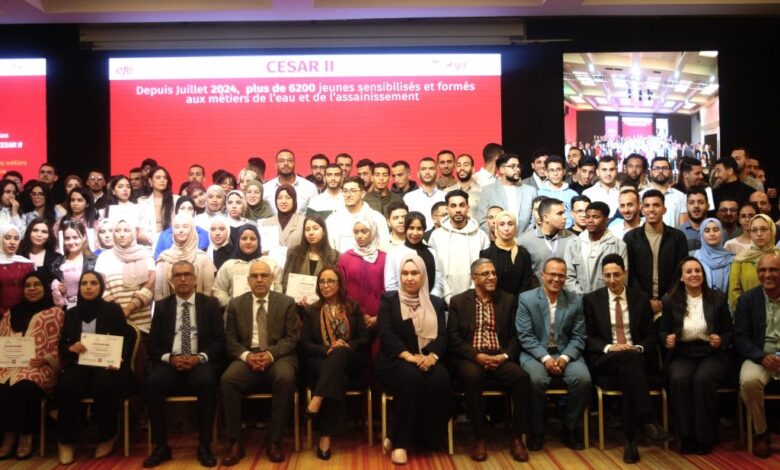
In this light, EFE-Maroc organized a ceremony to celebrate the achievements of the CESAR II project, implemented in partnership with GIZ. This event was an opportunity to review the main actions undertaken within the program and to celebrate its impact on youth employability in the water and sanitation sector, with a particular focus on the exemplary contributions of SRM-SM in successfully executing this project.
The ceremony recognized the gender contribution of two key women within SRM-SM: Ms. Barakat, Head of the Studies Department, and Ms. Ighious, Head of the QSE Service. This event also included the presentation of certificates following training sessions organized for SRM-SM personnel and subcontractors, marking a significant step toward enhancing the sector’s workforce capabilities.