Dakhla-Oued Eddahab: The Reuse of Treated Water at the Heart of an Integrated Vision for Water Security
Water Security: More than Just Access to Potable Water
Water security extends beyond a region’s ability to ensure a supply of drinking water. It encompasses the capacity to preserve available resources, enhance the efficiency of their utilization, and recover a portion of water after use for new applications in order to reduce the pressure on conventional resources.
In the Dakhla-Oued Eddahab region, the Dakhla-Oued Eddahab Regional Multiservices Company embodies this approach through a range of projects and investments that treat water as a limited resource requiring integrated management. This management begins with securing the supply and improving network efficiency and extends to the treatment, valorization, and reuse of wastewater.
In a region faced with the scarcity of conventional water resources, the equation of water security doesn’t limit itself to production or distribution. It also involves mobilizing all available solutions to preserve the resource and alleviate the pressure exerted upon it. In this context, the reuse of treated wastewater holds special significance as a practical tool for diversifying resources and enhancing the efficiency of the water cycle.
From Wastewater Treatment to Resource Valorization
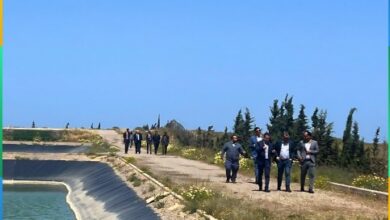
The Dakhla wastewater treatment plant plays a central role in this endeavor. It utilizes activated sludge technology, with a capacity of approximately 10,000 cubic meters per day.
The station’s function surpasses the mere treatment of wastewater prior to discharge. The developed approach aims to elevate the treatment level to transform a portion of the wastewater into a resource that can be valorized for specific uses.
Currently, about 5,000 cubic meters per day undergo tertiary treatment. The Dakhla-Oued Eddahab Regional Multiservices Company is actively working on the rehabilitation and enhancement of the plant to double the volume of water that can benefit from this level of treatment.
The goal is to achieve approximately 10,000 cubic meters per day of water suitable for reuse, particularly for irrigating green spaces.
This direction reflects one of the fundamental principles of the company’s approach: it is not only about ensuring the safe disposal of wastewater, but also recovering part of the resource and reintroducing it into the cycle of use.
This progress presents both economic and environmental dimensions. Every cubic meter of treated water that can be reused for appropriate purposes reduces reliance on drinking water for those uses and, consequently, helps preserve resources primarily allocated to meet the needs of the population.
Preserving Drinking Water for Population Needs
This approach becomes particularly significant in a context marked by limited conventional water resources in the region.
The reuse of treated wastewater, especially for applications that do not require potable quality, allows adapting the quality of the resource to the nature of its use.
In other words, it is unnecessary to mobilize drinking water for all purposes when treated water that meets specific standards can be utilized for non-potable needs.
Thus, reuse becomes an integral component of the water conservation policy, rather than a mere technical project associated with a wastewater treatment plant.
When treated water is designated, for instance, for the irrigation of green spaces, the saved volumes of drinking water can be prioritized for the essential needs of the population.
Consequently, treatment does not merely represent the final stage of the water cycle. It becomes a step toward recovering the resource and assigning it a new function.
Protecting Groundwater: Another Aspect of the Equation
The impact of these projects is not confined to water conservation; it also pertains to environmental protection and the safeguarding of groundwater resources.
The rehabilitation of the liquid sanitation system and the treatment of wastewater contribute to reducing risks associated with the discharge of inadequately treated wastewater into the environment, thereby limiting threats to groundwater resources.
This dimension is also taken into account in the company’s projects focused on rehabilitating liquid sanitation networks.
In the context of the rehabilitation and renewal project for drinking water and liquid sanitation networks in the Al Wahda neighborhood of Dakhla, approximately 20 kilometers of liquid sanitation pipelines are being renewed, in addition to about 4,000 domestic connections.
The project also includes the first-ever construction of a new collector in Dakhla to transport wastewater from the neighborhood to the pumping station. This underground structure, built using tunnel excavation techniques, spans nearly 1,008 linear meters.
The total cost for both phases of the project reaches around 120 million dirhams. The various components of this operation aim to enhance the functioning of the network, reduce recurring congestion and overflows, and limit the infiltration of wastewater into the groundwater.
Liquid sanitation projects are thus directly linked to the water conservation policy. Protecting the resource begins not only at the supply source but also concerns the natural environment integrated into the entire water cycle.
A Vision that Starts with the Networks and Extends Beyond the Station
This integrated approach is even more evident when the various projects undertaken by the company are viewed as components of a unified system.
Renewing drinking water networks, reducing losses, improving distribution efficiency, monitoring flows and pressures, rehabilitating storage and pumping infrastructures, and then treating and reusing wastewater—these efforts converge toward a singular objective: to maximize the efficiency of each water resource.
In this regard, the Al Wahda project provides a concrete example of the water conservation policy by preserving the resource within the network.
The project plans to renew around 47 kilometers of drinking water pipes, with diameters ranging from 75 to 400 millimeters, alongside the renovation of approximately 4,000 domestic connections.
According to data provided by the company, the project is expected to save approximately one million cubic meters of water, representing almost 15% of the total needs of the city of Dakhla.
This figure demonstrates that water conservation is not limited to the reuse of wastewater. It starts upstream with preventing losses in the networks, enhancing their efficiency and monitoring, and continues with recovering water after its use.
Technology Empowering Water Conservation
To implement this vision, the company does not rely solely on infrastructure and engineering works. It also integrates digital technologies into network management.
In this context, a remote management unit for drinking water and liquid sanitation networks is being developed, featuring 19 continuous monitoring devices connected to a remote intervention center.
This system enables continuous monitoring of flows and pressures while also overseeing water quality and levels in reservoirs and various facilities.
Additionally, the pumping stations are outfitted with gas detection systems to enhance the safety of personnel working on these installations.
The objective of these devices goes beyond mere monitoring of the networks; it shifts from an incident-response approach to a framework of anticipation and prevention.
The data collected by the monitoring equipment provide a basis for technical teams to quickly identify anomalies, direct interventions more effectively, reduce response times, and limit the duration of on-site operations.
Digitization thus becomes a fundamental tool for water conservation. Quicker leak detection and malfunction identification, combined with better control of pressures and flow rates, also help diminish the volumes of water that could be lost within the networks.
Reuse: A Link in a Larger System
However, the developed vision does not stop at wastewater treatment.
The goal is to establish an integrated system that views water as a resource to be preserved at all stages of its usage cycle.
This explains the complementarity of investments dedicated to networks, monitoring and remote management devices, diversification of supply sources, seawater desalination, wastewater treatment, and, ultimately, the reuse of treated water.
In this logic, reuse is not an isolated project; it represents the connection that links treatment, water conservation, and resource protection.
Water that has already been utilized does not necessarily become a lost resource. After the necessary treatment stages, it can be recovered and redirected towards suitable uses.
This approach facilitates enlarging the volume of mobilizable resources without exerting the same pressure on conventional resources.
Investing in Water with a Long-Term Vision
These projects are part of a multi-year investment program by the Dakhla-Oued Eddahab Regional Multiservices Company, which adopted its investment program for the period 2026-2030 at the end of 2025, following the implementation of the management contract in October 2025.
This program provides a framework for developing investments related to water and liquid sanitation services, as well as other services falling under the company’s responsibilities.
In the water sector, the value of these investments is thus measured not only by the amounts mobilized or the number of projects completed, but also by their capacity to evolve the management methods of the resource.
The more the networks enhance their efficiency, the more losses decline.
The more monitoring systems are developed, the faster and more precise interventions become.
The more the capacities for treating and reusing wastewater progress, the lesser the pressure on conventional resources.
And the more supply sources are diversified, the better positioned the water security system is to face resource scarcity and the effects of climate change.
It is this entire chain that gives water investment its strategic dimension.
From Water Conservation to Sustainability
The implications of reusing treated water thus extend beyond the technical dimension to directly relate to sustainability challenges.
The region requires water resources capable of supporting the needs of the population, economic activities, and urban development, while preserving natural resources and avoiding over-exploitation.
Consequently, water conservation becomes a responsibility that encompasses all stages of the system: from the resource to the treatment plant, from the distribution network to the user, and finally from wastewater to its treatment and potential reuse.
This logic is what the Dakhla-Oued Eddahab Regional Multiservices Company seeks to embed in its interventions: transitioning from managing water as a mere daily service to recognizing it as a strategic resource requiring planning, protection, and valorization.
A Responsibility that Extends Beyond Projects
However, investments, regardless of their magnitude, cannot alone ensure the sustainability of water resources.
Water preservation also hinges on user behaviors: rationalizing consumption, reporting leaks, reducing waste, and responsibly utilizing the resource.
While infrastructure and technologies provide the necessary means, responsible usage ultimately dictates how much of the resources can effectively be preserved on a daily basis.
Thus, the equation of water security in the Dakhla-Oued Eddahab region relies on multiple components: diversification of resources, rehabilitation of networks, infrastructure development, wastewater treatment, reuse of treated water, digital monitoring and anticipation systems, and raising awareness of the need to conserve water.
In this dynamic, the Dakhla-Oued Eddahab Regional Multiservices Company is working toward implementing an integrated system that makes resource protection, enhancing the efficiency of its utilization, and valorization components of a sustainable water security policy.
The water saved at the network level, the water recovered post-treatment, and the water preserved from waste all contribute to reinforcing the region’s water potential.
Thus, the reuse of treated water is not merely a technical solution for wastewater management. It embodies an evolution in how we perceive water: a resource that does not have to be consumed only once but can, under the appropriate treatment conditions and applicable standards, be recovered, valorized, and reintroduced into the use cycle.
Preserving water thus becomes a responsibility starting with investment in infrastructure and technologies, continuing through efficient management and ongoing monitoring, and ultimately relying on the collective awareness of the value of every drop.
For water security does not solely depend on mobilizing new resources. It also relies on the capacity to preserve what exists, reduce losses, recover what can be salvaged, and ensure the sustainability of the resource for future generations.