
Japan: A Hypersonic Aircraft Could Drastically Reduce Flight Times
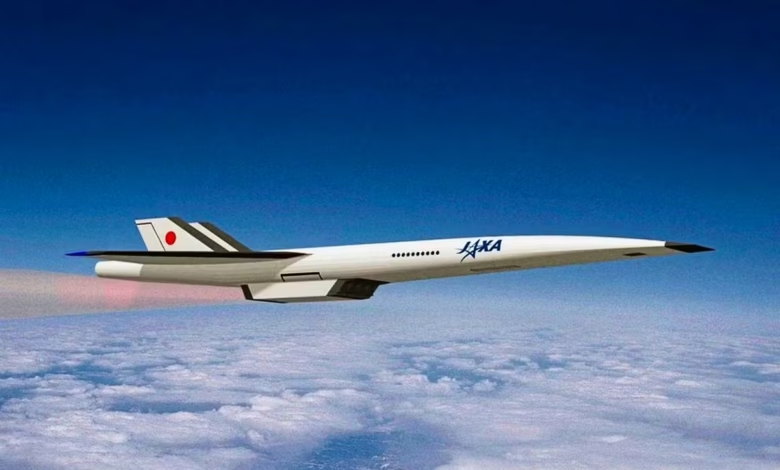
Japanese Researchers Make Breakthrough in Hypersonic Flight
Japanese researchers have achieved a significant milestone in the development of a hypersonic aircraft capable of flying at speeds twice that of the Concorde.
The Japan Aerospace Exploration Agency (JAXA) successfully tested a new type of engine at the Kakuda Space Center in northern Japan, paving the way for much faster intercontinental travel.
A Two-Hour Tokyo to Los Angeles Flight
The goal of this ambitious program is to reduce the current flight time between Tokyo and Los Angeles, which lasts about ten hours, to just two hours within the next few decades.
This project is part of a long-term vision for commercial aviation, with a potential launch around the year 2040.
An Engine Without Moving Parts
The system that was tested relies on a scramjet (supersonic combustion ramjet), an engine that has no moving parts and utilizes incoming airspeed to compress and ignite fuel.
This type of propulsion allows for extreme speeds, approaching Mach 5, which is around 5,400 km/h—well beyond the capabilities of the Concorde, which could reach Mach 2.
Major Technical Challenges Ahead
Engineers, however, must confront significant challenges, including managing extreme temperatures that can soar to 1,000°C in certain parts of the aircraft, as well as the stresses associated with high-speed pressure waves.
These conditions necessitate an integrated design of both the aircraft and its engine, as the two systems are closely interdependent.
Towards a New Generation of Air Transport
The next step in the program will involve testing the aircraft in real flight conditions at Mach 5, using a sounding rocket.
Researchers estimate that the complete development of this technology until it reaches commercial viability will take at least another twenty years, ushering in a new era of ultra-fast air travel.