Peace Education: Rabat Hosts the Inaugural Assembly of the Morocco House for Peace
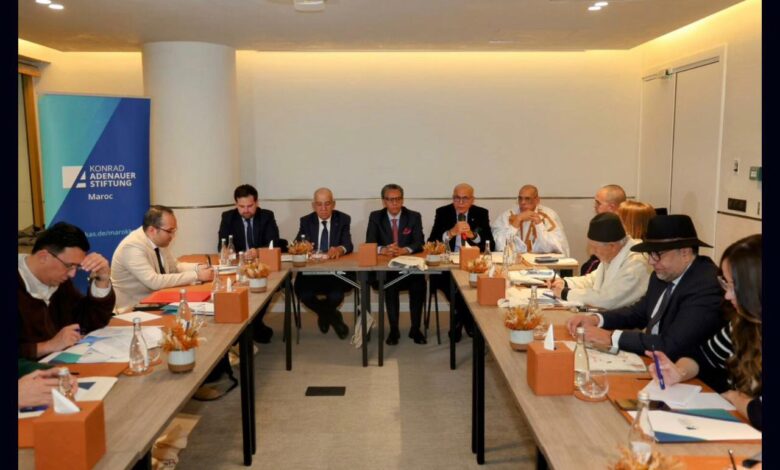
Rabat, March 4, 2026 – In a global context marked by tensions and misunderstandings, the Moroccan House for Peace and Tolerance gathered intellectuals, artists, and civil society actors from all over the Kingdom on Wednesday at the Story le Carrousel Hotel in Rabat for its first annual assembly dedicated to peace education. This hopeful initiative places dialogue and respect for diversity at the heart of contemporary challenges.
A Multifaceted Mobilization
Beginning at 5 PM, the atmosphere in the venue reflected the ambition of this gathering: to create a convergence space among different sensibilities, cultures, and religions. Participants from Casablanca, Marrakech, Fes, Essaouira, and other cities in Morocco gradually filled the room, bringing with them the richness of their experiences and commitments.
This plural dimension aligns fully with the spirit of the meeting: to make culture, art, and education essential vectors for social transformation and the promotion of coexistence.
A Shared Break-Fast
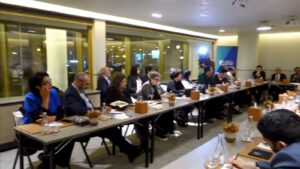
At 6 PM, participants were welcomed with a ftour, the meal breaking the fast, which symbolized the values of sharing and brotherhood cherished by the organizers beyond its religious dimension. Around the tables, academics, institutional leaders, educators, and activists exchanged in a warm and convivial atmosphere.
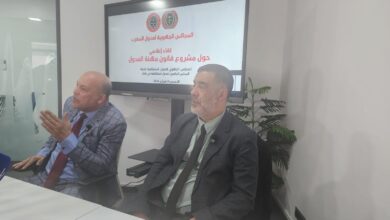
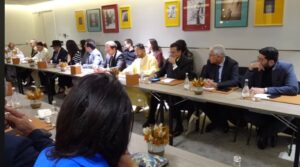
Once this moment of sharing concluded, all participants gathered for a roundtable to officially start the works of this inaugural assembly. The diversity of the profiles present testified to the extent of the mobilization: representatives of different faiths, social actors engaged with youth, and researchers specializing in conflict studies and peaceful resolution—all united by a common conviction. Among the notable guests from various regions of Morocco were Mustapha El Bakkouri, president of the Tetouan municipality, and his vice-president Anas Mellahi, illustrating the commitment of local communities in this battle for peace. In the face of ambiguities and identity retreats, everyone shared the same certainty: only education and dialogue can open sustainable pathways.
A Conference Rich in Contributions
The conference opened with remarks from Miloud Loukili, a professor at Mohammed V University in Rabat, who skillfully moderated the assembly. After recalling the objectives of this founding meeting, he handed the floor to Abdellah Ouzitane, co-organizer and founding president of the Center for Studies and Research on Hebrew Culture and Law in Morocco.
Mr. Ouzitane emphasized the importance of the Judeo-Moroccan heritage as a cornerstone of the Kingdom’s historical tolerance. “Morocco has always been a land of coexistence. Our responsibility today is to pass this living memory on to new generations,” he stated.
Farid El Bacha, founding president of the Moroccan House for Peace, then took the floor to reiterate the vision that drives this initiative. “Peace cannot be decreed; it is built day by day through education, dialogue, and recognition of the other,” he declared.
Steven Höfner, the resident representative of the Konrad Adenauer Foundation in Morocco— a key partner in this initiative—highlighted the international dimension of these issues. “Peace education is not a luxury; it is a necessity in a world where misunderstandings are multiplying. Morocco, with its history and geographical position, has a key role to play in promoting these values.”
Mr. El Bacha then ceded the floor to a distinguished guest: Mr. Sidi Khalifa, the former Minister of Foreign Affairs and Cooperation in Mauritania and also a former ambassador, who delivered a noteworthy speech on the theme of peace, contributing a regional African perspective to the discussions. His testimony widened the reflection beyond Moroccan borders, reminding all that issues of coexistence and dialogue transcend nations.
“Students of Peace”: A Message of Hope
The presentation of the institutional film “Students of Peace” was a highlight of the evening. This documentary showcases innovative educational initiatives for peace and included a video message from André Azoulay, Advisor to His Majesty King Mohammed VI and founder of the Essaouira-Mogador Association.
In this filmed intervention, a respected figure of intercultural dialogue in Morocco and internationally, Mr. Azoulay delivered a dense and inspiring message, anchored in the enlightened vision of His Majesty King Mohammed VI, who asserts that “the solution to the phenomena threatening our societies is neither military nor financial; this solution has only one name: education. My plea for education is a condemnation of ignorance.”
A Roadmap for 2026
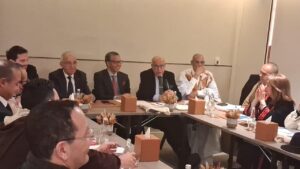
Beyond the speeches, the gathering aimed to outline concrete perspectives. The presentation of the roadmap for the year 2026 allowed participants to exchange ideas on actions to undertake: educational programs in schools, training for educators, awareness workshops in neighborhoods, partnerships with cultural and religious institutions.
Abdellah Ouzitane notably announced a launch event scheduled for Essaouira at the end of March 2026, marking the beginning of a regional deployment of the initiative. This participative phase revealed the enthusiasm of grassroot actors eager to translate grand principles into tangible actions.
Several proposals emerged, including the creation of a national network of peace educators, the establishment of certified training, and the organization of intercultural meetings among youth from different regions of Morocco.
A Musical Moment and the Artistic Revelation of Ghita
Before concluding the proceedings, the assembly shared a memorable artistic moment with beautiful songs performed by one of the participants. This musical interlude allowed guests to find themselves in a shared convivial moment, reminding everyone that peace is also nourished by emotions, beauty, and creativity.
The most moving moment of the evening surely occurred during the presentation of the painting by Ghita, a young artist who captivated the audience with her work and energetic presentation. Her pencil drawing illustrates peace through the ages with an evocative composition blending historical buildings, symbolic figures, and a dove that cannot fly—a powerful metaphor for the constraints still weighing on peace today.
Ghita presented her work with contagious energy and passion, instilling genuine hope in the audience. Her presence and commitment testify to the awareness of new generations regarding the value of peace and the importance of preserving it. As several participants noted, witnessing a young artist engage with such maturity and sensitivity with this universal theme is, in itself, a message of optimism for the future.
Towards the Next Steps in Tangier and Essaouira
As participants left the Story le Carrousel Hotel, they took with them more than just ideas: a collective energy, the conviction that change is possible, and above all, a network of allies determined to make peace education a daily reality.
This first annual assembly marks the launch of a cycle of initiatives that the Moroccan House for Peace and Tolerance aims to sustain. As announced by Miloud Loukili, the moderator of the assembly, a next meeting is already planned for Tangier, continuing the dynamic initiated in Rabat and reaching other regions of the Kingdom.
By choosing peace education as a starting point, the organizers have laid a solid foundation. As UNESCO reminded, whose efforts in peace education were praised during the meeting, it is indeed through the transmission of values of respect, mutual understanding, and rejection of violence that resilient societies are built.
In a Morocco that asserts itself as a land of dialogue and tolerance, in line with the royal vision, this assembly demonstrated that beyond cultural, religious, or geographical differences, a solid consensus can be built around universal values. The journey is long, but as evidenced by the smiling and determined faces from the evening of March 4, the will is present, and Tangier will be the next witness to this commitment.
Important Information
The Moroccan House for Peace and Tolerance is an initiative supported by several partner organizations, including the Essaouira-Mogador Association, the Center for Studies and Research on Hebrew Culture and Law in Morocco (Bayt Dakira), and the Konrad Adenauer Foundation. Its goal is to promote a culture of peace, intercultural dialogue, and coexistence in Morocco and beyond.
Remarkable presence from Tetouan: Mustapha El Bakkouri, president of the Tetouan municipality, along with his vice president Anas Mellahi, traveled from Tetouan to attend this assembly, demonstrating the commitment of northern cities to promoting peace and dialogue.
Academic Synergies: The Moroccan House for Peace collaborates closely with the International University of Culture and Heritage Tétouan-Essaouira, chaired by André Azoulay, in the context of associative partnerships aiming to develop educational programs around peace and coexistence.
✒️ Khouloud Bouzine