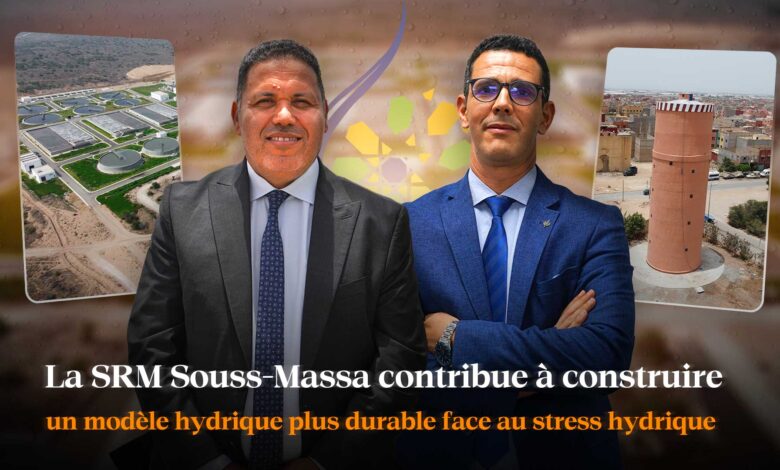
The Souss-Massa Water Management Authority Contributes to Building a More Sustainable Water Model in the Face of Water Stress
Water Management in Souss-Massa: Innovative Solutions for a Growing Demand
In the Souss-Massa region, water management has evolved beyond simply mobilizing resources to meet growing demand. Faced with declining precipitation, increasing pressure on conventional resources, and rapid demographic and economic development, the Société Régionale Multiservices Souss-Massa (SRM) is taking decisive steps to enhance and adapt the water supply system. This includes significant investments in infrastructure, focusing on networks, transportation, storage, and the reuse of water resources.
The Importance of Resource Diversification
This initiative comes at a time when resource diversification has become essential. SRM is actively involved in the transport and distribution of desalinated water while developing its projects aimed at optimizing treated wastewater, enhancing storage capacity, and improving the efficiency of existing networks.
From the M’zar wastewater treatment plant to the integration of desalinated water into supply networks, and the rehabilitation projects in Aït Amira, SRM’s efforts align with a common goal: building a more resilient and sustainable water system for the region.
Climate Change Demands New Strategies
The impacts of climate change are increasingly evident in Souss-Massa. Recent years have seen a marked drop in precipitation, leading to reduced inflow to dams and declining storage levels, which place traditional water supply systems under significant strain.
According to Abdelhak Id Mansour, Director of Investments at SRM Souss-Massa, this situation necessitates the exploration of solutions to diversify available resources and address the growing needs of local populations.
While climate change affects all of Morocco, Souss-Massa is particularly vulnerable. The decline in precipitation and the reduction of water reserves compel a new approach based on gradually utilizing unconventional resources. In this context, SRM’s challenge is to adapt infrastructure to facilitate the transport, storage, and distribution of these new resources while improving the efficiency of existing networks.
M’zar: Transforming Wastewater into a Resource
One of the projects that embodies this strategy is the M’zar wastewater treatment plant, which plays a pivotal role in the region’s water management efforts.
The facility does more than treat wastewater to specific technical standards; it also produces treated water for reuse, particularly in irrigation for green spaces, golf courses, and certain industrial applications.
The expansion of the plant has boosted its overall treatment capacity to 144,000 cubic meters per day, with the capacity for producing treated water reaching 66,000 cubic meters per day.
The plant processes wastewater from multiple areas of Greater Agadir and operates under two primary technical facets: industrial water, which accounts for about 78,000 cubic meters per day, and domestic water.
This infrastructure allows for the production of approximately 24 million cubic meters of unconventional water annually, aimed primarily at irrigating green spaces and golf courses, as well as satisfying various industrial needs.
The valorization of treated wastewater directly contributes to reducing the pressure on conventional resources, which are primarily reserved for drinking water supply.
With an announced total investment of approximately 905 million dirhams, the M’zar project highlights the significance of investing in water resource optimization and developing solutions to diversify usage.
SRM: A Key Link in Supply and Distribution
However, securing a water supply does not solely depend on the availability of new resources. It also relies on the ability to efficiently transport, store, and distribute these resources to end-users.
This is where a significant portion of SRM Souss-Massa’s investments comes into play. The Regional Multiservice Company has committed to investments aimed at ensuring the transport of desalinated water to the relevant areas and enabling its distribution through the managed networks.
Nearly 400 million dirhams have been invested to facilitate the transport of desalinated water to the northern region and to secure water supply for several communities.
According to Abdelhak Id Mansour, meeting citizens’ needs requires substantial investments in infrastructure. These investments are carried out in collaboration with various stakeholders, both in funding and support for structural projects.
The goal is to ensure an equitable distribution of available resources while gradually enhancing network capacity.
Desalination: A New Resource Integrated into the Regional System
Desalination has become a vital component in securing the water supply for Souss-Massa. By 2025, the region’s water consumption reached approximately 94.7 million cubic meters, with nearly 50% derived from desalinated seawater.
This figure illustrates the increasing importance of this unconventional resource within the regional water system. For SRM Souss-Massa, the focus is on developing the infrastructure necessary to receive, transport, store, and efficiently integrate this resource into distribution networks.
These developments help to gradually relieve pressure on conventional resources, particularly groundwater, which is heavily relied upon in certain areas of the region.
Aït Amira: A Region Under Pressure
The situation in Aït Amira, located in the province of Chtouka-Aït Baha, exemplifies the challenges facing the region and the solutions implemented by SRM Souss-Massa.
According to Noureddine El Amri, provincial director of SRM Chtouka-Aït Baha, the water supply system for the municipality, which serves over 113,000 inhabitants, primarily relies on groundwater from multiple boreholes.
Currently, the available flow is about 60 liters per second, while peak demand can exceed 100 liters per second. This disparity between available supply and actual needs highlights the considerable pressure on local resources.
Compounding this issue is the condition of the distribution network; portions of the system, built in 1975, are now facing several malfunctions and leaks, directly affecting its efficiency, which is estimated at only 34%.
In light of this situation, numerous meetings were held at the provincial level, chaired by the governor and involving various interested parties, to identify solutions to enhance the drinking water supply system.
Utilizing Desalinated Water to Alleviate Pressure on Aquifers
As part of this initiative, SRM Souss-Massa is working to integrate desalinated water into the supply for several sectors in Aït Amira to gradually alleviate pressure on groundwater resources.
Several residential developments will be supplied from the main pipeline serving Biougra. This effort is expected to benefit around 9,000 residents, particularly in the Al Iskane, Al Amal, Asrir, and model village areas.
Supply will be provided from a reservoir whose construction and outfitting were completed in August, funded directly by the National Initiative for Human Development.
This initiative represents a significant step toward integrating desalinated water into the local supply system and gradually reducing reliance on groundwater.
A Structuring Project of 260 Million Dirhams
Additionally, SRM Souss-Massa has planned a structural project aimed at reinforcing the supply of desalinated water to the central area of Aït Amira and other douars.
The overall estimated budget for this project is approximately 260 million dirhams. It includes the construction of about 90 kilometers of supply pipes, building new reservoirs to enhance storage capacity and supply autonomy, and creating around 190 kilometers of new distribution networks while renewing a large portion of individual connections.
The project will be carried out in phases, with an urgent tender to be launched in August 2026 for the first phase, which involves rehabilitating the distribution network in central Aït Amira, with an estimated investment of 30 million dirhams.
On a provincial scale, the system will rely on resource diversification, combining desalinated and groundwater, through a distribution network of about 314 kilometers, ensuring potable water service to over 17,000 subscribers.
Rehabilitation of Networks to Prevent Resource Loss
Integrating new resources, however, cannot be separated from the performance of the networks.
For Abdelhak Id Mansour, connecting Aït Amira to desalinated water must go hand in hand with upgrading the existing pipelines. The first phase of this operation has already commenced in areas where the networks do not present significant leak issues. Other sectors will be gradually connected following the renovation of their pipelines.
This approach addresses a crucial imperative: to ensure that newly mobilized water resources are effectively utilized and benefit residents with minimal losses. Therefore, investing in new resources should align with investments in networks to improve their performance and guarantee the overall system’s efficiency.
A Strategy Based on Resource Complementarity
Through these various projects, SRM Souss-Massa contributes to the emergence of a water management system grounded in resource complementarity. Desalinated water provides an additional source to secure drinking water, while treated wastewater becomes a reusable resource for certain applications. Storage infrastructures enhance the system’s resilience, and network rehabilitation aims to improve efficiency and minimize losses.
This complementarity allows for better resource allocation while helping to preserve conventional resources, particularly groundwater, by prioritizing them for essential needs.
Building Tomorrow’s Infrastructure Today
The projects initiated by the Société Régionale Multiservices Souss-Massa reflect a shift in how water management is approached in the region. The challenge is no longer just to have additional resources but also to establish the necessary infrastructures to transport, store, distribute, and, whenever possible, reuse water.
From the M’zar facility to desalinated water transport, through enhanced storage capabilities and the rehabilitation of Aït Amira’s networks, SRM’s investments share a common aim: to contribute to creating a more sustainable water security for the region.
In a territory particularly exposed to water stress, every resource optimized, every network rehabilitated, and every infrastructure strengthened plays a role in this ambition.
Thus, SRM Souss-Massa positions itself as a crucial player in water management and distribution in the region, adapting its infrastructures to new water realities and collaborating with various institutional and technical partners to construct a more resilient model.