Toyota is preparing to deploy 400,000 robots in its industry.
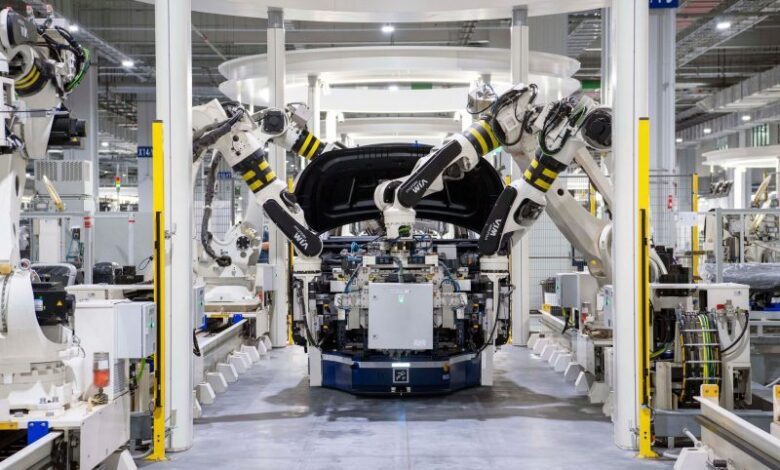
Toyota Unveils Ambitious Automation Program for Global Manufacturing by 2028
The Japanese automotive manufacturer, Toyota Motor Corporation, is exploring an extensive automation program for its global industrial operations that could allocate up to $6.4 billion annually starting in 2028. This project, which remains conditional, aims to deploy approximately 400,000 robots across the group’s factories, its affiliated companies, and major suppliers.
This initiative reflects the accelerating transformation in the automotive sector, where manufacturers are striving to enhance productivity, reduce operational constraints, and bolster competitiveness amid intensifying international competition.
400,000 Robots Planned within the Toyota Ecosystem
The proposed program will not be limited to production sites directly owned by Toyota. It will also extend to affiliated companies and key suppliers, particularly in the context of modernization, renovation, and reconstruction projects for industrial facilities.
According to presented estimates, the deployment could involve around 400,000 robots, including 150,000 in Toyota’s factories and nearly 250,000 across affiliated companies. These robots will either replace existing equipment or augment production capacities at new sites.
The initiative is expected to incorporate fixed industrial robots, mobile units primarily intended for logistical operations, and collaborative systems designed to work alongside human operators.
The overarching goal is to enhance productivity and safety in facilities while strengthening the flexibility and resilience of the industrial supply chain.
ELEY: A Humanoid Robot Designed for the Factory
Among the technologies being developed by Toyota is ELEY, which stands for “Embodied Learning for Enhanced Yield.” This is a mobile humanoid robot, wheeled for easy movement, designed to assist teams in various industrial operations.
Powered by battery or direct electricity, this equipment features two-fingered grippers. Its learning process partially relies on imitation, an approach intended to enable it to quickly master the precise movements necessary for executing detailed tasks.
Additionally, Toyota plans to centralize the learning data from its robots to facilitate knowledge sharing between different fleets and production sites. This strategy could enhance continuous performance improvements and accelerate the rollout of new applications.
An Investment Addressing Challenges in the Automotive Industry
Through this program, Toyota aims to tackle several structural challenges, including the aging of certain industrial infrastructures, labor market pressures, and the need to improve production line efficiency.
Automation is also expected to lessen the burden of certain tasks, allowing employees to focus more on higher-value operations.
However, the company emphasizes that the projected annual investment, potentially reaching nearly 1 trillion yen, is subject to investment decisions and implementation conditions. The priority remains strengthening its automotive operations and industrial network, while future commercialization of certain robotic technologies is also under evaluation.
Toyota Morocco: Focusing on Innovation Since 1995
In Morocco, Toyota has been present since 1995, operating through Toyota du Maroc, a part of Jameel Motors. Based in Casablanca, the company has gradually established a nationwide distribution and after-sales service network catering to both individual consumers and businesses.
The subsidiary also supports the evolution of the manufacturer’s offerings, particularly through the development of hybrid vehicles and the promotion of new mobility solutions.
While the announced automation program primarily concerns Toyota’s global industrial framework, it illustrates the technological directions that are now shaping the future of the automotive sector, with a strong focus on robotics, artificial intelligence, and the continuous improvement of production processes.