Global Markets: The Crisis of AI Values is Shaking Stock Exchanges
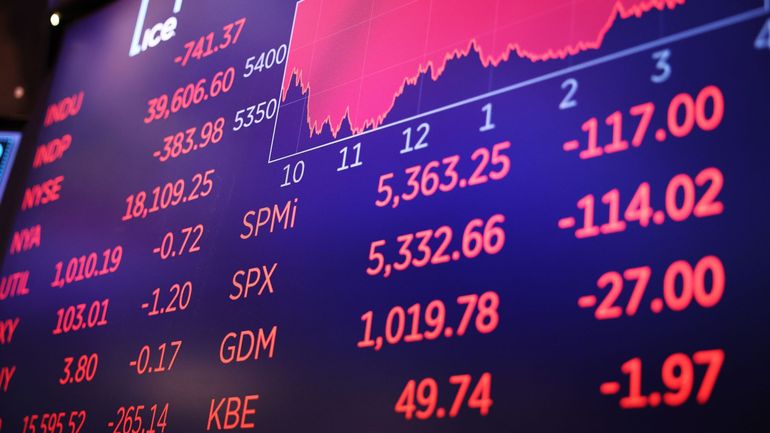
International Financial Markets Shake-Up: AI Valuations Under Scrutiny
On Friday, November 6, international financial markets experienced a tumultuous wave of sell-offs, impacting major stock exchanges from Tokyo to Paris. The catalyst for this latest turbulence was the growing concern over valuations of companies associated with artificial intelligence (AI), following a steep decline recorded the previous day on Wall Street.
This correction comes amidst rising questions about the outlook for the American technology sector and the potential economic and regulatory implications stemming from the rapid development of AI.
Significant Decline in Major Financial Markets
European stock exchanges opened the session in the red. By 12:40 GMT, the CAC 40 in Paris had dropped by 1.67%, while London’s FTSE 100 fell by 2.05% and Zurich’s SMI decreased by 2.08%. Frankfurt faced the most significant slide, down 2.42%, following a new historical record set the day before at 26,692.90 points.
In Asia, the correction was equally pronounced. The markets in Tokyo and Seoul plunged by around 6%, while Taipei fell by 4.5%.
This wave of selling followed a particularly challenging trading session in New York on Thursday. The Nasdaq, heavily weighted with technology stocks, plummeted by 5.52%, marking its steepest decline since April 2025. Semiconductor manufacturers were among the hardest hit, with Micron and AMD both seeing losses exceeding 17%, while Nvidia dropped over 9%.
AI Concerns Take Center Stage
Investor fears are mainly focused on the future of the infrastructure crucial for AI development, particularly data centers, which require substantial amounts of energy to operate.
The results of the recent U.S. midterm elections have further exacerbated these concerns. Following the Democrats’ victory and their control of both chambers of Congress, markets are wary of potential tightening of regulations affecting data centers.
Bruno Cavalier, chief economist at Oddo BHF, noted that the AI ecosystem is navigating a period of significant turbulence. He also highlighted the risks posed by a prolonged correction in financial markets on U.S. household consumption. According to him, 43% of Americans’ financial assets are now exposed to the stock markets, which is ten percentage points higher than in 2000.
A possible reversal of this wealth effect could dampen consumer spending and, consequently, the growth of the world’s largest economy.
European Tech Stocks Show Resilience
Despite the general downturn, certain European companies directly linked to the AI value chain managed to see gains. In the semiconductor sector, ASML rose by 3.98%, ASM International advanced by 3.08%, STMicroelectronics gained 2.67%, BE Semiconductor Industries was up by 2.59%, and Infineon increased by 2.09%.
Conversely, several major European stocks faced losses. AstraZeneca dropped by 3.69%, Nestlé fell by 2.75%, and Allianz saw a decline of 3.76%. The luxury sector was also hit hard, primarily due to its reliance on American clientele. In Paris, LVMH lost 3.75%, Kering declined by 3.35%, and Hermès fell by 2.92%.
Investors Await American Economic Indicators
Market operators were also monitoring the upcoming U.S. monthly employment report, which could influence the session’s direction and expectations regarding the Federal Reserve’s monetary policy.
Economists predicted approximately 70,000 job creations for October. Numbers exceeding these expectations could bolster forecasts for a rise in benchmark interest rates in December as part of efforts to combat inflation.
In the bond market, the yield on ten-year U.S. Treasury bonds stood at 4.87%, up from 4.84% the previous day. In Europe, the German ten-year yield reached 3.25%, while its French counterpart rose to 4.80%.
Meanwhile, the oil market exhibited relative stability, with North Sea Brent crude trading around $98 a barrel.
Source: Bourse News.