Morocco-BAD: A Financing of 434 Million Euros to Support Economic and Climate Reforms
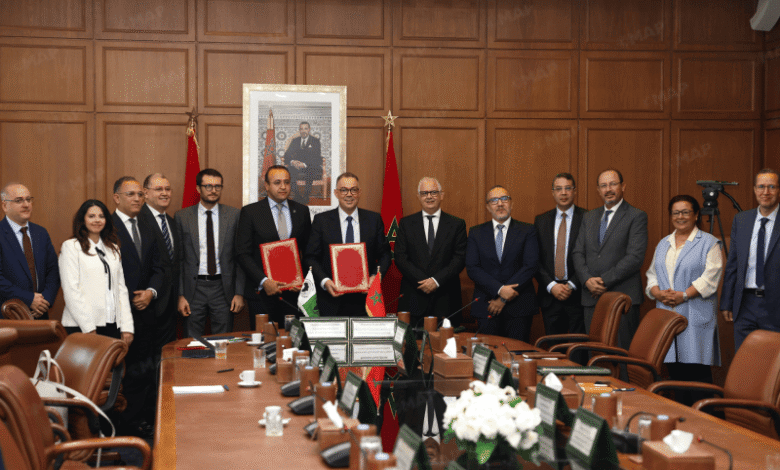
Morocco and the African Development Bank Sign €434 Million Financing Agreement
On Friday, November 13, in Rabat, Morocco, the Kingdom and the African Development Bank (AFDB) signed a financing agreement amounting to €434 million to support the third phase of the Program for Economic Governance Strengthening and Climate Change Resilience (PGRCC).
The agreement was signed by Fouzi Lekjaa, the Minister of Economy, Finance, and Public Performance, and Achraf Tarsim, the country director of the AFDB group in Morocco, in the presence of Nizar Baraka, the Minister of Equipment, Water, and Forests.
This financing aims to support several structural reforms across strategic sectors, including the transformation of public institutions and enterprises, improvement of the business climate, enhancement of governance in the water and electricity sectors, and acceleration of renewable energy development.
During the event, Fouzi Lekjaa praised the trust that the AFDB has placed in the reform dynamics initiated by the Kingdom. He also emphasized the importance of this partnership in an international context marked by geopolitical tensions and the effects of climate change, which are evident in the alternation of droughts and floods.
The Minister stressed the need to strengthen anticipation, prevention, and the convergence of public policies, especially in the areas of water and energy. He highlighted the complementarity between water resource management and the development of clean energy within a medium- and long-term vision.
For his part, Nizar Baraka called for the adaptation of management policies to extreme climatic phenomena, prioritizing coordination and integration of public interventions. He also underscored the close links between food sovereignty and energy sovereignty.
The Minister presented the main axes of integrated water resource management, which notably includes mobilizing new resources through seawater desalination and the recycling of wastewater, as well as preserving existing resources, particularly groundwater.
Achraf Tarsim praised the coordination among various ministerial departments and public organizations involved in the reforms. He specifically mentioned the state’s shareholder policy, the transformation of public enterprises, openness to private investment, water pricing, and the reuse of wastewater.
The AFDB representative clarified that the institution’s support is not limited to budgetary assistance; it also encompasses investment financing and technical assistance.
The program’s implementation involves several departments and public organizations, including the Ministries of Economy and Finance, Interior, Energy, and Equipment, as well as the National Agency for State Participation Strategic Management (ANGSPE), the National Office of Electricity and Drinking Water (ONEE), and the National Electricity Regulatory Authority (ANRE).