Morocco–United States: CGEM Aims to Accelerate Moroccan Exports to the American Market
Twenty Years After the Implementation of the Free Trade Agreement, CGEM Aims to Revitalize Trade Between Morocco and the United States
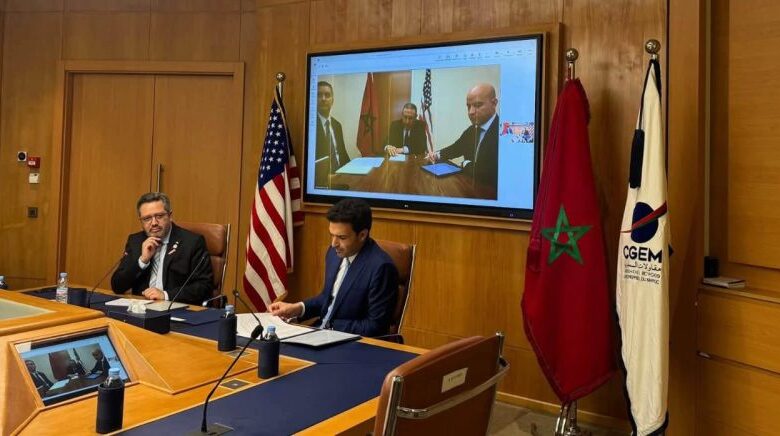
On November 24, 2023, a seminar dedicated to accessing the American market was held in Casablanca, highlighting the opportunities for export, regulatory constraints, and prospects for industrial partnerships. The event sought to provide a renewed impetus to trade relations between Morocco and the United States, two decades after the free trade agreement came into effect.
The U.S. market still represents significant growth potential for Moroccan businesses, a key point underscored during the "Unlocking the U.S. Market" seminar organized by the Americas Commission of the General Confederation of Moroccan Enterprises (CGEM).
The meeting brought together business leaders and international trade specialists, attended by Mehdi Tazi, president of CGEM, and Youssef Amrani, Morocco’s ambassador to the United States, who participated remotely.
According to figures shared by Ambassador Amrani, trade in goods between the two countries approached $7.4 billion in 2025. However, Moroccan exports to the U.S. total less than $2 billion, indicating substantial room for growth for national operators.
Two decades after the free trade agreement, which remains Washington’s only such arrangement with an African country, the focus is now on Moroccan companies’ ability to better capitalize on the opportunities provided by this trade framework.
CGEM Focuses on Partnerships and Support for SMEs
Mehdi Tazi emphasized the need to strengthen business relationships between Moroccan and American economic operators. For Tazi, the goal extends beyond increasing exports; it also aims to foster cross-border investments and the creation of industrial partnerships between the two nations.
In this context, the Moroccan private sector intends to enhance support for small and medium-sized enterprises (SMEs) seeking to access the U.S. market. The Americas Commission plans to assist in identifying commercial opportunities, preparing companies for local requirements, and searching for distribution partners.
The development of joint industrial projects and technology transfers were also highlighted as avenues for deepening bilateral economic cooperation.
Morocco’s Advantages and Trade Tensions at the Heart of Discussions
Youssef Amrani outlined the advantages of Morocco for American industrial players seeking more secure supply chains. He identified the country’s stability, port infrastructure, industrial fabric, and geographic location as favorable factors for the development of new collaborations.
The ambassador also addressed trade tensions stemming from an investigation by the U.S. Trade Representative (USTR) under Section 301, as well as the 12.5% customs duty mentioned during the meeting.
He indicated that discussions were underway with U.S. trade authorities to maintain the market access conditions provided by the free trade agreement.
Additionally, the Moroccan embassy in Washington is willing to facilitate national businesses’ engagements with federal agencies and various state authorities. Organizing economic missions to the U.S., in coordination with CGEM, is also among the initiatives under consideration.
Regulation, Logistics, and Financing: The Challenges of Entering the U.S. Market
Moderated by Achraf Bouqdib, vice president of the Americas Commission, the seminar examined the obstacles Moroccan exporters might face when establishing commercial operations in the U.S.
Regulatory requirements took a center stage in the discussions, with particular focus on products subject to oversight by the Food and Drug Administration (FDA).
Several experts provided insights into the conditions for entering and thriving in the U.S. market, including Kamal Nasrollah, a partner at Baker McKenzie; Kenza El Amrani, senior specialist at the U.S. Commercial Service; Othmane Samie, senior attorney at Samie Law Firm; and William C. Fellows, managing director of LixCap.
A second panel focused on the competitiveness of Moroccan offerings, as well as logistics costs and solutions, and the financing of export operations. It featured Ali El Harti, president of the CGEM’s External Trade Development Commission and FENELEC; Zineb El Korri Slimani, deputy general manager of Bank of Africa; Reda Moukhli, director of strategy and development at Marsa Maroc; and Eyad Sobh, chair of the FENAGRI’s Foreign Trade Committee.
Moroccan Companies Share Their Experiences in the U.S. Market
The seminar also provided a platform for Moroccan companies that have successfully expanded their activities in the U.S. market to share their experiences.
Mohamed El Baroudi, general director of SITI; Rita Maria Zniber, CEO of Diana Holding; and Sharif Bennani, marketing director of Ait Manos, each shared their unique journeys. Their testimonies covered various aspects of business development, from initial prospecting to contract signing, including product adaptation and distributor selection.
Through this meeting, CGEM aims to connect Moroccan businesses with the opportunities that the U.S. market offers while underscoring the necessary conditions to transform the potential of the free trade agreement into increased commercial exchanges, investments, and industrial partnerships.