Sulfur: Morocco Becomes the World’s Leading Importer by 2025
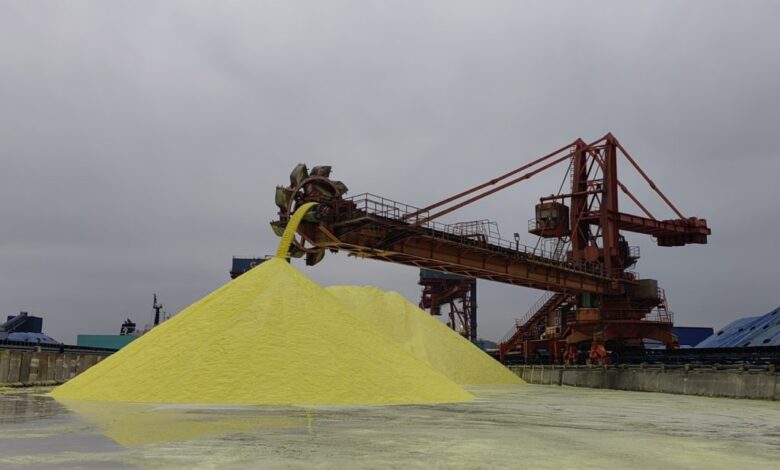
Morocco Becomes the World’s Leading Sulfur Importer in 2025 according to data cited by the Economic Commission for Latin America and the Caribbean (ECLAC) in its 2026 Economic Study of Latin America and the Caribbean, published in August.
The Kingdom accounted for 24.2% of global sulfur imports, outpacing China at 19.6% and Indonesia at 9.5%. Thus, Morocco’s share exceeds that of China by 4.6 percentage points and that of Indonesia by 14.7 points.
This ranking is largely attributed to the significance of Morocco’s phosphate industry, which relies on sulfur as a crucial raw material in fertilizer production.
Why Does Morocco Import So Much Sulfur?
Sulfur plays a central role in the phosphate transformation chain.
It is primarily used to produce sulfuric acid, which is then involved in converting phosphate ore into phosphoric acid. The latter is an essential intermediate in the production of many phosphate fertilizers.
Therefore, the high levels of Moroccan imports reflect the strength of the kingdom’s phosphate industry and its integration into global fertilizer production chains.
However, this situation also indicates a strong dependence on international sulfur supplies.
The Gulf Concentrates a Large Part of Global Supply
International sulfur supply is heavily concentrated around the Persian Gulf.
According to data referenced by ECLAC for 2025, the United Arab Emirates represented 23.5% of global sulfur exports, followed by Qatar at 12.1% and Saudi Arabia at 10.8%.
This concentration is also significant in terms of production. Saudi Arabia, the United Arab Emirates, Iran, Kuwait, and Qatar together accounted for nearly a quarter of global sulfur production, according to the study.
This configuration grants the Gulf a strategic role in supplying major global consumers, including Morocco.
The Strait of Hormuz: A Point of Vigilance for the Moroccan Industry
This geographical dependence indirectly exposes Moroccan supplies to risks associated with navigation through the Strait of Hormuz.
This maritime route is one of the strategic passages for global trade. Military tensions surrounding Iran already contributed in 2026 to disrupting maritime traffic in the region, while increasing insurance costs and operator caution.
For Morocco, the potential consequences are not confined to the maritime sector.
A sustained disruption in sulfur flows could affect supply costs for manufacturers and, consequently, impact the entire production chain from sulfuric acid to phosphoric acid and then to phosphate fertilizers.
The Gulf is Also a Major Player in the Fertilizer Market
The importance of the Persian Gulf extends far beyond the sulfur market.
The region is also a significant global center for the production and export of various raw materials and chemicals used in the fertilizer industry.
From 2023 to 2025, the Gulf represented 29% of global ammonia exports, 36% of urea, 26% of diammonium phosphate shipments, and 13% of monoammonium phosphate.
Thus, the region concentrates a substantial portion of the resources necessary for fertilizer manufacturing while hosting several major fertilizer producers.
A Strategic Exposure for Morocco
Morocco’s unique situation stems from the combination of two factors: its considerable weight in global sulfur imports and the significance of this raw material for its phosphate industry.
With 24.2% of global imports in 2025, the Kingdom emerges as a major player in international demand.
This position helps secure the supply for a strategic industry in the Moroccan economy, but it also makes the continuity of maritime flows particularly critical.
Any closure, navigation restriction, or sustained increase in insurance premiums in the Strait of Hormuz could thus raise the cost of sulfur imported to Morocco.
In the long term, diversifying supply sources and securing logistics chains could therefore become significant challenges to maintaining the competitiveness of Morocco’s phosphate and fertilizer industry.