Between Love and Acceptance: An Exploration of Marital Crisis in the Play “Je passe”
Between Love and Acceptance: An Exploration of Marital Crisis in "I Pass"
Fouzia ELBAYED
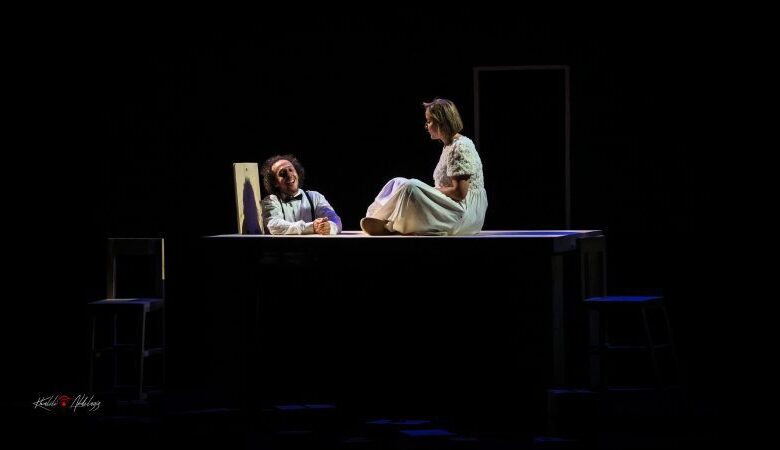
Presented on October 17, 2026, as part of the official programming of the 26th edition of the National Theatre Festival in Tétouan, the play I Pass (أَمْرْ / Adaɛthiɣ), produced by the Al Hoceima Theatre Club, cements contemporary Moroccan theatrical creation within a reflection on the contradictions of existence and the complexity of human relationships. Performed by Hoda Abaïr and Mohammed Bensaïd, with musical composition by Abdelaziz El Bakkali, this piece portrays a couple as a laboratory for the tensions individuals face when confronted with the otherness, social conventions, and their own limitations.
Written by Ahmed Sbiaa, a Moroccan playwright known for prioritizing theatre of idea over linear storytelling, the play is built on a unique marital situation to explore universal issues: love and its disillusionments, beauty and ugliness, memory and forgetfulness, but above all, the difficulty of accepting another without attempting to mold them to one’s own expectations. The direction by Youssef El Arkoubi, conceived through the articulation of space, light, and actor performances, approaches the show as a composition where visual and sound elements contribute to meaning-making.

At the intersection of black comedy, absurd theatre, and existential reflection, I Pass invites audiences to transcend the marital anecdote to question the mechanisms of human relationships. How do we coexist with another without confining them to a preconceived image? And what remains of love when appearances, memories, and ideals clash with reality?
Ahmed Sbiaa: A Dramaturgy of Ideas and Human Contradictions
Ahmed Sbiaa holds a significant place in the landscape of contemporary Moroccan theatre. His writing is distinguished by a desire to break free from conventional narrative structures, instead prioritizing symbolically rich situations, ideological confrontations, and the paradoxes of the human condition. Rather than constructing a plot solely based on a succession of events, the playwright unveils meaning through the tensions between characters, their dialogues, and the representations they maintain of themselves and others.
In I Pass, this approach manifests through an intentionally unusual initial situation: a man with a prominent nose and a woman with a long nose confront the realities of marital life post-wedding. The protagonists’ physical peculiarities resonate not only on a comedic level but also open a dialogue on aesthetic norms, social judgment, and how individuals construct themselves under the gaze of others.
This approach bears affinities with certain explorations within absurd theatre, particularly those by Eugène Ionesco in The Bald Soprano, where the deconstruction of dialogue and disruption of ordinary conventions reveal the incoherence of some social behaviors. It can also be compared, from an existential reflection perspective, to Sartre’s No Exit, where the confrontation among characters transforms the gaze of the other into an instrument of judgment and confinement. Such comparisons do not imply direct influence but rather illuminate a shared concern: to make theatre a space for critical examination of human relations.
Sbiaa’s uniqueness lies in his capacity to transform an apparently anecdotal situation into a philosophical inquiry. The couple is more than a subject of a sentimental story; it becomes a space where contradictions between self-image, the desire for recognition, and the impossibility of fully controlling another’s identity are revealed.
The Couple: Between the Desire for Union and the Rejection of Difference
Marriage constitutes the dramatic core of the play. Generally associated with union, stability, and the promise of a shared future, it emerges here as a space fraught with tensions that test idealized representations of love.
The two protagonists, portrayed by Hoda Abaïr and Mohammed Bensaïd, do not merely represent opposing poles in a clash between man and woman. Their confrontation can be read as an encounter of two subjectivities, each carrying its own expectations, vulnerabilities, and conception of shared life. The relationship becomes problematic when the other ceases to conform to the image one has constructed of them.
This dynamic aligns with a central question of existentialist philosophy: does recognizing another necessitate renouncing one’s own freedom or, conversely, acknowledging one’s own freedom? In No Exit, Sartre delves into the tensions linked to the gaze and judgment of others. In I Pass, this issue extends into the marital relationship, where attachment can coexist with the need to control the partner’s image.
The challenge, therefore, is not to determine which of the two characters holds the truth, but to understand how each contributes to the fragilization of the bond. The conflict reveals the limits of a conception of love based on idealization: loving a representation of the other does not necessarily equate to accepting their reality.
Thus, the play raises a fundamental question: Can love survive when the other no longer corresponds to the ideal we have projected onto them? This inquiry imbues the work with universal resonance, as it pertains equally to intimate relationships and the broader mechanisms of recognition and exclusion.
The Stage Space: The Marital Home as a Psychological Closed Room
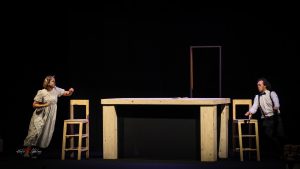
The domestic space serves as a primary vector of meaning in the performance. Traditionally associated with protection and intimacy, the home can transform into a place of confinement when the relationship it shelters becomes conflict-ridden.
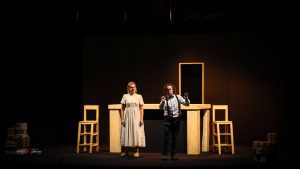
The spatial limitation concentrates attention on the two performers and intensifies the significance of their exchanges. Gestures, movements, silences, and bodily attitudes take on special importance, as they visibly manifest the tensions that traverse the characters. The space does not merely situate the action; it also contributes to the representation of inner conflict.
This conception recalls certain aspects of Sartre’s No Exit, where spatial confinement becomes the materialization of an existential impasse. It also evokes some dramatic worlds of Samuel Beckett, notably Waiting for Godot, in which the reduction of spatial markers and repetition of situations contribute to a sense of uncertainty and anticipation.
However, it is essential to distinguish these approaches: in Beckett’s works, space contributes to a radical inquiry into existence, time, and waiting; in I Pass, the marital home primarily serves to examine the difficulties of coexistence and the contradictions of intimacy.
Thus, the stage space possesses a dual dimension. On one hand, it is a concrete location where the couple’s daily life unfolds; on the other, it symbolizes their mental universe. The more the characters seem confined within their relationship, the more the scene reveals the impossibility of resolving conflict simply by changing the location.
The Semiotics of Objects: When Memories Become Signs
Old photographs, gifts, letters, and a red rose comprise a system of signs that materialize marital memory. Their presence invites us to consider objects not as mere accessories but as dramatic elements capable of bringing the past into the present.
Photographs evoke a shared history and the images that characters maintain of their relationship. They can juxtapose the memory of previous happiness with the couple’s reality, revealing the gap between past idealization and present tensions.
Gifts embody gestures of affection, promises, and expectations that accompany romantic relationships. However, their significance remains unstable: an object once associated with tenderness can become a reminder of disappointment or a commitment that seems to have lost its meaning.
Letters, in turn, preserve traces of words spoken or feelings expressed at another moment in the relationship. They establish a confrontation between past speech and present behavior, between promise and its fulfillment.
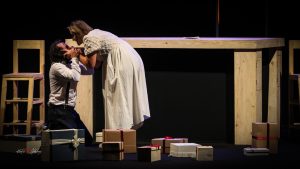
Finally, the red rose, traditionally associated with passion and love, holds an ambivalent value. It can evoke the persistence of love, but also the fragility of a bond threatened by disillusionment. Its meaning depends on the context in which it appears and how the characters receive it.
This dramaturgical use of objects can be contextualized within Symbolist theatre and certain practices of contemporary theatre, where a material element concentrates an emotional or conceptual load that surpasses its utilitarian function. It also recalls how ordinary objects acquire existential value in certain Beckettian worlds.
Thus, memory does not emerge as an unassailable refuge. Instead, it becomes a battlefield between what characters have experienced, what they believe they have experienced, and what they are now capable of recognizing. Objects contribute to staging the difficulty of reconciling shared history with individual transformations.
Black Comedy and the Aesthetics of the Absurd: Laughing at Human Discomfort
One of the distinctive features of I Pass lies in its ability to intertwine comedy and existential anxiety. The physical uniqueness of the protagonists, the contradictions within their relationship, and the dissonance between marriage ideals and the challenges of daily life pave the way for a form of humor that seeks not solely entertainment.
Black comedy derives its strength from this ambiguity: the audience can laugh at a situation while perceiving the symbolic violence, discomfort, or suffering it encapsulates. Laughter thus becomes a critical instrument, capable of unveiling aesthetic prejudices and contradictions in social behavior.
This ambivalence resonates with Ionesco’s Rhinocéros. Beneath the surface of an absurd situation, the play questions conformity and mechanisms of collective adherence. Likewise, in The Bald Soprano, humor and the disruption of language reveal the mechanical nature of certain social conventions.
In I Pass, the use of the grotesque can be interpreted as a means of destabilizing the norms that dictate what is deemed beautiful or ugly, acceptable or unacceptable. The body then becomes a revealer of the criteria through which a society evaluates individuals. The characters’ physical peculiarities, far from serving as mere comic devices, interrogate the mechanisms of stigmatization and the difficulty of freeing oneself from external judgment.
The absurd dimension also manifests in the potential for conflicts to repeat without reaching a definitive resolution. Dramaturgy thus favors situations, oppositions, and ideas over strictly linear narrative progression. This construction encourages a circular reading of the marital relationship: the characters seem to return to the same questions because they cannot move beyond the representations that confine them.
In this manner, laughter becomes a form of lucidity. It reveals that the most ordinary behaviors can conceal profound contradictions and that human beings sometimes contribute to the impasse they suffer from.
Youssef El Arkoubi’s Direction: Space as Dramatic Language
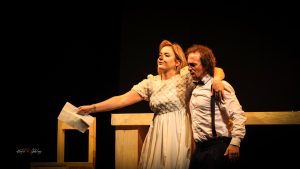
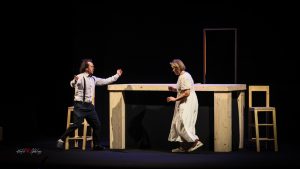
Youssef El Arkoubi’s directorial and scenographic approach relies on a conception of theatrical space that transcends mere decorative function. In this light, light, volumes, objects, and actors’ movements contribute to creating a genuine visual language.
Light, in particular, can transform the perception of a space, isolate a character, emphasize a rupture, or alter the atmosphere of a scene without requiring a physical change in the set. It thus becomes a means of conveying psychological tensions and evolving the meaning of the same space.
A stripped-down and symbolic scenography also provides particular visibility to objects. In a work where photographs, letters, gifts, and the red rose carry a memorial load, their arrangement and handling can help guide the audience’s gaze and organize the reading of the action.
This conception echoes Peter Brook’s explorations, particularly in The Empty Space, where theatrical acts are conceived from the intersection of a space, an actor, and an audience. It can also be compared, with necessary caution, to Tadeusz Kantor’s work, which attributed a unique stage presence to objects, charged with memory and symbolic associations.
These comparisons highlight the importance of scenography as a dramaturgical component. The space is no longer a neutral container; it becomes a partner in the performance, capable of extending the characters’ emotions and materializing their contradictions.
In the case of I Pass, this approach invites us to observe how light, visual composition, and actors’ movements contribute to transforming the marital home into a space of psychological confrontation. However, an accurate appreciation of the directorial choices must rely on the elements effectively observed in the performance.
Music, Silences, and Rhythm: A Dramaturgy of Tension
The musical composition by Abdelaziz El Bakkali plays a significant role in the auditory identity of the performance. In a play that primarily hinges on the confrontation between two characters, the rhythm does not solely depend on the succession of lines; it also builds through pauses, silences, gestures, and variations in intensity.
The music may accompany emotional transitions, accentuating a rupture, or introduce a contrast between the apparent banality of a situation and the gravity of the underlying conflict. Silences can express what the characters cannot articulate or what they prefer to avoid acknowledging.
This emphasis on what remains unspoken can be compared to Harold Pinter’s theatre, particularly in The Lover or Betrayal, where intimate relationships are also constructed through ambiguities in dialogue, omissions, and latent tensions. It is not about assimilating the dramaturgical structures of the two authors but highlighting a potential commonality: speech does not always reveal the truth of relationships, and silence can become a theatrical event in its own right.
Music and rhythm can thus help the audience feel what escapes explicit discourse. Their function is not solely to accompany the action but also to create a sensitive space in which the conflict becomes perceptible even before it is clearly articulated.
From Marital Intimacy to Social Critique: The Ethics of Acceptance
Beyond romantic relationships, I Pass opens a reflection on the social mechanisms of normalization. The distinction between beauty and ugliness, the expectations associated with marriage, and the desire to see the other conform to an ideal representation refer to norms that extend beyond the private sphere.
Acceptance does not mean the absence of disagreement or the disappearance of conflicts. It rather implies recognizing otherness—the ability to consider the other as an autonomous subject, irreducible to our expectations and projections. The problem arises when the relationship transforms into an attempt at correction, domination, or conformity.
Thus, the play invites reflection on a fundamental contradiction: we desire to be recognized for who we are, yet we often struggle to grant the same freedom to others. The couple becomes a mirror of a broader social tension between individuality and collective norms.
This issue resonates with several international theatre traditions. In Sartre, the relationship with others can become a confrontation between freedoms; in Ionesco, social conventions may turn into absurd mechanisms; in Pinter, intimate relations reveal power tensions that do not always manifest openly.
These perspectives shed light on the philosophical significance of the play without diminishing its uniqueness. By placing difference at the heart of the marital conflict, Ahmed Sbiaa invites the audience to examine their own judgment criteria and how these influence their relations with others.
The stakes are therefore both ethical and sentimental: how do we construct a relationship in which otherness is neither a threat nor a flaw to correct, but a constitutive dimension of shared life?
Summary of Key Dramaturgical Techniques
| Technique | Function and Interpretive Scope |
|---|---|
| Domestic closed room | Concentrates tensions and transforms the home into a space of psychological confrontation. |
| Physical uniqueness of characters | Questions aesthetic norms and social judgment. |
| Memory objects | Materialize the past and confront memories with present realities. |
| Black comedy and the grotesque | Links laughter to discomfort and highlights human contradictions. |
| Idea-driven dramaturgy | Favors symbolic situations and philosophical questioning over traditional plots. |
| Light and scenic composition | Can make tensions visible and contribute to meaning construction. |
| Music and silences | Support emotional rhythm and give place to the unspoken. |
| Marital conflict | Serves as a starting point for reflection on freedom, difference, and acceptance. |
Conclusion: Accepting the Other Without Renouncing Oneself
I Pass (أَمْرْ / Adaɛthiɣ), stands out for its ability to transform a unique marital situation into an inquiry about the human condition. Through Ahmed Sbiaa’s symbolic writing and Youssef El Arkoubi’s direction, the performances by the two artists and the expressive potential of the stage space bring tension to the ideal of love and the reality of relationships, memory and present, self-image and the gaze of others.
Connections with Ionesco, Beckett, Sartre, Pinter, Brook, or Kantor allow us to situate some of its concerns within an international theatrical horizon: the absurdity of conventions, existential confinement, the ambiguity of human relations, and the capacity of stage space to produce meaning that can resonate with the audience. However, these affiliations should be understood as comparative reading tools rather than evidence of direct influences.
Ultimately, the play’s significance lies in its ability to make the couple a site for observing human contradictions. Love there does not appear as a guarantee of harmony or an automatic solution to differences. It becomes a demanding experience, confronted with the necessity of recognizing the other in their irreducible uniqueness.
The fundamental question left open by the play is then: Can we truly love another without seeking to transform them into a version that conforms to our own desires? By placing this inquiry at the heart of the representation, I Pass reminds us that accepting the other is not merely a sentimental ideal but an ongoing test of freedom, lucidity, and mutual recognition.