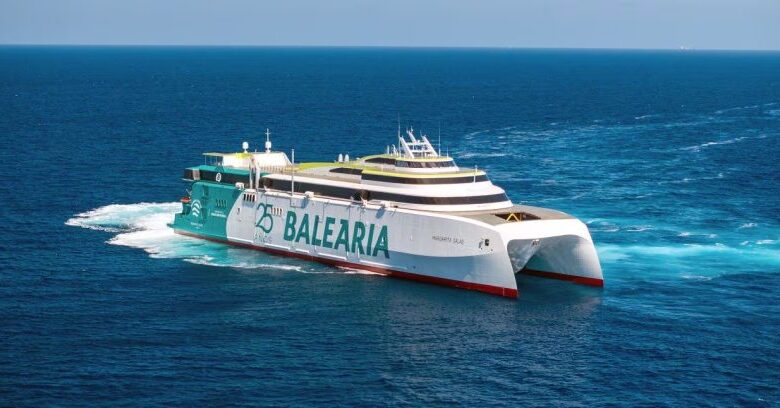
Balearia is preparing a 100% electric maritime connection between Tangier and Tarifa.
Spanish Shipping Company Balearia Takes Major Step in Maritime Decarbonization
The Spanish shipping company Balearia has reached a significant milestone in its project to decarbonize maritime transport between Morocco and Europe. On Sunday, the company announced the launching of its first fully electric fast ferry, which will facilitate the connection between Tangier City and Tarifa in southern Spain, starting in the summer of 2027. This initiative aims to create the first green maritime corridor between Europe and Africa.
Two Electric Ferries to Connect Morocco and Spain
As part of this initiative, Balearia plans to introduce two catamarans powered entirely by electricity. These vessels will enable crossings between Tangier and Tarifa without any direct carbon dioxide (CO₂) emissions, while also reducing noise pollution associated with navigation.
The first ship recently witnessed a major construction milestone with its launch. The second catamaran is still under construction and is expected to join the fleet after the summer of 2027, according to the company’s announcement.
The project is not solely focused on the construction of new ships; it also includes the electrification of the port infrastructures in Tangier City and Tarifa, ensuring the functionality of this maritime route powered by electric propulsion.
Over €200 Million Investment
To realize this ambition, Balearia plans to invest more than €200 million overall. This budget covers the construction of the two ferries, as well as the necessary works for the electrification of the involved ports.
The company’s president, Adolfo Utor, presented the launch of the first vessel as a strategic step toward the commencement of the service in 2027. According to him, this advancement brings Balearia closer to operationalizing what he describes as the first 100% electric maritime link between Europe and Africa.
Utor also highlighted that the project anticipates achieving the net-zero emissions goal set for 2050 by several decades. He emphasizes the role of technological innovation, investment, and industrial cooperation in speeding up the energy transition in the maritime sector.
An 87-Meter Catamaran with 14 MWh Batteries
Balearia’s first electric ferry boasts technical specifications tailored for the demands of fast passenger and vehicle transport on short sea routes. The 87-meter-long catamaran has an aluminum structure designed for a balance of lightweight and durability.
It is also equipped with a battery system that offers a storage capacity of 14 megawatt-hours (MWh) to power its electric propulsion. This technology aims to ensure crossings without direct CO₂ emissions during navigation.
However, the project’s success will depend on the implementation of port charging infrastructure and operational conditions along the route. The goal is to offer a high-performance maritime service while reducing the environmental footprint of travel between the two banks of the Strait of Gibraltar.
Tangier-Tarifa: A Strategic Corridor for Sustainable Mobility
The link between Tangier and Tarifa occupies a strategic position in trade between Morocco and Spain. Shifting to fully electric propulsion could mark a significant advancement in the decarbonization of short maritime links, provided that the vessels and port facilities are operational according to the announced schedule.
With this program, Balearia aims to combine the modernization of maritime transport with direct emission reductions and the development of suitable energy infrastructure. The planned launch in the summer of 2027 will mark a new chapter for maritime connections between Morocco and Europe, in a context where transport stakeholders are striving to accelerate their transition towards more sustainable solutions.