Stellar Announces High Grades at Tichka, Morocco
Stellar AfricaGold Reports Promising Gold Exploration Results at Tichka Est Project
The Canadian company Stellar AfricaGold has announced new encouraging results from its gold exploration project Tichka Est, located in the High Atlas region, approximately 90 kilometers south of Marrakech. Trenching work conducted in zone D has revealed gold concentrations reaching 9.53 grams per tonne over three meters, with three out of four explored dykes yielding results of more than five grams per tonne.
These findings are intended to inform the planning of a new drilling campaign. The company plans to carry out five drill holes in this area as part of a fully financed program consisting of 24 core drillings totaling approximately 5,000 meters. At this stage, however, the project remains in the exploration phase, and no mineral resource has yet been defined.
High Grades Found in Three Dykes in Zone D
In its press release dated October 27, 2026, Stellar AfricaGold highlighted results obtained from various geological structures in zone D. Dyke 3, an intrusion consisting of diorite and dolerite with an estimated length of around 600 meters based on initial field observations, delivered the best grades in this trenching campaign.
Trench TR4-D-26 notably revealed 9.53 grams of gold per tonne over three meters, along with an interval of two meters at 13.91 g/t. Other significant results were recorded from the other three analyzed dykes.
Dyke 1 reported a grade of 5.99 g/t over nine meters and 8.98 g/t over two meters. In dyke 4, analysis showed 5.81 g/t over three meters in trench TR6-D-26, as well as 8.52 g/t over two meters. Dyke 2 exhibited a lower grade of 0.51 g/t over three meters at the end of the trench.
According to Stellar AfricaGold’s CEO, J. François Lalonde, there is gold mineralization in each of the dykes that were trenched and analyzed.
Quartz Veins Associated with Gold Mineralization
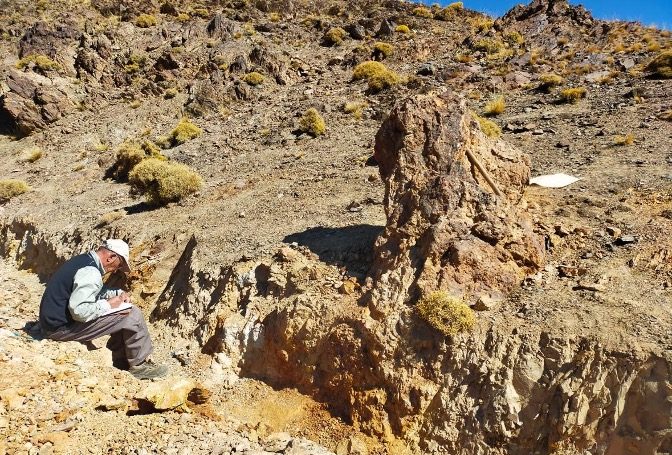
Field observations have identified quartz veins containing arsenopyrite and pyrite. According to the company, gold is associated with these veins, the surrounding rocks, and faults cutting through the dioritic dykes and their peripheral breccia zones.
In trenches dug perpendicular to the dykes, mineralization mainly concentrates in intervals of one to three meters. Notably, trench TR4-D-26 yielded two consecutive intervals presenting 12.99 g/t and 14.82 g/t, respectively. In trench TR6-D-26, two successive intervals showed 8.68 g/t and 8.36 g/t.
Further results were obtained in trenches TR3-D-26 and TR5-D-26. The former revealed 0.38 g/t over two meters on dyke 3, while the latter showed 1.24 g/t over four meters and 4.09 g/t over one meter on dyke 4.
Stellar emphasizes that trenches TR5-D-26 and TR2-D-26 terminate just after encountering a sterile siltstone, on either side of their respective dyke. The mineralized intervals thus close against this rock rather than at the end of the trenches.
Additional Work Needed on Dyke 1
The company has also clarified the description of trench TR1-D-26, provided in its October 6 communication. This trench was dug along a cleared roadside embankment, oriented between 170 and 175 degrees, nearly parallel to dyke 1 and approximately perpendicular to the mineralized veins.
The nine meters sampled in this trench, according to Stellar, reflect the extension of the veins and mineralized faults along the dyke, rather than the actual thickness of a gold body. The width of dyke 1 and the true grade of the mineralized zones remain to be determined.
The two best samples from this trench yielded grades of 10.71 g/t and 10.64 g/t, coming from the vicinity of the veins and adjacent faults. Despite the trench’s particular orientation, Stellar notes that it also showed a concentration of 5.99 g/t gold.
To better understand the geometry of the mineralization, the company plans to dig two short cross trenches covering the full width of dyke 1 and both of its contacts. Each vein will be subject to separate sampling before final interpretation of results and preparation for drilling.
Five Drills Planned in Zone D
The trench results will help determine the location and orientation of the five planned drill holes in zone D. This work is part of a second phase of drilling consisting of 24 core drill holes totaling approximately 5,000 meters, fully financed by the company.
The drill holes will be oriented to intersect both the dykes and the cluster of mineralized veins. Weather permitting, work in zone D should proceed after initial drilling in zone B, considered the most advanced area of the Tichka Est project.
Stellar has indicated that it has completed preparations for deploying drilling rigs and teams from the drilling company CMFM. Platforms and site access have also been established. However, moving equipment to the site is contingent on receiving the necessary administrative authorization. The company states it will announce the official start of drilling.
A Drone-Magnetic Survey to Refine Exploration
In parallel, Stellar AfricaGold is continuing efforts to enhance its understanding of the geological structure of zone D. The company Progrem was engaged for the project on October 20 to conduct a high-resolution drone magnetic survey, which has been expanded to this area.
Test flights began the following day and were ongoing at the time of Stellar’s announcement. The goal is to refine the structural interpretation of the dyke corridor before determining the final placement of the drill holes.
The company also plans new trenches on previously studied dykes, followed by the first investigations on dykes 5, 6, and 7, which have yet to undergo any exploratory work. A systematic mapping of the zone D corridor is also scheduled.
The combined interpretation of existing data, results from the planned cross trenches on dyke 1, and the magnetic survey should help clarify the next steps in the campaign.
Analyses Conducted under a Quality Control Protocol
Samples collected from the trenches were analyzed by Afrilab, an independent laboratory based in Marrakech and accredited according to ISO/IEC 17025 standards. The laboratory employed a gold assay method through fusion on a 50-gram sample, with atomic absorption finish and a detection limit of 0.05 g/t.
The channel samples weighed between 2.3 and 4.3 kilograms and were sent to the laboratory under a chain of custody. The nine samples with grades exceeding five grams per tonne are subject to re-analysis via fusion with a gravimetric finish. Stellar intends to publish the results of these checks if they differ significantly from the initial analyses.
The quality control program also included nine blind samples inserted among the 73 samples in the batch, accounting for 12.3% of the total. These comprised three certified reference materials, three blank samples, and three field duplicates.
According to Stellar, the reference materials remained within one standard deviation of their certified value, while the blank samples showed concentrations below 0.05 g/t. Two duplicates adhered to the 20% tolerance. The third exhibited a 21% discrepancy, with results of 3.94 g/t and 3.19 g/t—a difference the company considers compatible with the natural variability of gold over short distances.
Twelve additional analyses conducted on pulp samples at the laboratory also matched the initial results. The analysis certificates are dated October 15.
Tichka Est Remains a Gold Project in the Exploration Phase
The seven trenches carried out in zone D total 84 meters. After examining outcrops, Stellar focused channel sampling on sections showing signs of mineralization. In total, 64 meters were continuously sampled, in one-meter passes, across six trenches. Trench TR7-D-26, lacking visible veins, along with sterile ends, was excluded from this sampling.
The published intervals represent length-weighted composites, without grade caps, featuring a cut-off grade of 0.20 g/t and a maximum of three meters of internal dilution. They are measured along the bottom of the trenches and do not alone determine the actual thickness of the gold zones.
Stellar reminds that work on Tichka Est remains preliminary. The investigations conducted thus far are insufficient to define a mineral resource, and there is no guarantee that subsequent campaigns will delineate one.
The project covers an area of 82 square kilometers and includes five exploration permits as well as an operating license. Four gold zones, designated A, B, C, and D, have been identified.
Under a progressive acquisition agreement with the National Office of Hydrocarbons and Mining (ONHYM), Stellar can attain an 85% stake in the project in exchange for $2.39 million, approximately 23.52 million dirhams, in exploration expenditures over three years.
Based in Vancouver with an office in Marrakech, the Canadian company is also advancing the Zuénoula gold project in Ivory Coast, under a progressive acquisition and joint venture agreement with MetalsGrove Mining. It plans a fully financed program of 10,000 meters of auger drilling there.
The results from zone D reinforce the interest in continuing investigations at Tichka Est. However, their economic significance will depend on upcoming exploration steps, confirmation of grades, and determining the actual geometry of the mineralized zones.