Green Finance in Morocco: The EIB and Bank Al-Maghrib Partner to Strengthen Climate Risk Management
The European Investment Bank and Bank Al-Maghrib Join Forces to Enhance Climate Risk Management in Morocco’s Financial Sector
The European Investment Bank (EIB), through its division EIB Global, has signed a cooperation agreement with Bank Al-Maghrib aimed at bolstering the Moroccan financial sector’s capacity to assess and manage risks associated with climate change. This partnership will include technical assistance, specialized training, and the development of supervisory tools.
Morocco takes a significant step in integrating climate-related issues into its financial system. EIB Global, the EIB’s branch dedicated to activities outside the European Union, and Bank Al-Maghrib have formalized an agreement designed to support the greening of the national financial sector and to enhance its resilience to climate risks.
As part of this collaboration, the EIB will provide technical assistance to the Moroccan central bank to strengthen its supervisory practices and tools. This support will focus on evaluating climate risks, conducting climate stress tests, and enhancing the expertise of Bank Al-Maghrib’s teams.
A Program Funded by Germany and Luxembourg
This cooperation is part of the Greening Financial Systems (GFS) technical assistance program, dedicated to the greening of financial systems. It is funded by Germany and Luxembourg through the Greening Financial Systems Fund, in close coordination with the NDC Partnership.
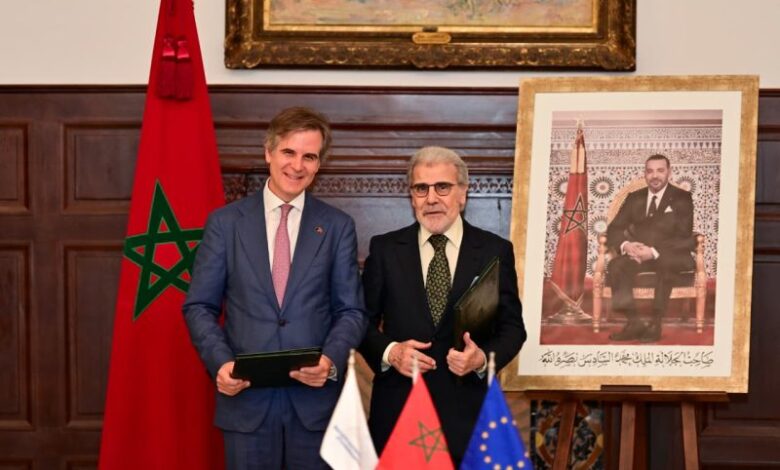
The signing of the agreement took place in Rabat between Abdellatif Jouahri, the Governor of Bank Al-Maghrib, and Adrien de Bassompierre, head of the EIB representation in Morocco, with the presence of Stefan Bantle, chargé d’affaires a.i. of the German Embassy in Morocco.
The program aims to combine technical expertise, tailored training for the central bank’s needs, and international peer exchanges, particularly with central banks and European supervisory authorities.
The objective is to assist Bank Al-Maghrib in aligning its practices with international standards while considering the specificities of the Moroccan financial system. This approach encompasses both regulatory frameworks and prudential mechanisms for addressing climate risks.
Bank Al-Maghrib Seeks to Strengthen its Supervisory Tools
According to Abdellatif Jouahri, this cooperation aims to allow the central bank to take a significant step forward in incorporating climate risks into its banking supervision framework.
"Bank Al-Maghrib has been committed early on to integrating climate risks within the banking supervision framework by gradually adapting its regulations and prudential practices," he emphasized.
The Governor believes this partnership will enhance the alignment of the institution’s tools and capabilities with the best international standards while adapting them to the characteristics of Morocco’s economy and financial sector.
EIB Targets a More Resilient Financial Sector
On his part, Adrien de Bassompierre emphasized that the green transition requires a financial sector capable of both managing climate-related risks and directing more funding toward sustainable activities.
The head of the EIB’s Moroccan representation indicated that this cooperation is expected to help financial institutions better support businesses, especially small and medium enterprises (SMEs), in their transition to more sustainable economic models.
He also praised the support from Germany and Luxembourg, noting that their contributions to the Greening Financial Systems Fund have made this partnership possible.
For Stefan Bantle, this initiative continues the cooperation between Germany and Morocco in the field of climate protection. He referred to the GFS program as a framework designed to enhance the resilience of financial systems against the shocks posed by climate change.
Morocco Joins Twelve Other Countries Benefiting from the GFS Program
The Greening Financial Systems program supports several countries in their transition to greener and more resilient financial systems in the face of climate risks.
It provides assistance to central banks, supervisory authorities, and financial institutions to strengthen their capabilities for identifying and managing climate risks, as well as creating favorable conditions for increasing green investments.
With this new cooperation, Morocco joins twelve other countries benefiting from the initiative: Albania, Armenia, Bosnia and Herzegovina, Ethiopia, Georgia, Jordan, Kenya, North Macedonia, Nigeria, Uganda, Rwanda, and Vietnam.