Ports: Morocco Strengthens Its Position in Global Maritime Trade
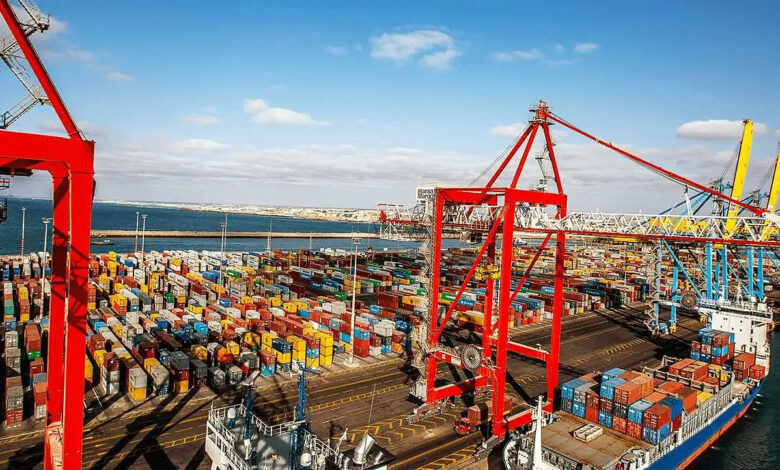
In 2026, Morocco reaffirms its role as a strategic maritime hub connecting Europe, Africa, Asia, and the Americas. Data published by several prominent port authorities and shipping companies indicate a significant increase in certain trade routes with the Kingdom, particularly in European connections, while the Tanger Med port continues to play a central role in intercontinental exchanges.
The available statistics, however, reveal differing trends across ports and types of traffic. Barcelona, Valencia, and Hamburg are notably experiencing an increase in their containerized trade with Morocco, while major ports like Rotterdam, Antwerp-Bruges, and Montreal have only reported overall results without detailing the volumes specifically associated with the Moroccan market.
Barcelona Shows Significant Growth with Morocco
Barcelona’s port exhibits one of the most marked developments. From January to July 2026, short-distance maritime traffic with Morocco reached 128,727 TEUs, marking a 66.7% increase year-on-year.
Morocco thus accounts for 16.8% of the 764,975 TEUs processed in this category by the Spanish port, ranking second after Algeria.
However, statistics present a more contrasted reality when focusing exclusively on full containers excluding transit. This segment accounted for 14,659 TEUs with Morocco, down 17.1%. The number of containers loaded in Barcelona destined for the Kingdom decreased by 18.7%, totaling 13,447 TEUs.
This disparity between the two indicators emphasizes the importance of not aggregating data that correspond to different statistical scopes, particularly due to transit, empty containers, and the composition of flows.
Valencia and Hamburg Also Show Dynamic Trends
Morocco is among the most dynamic maritime relations for Valencia’s port. In the first quarter of 2026, container traffic with the Kingdom increased by 19.09%, although the port authority did not specify the exact number of TEUs involved.
Across the three ports managed by the Valencia authority, traffic reached 18.68 million tons and 1.31 million TEUs in the first quarter. During the first six months, volumes neared 39.92 million tons and 2.82 million TEUs.
In Hamburg, container exchanges with Morocco also rose by 4.7% in the first half of the year. The German port processed 56.1 million tons and approximately 4 million TEUs during this period. Again, the available data do not allow for precise assessments of Morocco’s contribution to the port’s total activity.
Tanger Med: A Central Link Between Continents
Beyond bilateral exchanges with major European ports, Morocco has a significant strategic advantage: its position at the entrance to the Mediterranean Sea and its proximity to the Strait of Gibraltar.
Tanger Med is connected to numerous shipping lines linking Asia, Europe, Africa, and the Americas. Major shipping lines such as Maersk and CMA CGM integrate the Moroccan port into several intercontinental services.
The Asia-Europe routes notably connect Tanger Med to major hubs such as Shanghai, Ningbo, Yantian, Rotterdam, Hamburg, Antwerp, and London.
This location is gradually transforming the Moroccan port into a significant redistribution platform for goods between various regions of the world.
The Strait of Gibraltar: Concentrating Passenger Traffic
Morocco’s maritime traffic is not limited to containers and goods. Connections with Spain also serve as a major axis for travelers and vehicles.
During the first month of the Operation Paso del Estrecho, from June 15 to July 15, connections between Spain and Morocco’s ports of Tanger Med and Tanger Ville transported 366,384 travelers and 92,604 vehicles.
On the Moroccan side, the Marhaba operation recorded by August 3 2.74 million Moroccans living abroad and 287,518 vehicles. Arrivals by sea accounted for more than half of the total, with 1.43 million people.
Tanger Med captures a significant portion of this traffic. The port recorded a peak of 31,917 travelers and 8,612 vehicles in a single day at the beginning of August.
New Capacity for Moroccan Maritime Routes
Shipping companies are simultaneously enhancing their capacities on major routes with Morocco.
Baleària has scheduled up to twelve daily departures between Tarifa and Tanger Ville during the Operation Paso del Estrecho, along with several rotations between Algeciras and Tanger Med as well as Almería and Nador.
DFDS is also offering multiple daily departures between Algeciras and Tanger Med, while the Motril–Al Hoceima route resumed operations during the summer.
The French port of Sète is also enhancing its service to the Kingdom with several weekly rotations to Tanger Med and Nador.
The GNV company has integrated two new vessels into the Moroccan network. The GNV Aurora and GNV Virgo, powered by liquefied natural gas, particularly serve the Tanger Med–Barcelona–Genoa route.
These ships can each carry over 1,700 passengers, have 426 cabins, and nearly 2,780 linear meters of freight capacity.
Tanger Med Strengthens Connections to Africa and the Americas
Morocco’s maritime network also extends toward West Africa. The new KORA Express service connects Southampton, Vlissingen, Antwerp, Tanger Med, Algeciras, Tema, Lekki, Cotonou, and Dakar.
Additional services connect Tanger Med to Dakar, Abidjan, Nouakchott, Praia, Bissau, Banjul, and Nouadhibou.
Toward the Americas, several routes link the Moroccan port to Brazil, the Caribbean, Canada, and the United States, integrating Tanger Med into networks serving Santos, Salvador, Montreal, Savannah, Houston, Norfolk, and New York.
This diversification of destinations strengthens Morocco’s positioning as a connection hub between several major trading regions.
Casablanca Disruptions Impact Costs
Despite this dynamic, Moroccan maritime transport has been affected by disruptions that hit the port of Casablanca at the beginning of the year.
Severe weather conditions caused significant disturbances and led to the implementation of surcharges by several shipping companies. CMA CGM, Maersk, and Hapag-Lloyd, among others, applied various additional fees on certain routes to and from Morocco.
These extra costs also affected certain routes to North America, as carriers had to adjust their rates and operations in response to the challenges faced on the network.
Nador West Med Prepares for a New Phase
In this evolving maritime landscape, Nador West Med stands out as one of the most significant projects for the future of Moroccan ports.
Its commercial opening is scheduled for the fourth quarter of 2026. The project represents, according to Moroccan authorities, approximately 51 billion dirhams in public and private investments and includes 5.4 kilometers of dikes and 4 kilometers of quays.
The complex is expected to have significant capacities for containers and bulk goods, as well as Morocco’s first liquefied natural gas terminal.
The East container terminal notably brings together Marsa Maroc and Terminal Investment Limited, a subsidiary of MSC. It will feature a 1,520-meter quay and a projected final capacity of 3.4 million TEUs.
Casablanca Continues Its Development
Meanwhile, the port of Casablanca maintains a major role in the national framework. The twenty-year extension of the TC3 terminal’s concession entails 3 billion dirhams in investments.
These investments are expected to increase the terminal’s annual capacity from 600,000 to 900,000 TEUs by 2030, aiming ultimately to surpass 2 million TEUs for the entire port complex.
Marsa Maroc is also pursuing its international development. The company has signed an agreement with the port authority of Liberia to participate in the rehabilitation and operation of two jetties in Monrovia.
Morocco Reinforces Its Role as a Maritime Hub
The available data outlines a rapidly transforming Moroccan maritime landscape.
Tanger Med establishes itself as the primary connection point between intercontinental networks, Casablanca continues to modernize its capabilities despite vulnerability to weather disruptions, while Nador West Med prepares for the arrival of a new high-capacity port platform.
With the increasing number of links to Europe, Africa, Asia, and the Americas, Morocco is gradually solidifying its position as an international logistics and maritime hub at the heart of the main trade routes connecting the three continents.