Riyad Mezzour and the Lesson of the Diaspora: When Political Language Goes Awry
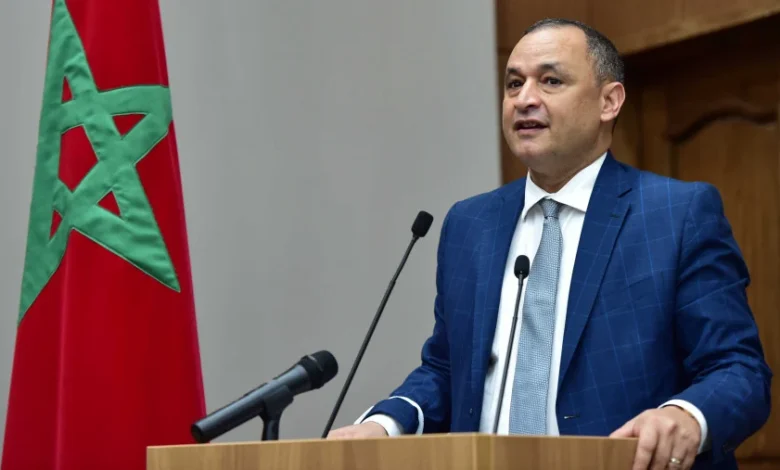
In political communication, words are never neutral. They build bridges… or dig trenches. This is a lesson that Morocco’s Minister of Industry and Commerce, Riyad Mezzour, is learning the hard way. What was intended to be an enthusiastic plea for industrial investment quickly morphed into a national controversy regarding the tone used toward Moroccans living abroad.
This incident reveals a broader phenomenon: in the age of social media, governmental communication is not only assessed based on the content of a speech but also on its tone, symbolic weight, and the perceptions of the affected audiences. In this specific case, many interpreted the minister’s comments as a reproach to the diaspora for its alleged lack of economic involvement with Morocco.
The issue lies in the fact that the relationship between the Moroccan state and its diaspora is anything but ordinary. Moroccans abroad are not just an expatriate community; they represent a crucial economic and social pillar of the country. Their financial remittances amount to billions of dirhams each year and are among the primary sources of foreign currency for the kingdom. However, their contribution extends beyond mere financial flows; it encompasses an emotional, cultural, and symbolic dynamic that transcends economic logic.
Some observers believe that the minister’s remarks have jeopardized this connection. When a public official seems to hold the diaspora accountable—one that has supported the national economy for decades and mobilized during crises—the message can swiftly be perceived as a form of institutional ingratitude.
Recent memories are still fresh. During the COVID-19 pandemic and after the Al Haouz earthquake in 2023, Moroccans abroad displayed remarkable solidarity, mobilizing associative networks and financial resources to support their home country. In this context, any statement suggesting their engagement is insufficient strikes a sensitive chord.
Yet, this matter transcends a mere rhetorical misstep. It highlights a structural tension in how public authorities regard the diaspora: balancing symbolic recognition with economic expectations. For years, Morocco has been attempting to transform the savings and skills of expatriates into productive investments that can bolster the country’s industrial sovereignty. This goal is valid, but the call for contribution must not turn into a mandate.
The Moroccan diaspora has changed drastically. It is no longer solely made up of migrant workers sending home remittances. A new generation of entrepreneurs, engineers, and investors is emerging internationally. This generation thinks in terms of ecosystems, business climates, and legal security. They are unlikely to respond to calls for economic patriotism if these calls are not accompanied by concrete reforms.
In this context, the controversy surrounding Riyad Mezzour serves as a litmus test. It emphasizes that, in terms of relations with the diaspora, education and recognition are equally as important as economic incentives. It also underscores a political reality: in a hyper-connected world, the diaspora now constitutes a public opinion in its own right, capable of influencing the image and credibility of political leaders.
It remains to be seen whether this episode will remain a mere communication incident or spark a broader debate about the role of Moroccans abroad in the country’s economic strategy. One thing is certain: the industrial sovereignty that Morocco seeks to establish cannot be solidified without a strong trust pact with its diaspora.
And this pact always starts with a simple principle: respect.