Water Security in Dakhla: SRM-DO Focuses on Resource Diversification and Treatment System Development
Strengthening Water Security in Dakhla-Oued Eddahab: A Comprehensive Approach to Manage Scarce Resources
In light of the limited availability of conventional water resources and the accelerating impacts of climate change, the Dakhla-Oued Eddahab region is focusing on enhancing its water security through diverse supply sources and the development of unconventional water resources. In this context, the Regional Multi-Services Company of Dakhla-Oued Eddahab is actively working on the implementation of monitoring and management systems as well as supporting desalination and water treatment projects, aiming to ensure a continuous supply of drinking water and to bolster the region’s capacity to meet its future needs.
Water is a key determinant of sustainable development, especially in areas where natural and climatic conditions restrict the availability of conventional water resources. In the Dakhla-Oued Eddahab region, this equation is particularly crucial due to urban and demographic growth as well as economic dynamics in the area, which continue to increase water demands.
To address these challenges, the Regional Multi-Services Company of Dakhla-Oued Eddahab is implementing a series of projects aimed at improving water system management by enhancing monitoring capabilities, improving network performance, diversifying supply sources, and increasing the use of unconventional water resources.
From Network Monitoring to Preventive Action
Securing water supply is not solely reliant on resource availability; it also hinges on the ability to monitor networks and control their various components.
In this framework, the company has introduced a project aimed at establishing a telemanagement hub for drinking water and wastewater networks, designed to enhance continuous monitoring and improve the speed and effectiveness of technical interventions.
This system will incorporate 19 continuous monitoring devices linked to a telemanagement center, allowing for tracking of flow rates and pressure within the network while also strengthening the quality control of distributed water.
The company’s reservoirs will also be equipped with continuous monitoring technologies, providing accurate data on the network’s status and various indicators related to supply.
This approach extends to pumping stations, which will be outfitted with gas detection and monitoring systems to improve safety within these facilities and protect the workers. Water level monitoring systems will likewise be implemented in these pumping stations.
The value of this equipment goes beyond technical control; it will also create an exploitable database to anticipate interventions, reduce response times for technical teams, and more accurately direct on-site operations to areas in genuine need.
Consequently, network management is shifting from a reactive approach—addressing issues post-anomaly—to a strategy rooted in continuous monitoring and anticipatory measures to prevent failures from disrupting service continuity.
Conventional Resources Alone Are Not Enough
However, enhancing network performance, while essential, cannot single-handedly meet the fundamental challenge of water resource availability.
According to data presented by the company’s investment director, Khalid Mimich, the available raw water resources in the region do not directly meet the health standards required for human consumption. Thus, leveraging unconventional water resources becomes a critical component of the supply security strategy.
Seawater desalination stands out as one of the primary solutions deployed. It enables the harnessing of a resource consistently available along the coast and transforms it into usable water after undergoing necessary treatment stages.
These projects align with the national strategy aimed at reinforcing water security and diversifying water supply sources, particularly against the backdrop of climate change and the increasing pressure on conventional resources.
Six Desalination and Treatment Stations in the Region
The Dakhla-Oued Eddahab region features six desalination and water treatment stations distributed across its various territories, highlighting the scale of investment in unconventional water resources.
The setup includes:
- One operational station in the city of Dakhla.
- Two stations in the Aousserd province, activated during the last Aïd Al-Adha.
- One station in Mhiriz currently being put into operation.
- One station in El Argoub center, presently under construction.
- One station in Bir Gandouz.
These infrastructures are part of a strategy aimed at reducing dependence on conventional resources and enhancing the region’s ability to secure its drinking water requirements, especially in areas where natural and climatic characteristics necessitate alternative sourcing solutions.
These projects are particularly significant considering the vastness of the regional territory and the distribution of urban and rural centers. Securing water services thus requires the development of infrastructures capable of aligning with the specific needs of each area.
Treatment: A Critical Link in the Water Management System
Investments are not limited to desalination. Wastewater treatment also constitutes a vital component in the management of the region’s water resources.
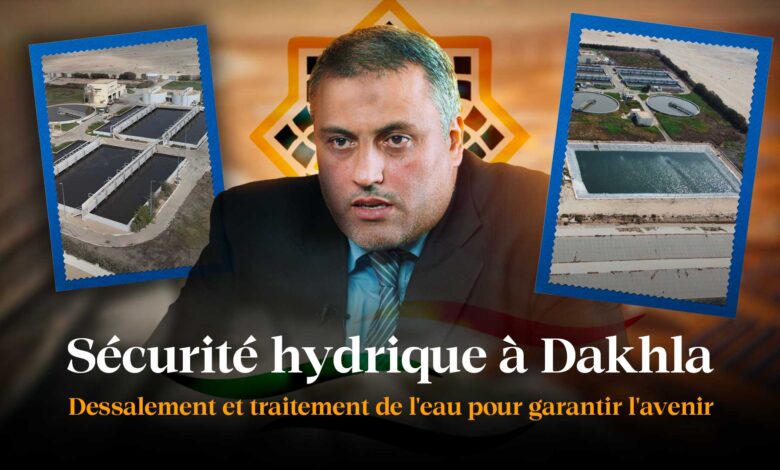
The wastewater treatment plant in Dakhla is an environmentally significant and strategic project. It contributes to the processing of wastewater and enhances its quality before discharge while providing options for the reuse of treated water.
The facility utilizes activated sludge technology, with the current capacity of approximately 10,000 cubic meters per day. Of this volume, about 5,000 cubic meters per day undergo tertiary treatment, yielding treated water of a quality suitable for non-potable uses according to current standards.
To enhance this infrastructure, the Regional Multi-Services Company of Dakhla-Oued Eddahab is implementing a project to rehabilitate the plant and boost its tertiary treatment capacity.
The project aims to double the tertiary treatment capacity, ultimately allowing for the production of around 10,000 cubic meters per day of treated wastewater designated for reuse.
Treated Waters: An Additional Resource for the Region
The reuse of treated water represents a major element of the new water security approach. It enables the value of a resource that was previously focused on discharge to be transformed into a reusable asset for appropriate applications.
The targeted volume, estimated at around 10,000 cubic meters per day, will primarily be used for irrigation of green spaces, thus reducing the pressure on conventional water resources and preserving groundwater.
This approach also ensures that potable water is reserved for uses that genuinely necessitate drinking water quality, rather than being used for activities that could be covered by reclaimed water.
From an environmental perspective, treatment contributes to enhancing water quality prior to discharge into the marine environment and limits potential impacts associated with wastewater, in alignment with environmental protection and sustainable development principles.
An Integrated Approach to Water Security
These projects demonstrate that the approach to water security in the Dakhla-Oued Eddahab region is no longer reliant on a singular solution, but rather on a system of interconnected, complementary strategies.
From rehabilitating distribution networks and reducing water losses to telemanagement and monitoring of flow rates and pressures, coupled with seawater desalination and wastewater treatment, these various projects coalesce towards a common goal: fortifying the region’s capacity to secure its water resources while enhancing their utilization efficiency.
In this dynamic, the Regional Multi-Services Company of Dakhla-Oued Eddahab plays a crucial role in executing these projects through investments in infrastructure, the development of management and control tools, and aiding the transition towards unconventional water resources.
This approach aligns with national water policies focused on diversifying supply sources, developing unconventional water resources, improving governance in water management, and strengthening infrastructures to ensure service sustainability.
From Resource Mobilization to Water Cycle Management
The essence of this approach lies in its recognition of water as an integrated system that begins at the source and does not end at the point of use.
Desalination allows for the mobilization of a new resource; network rehabilitation helps minimize losses; monitoring systems provide precise management; while treatment and reuse of wastewater pave the way for reclaiming part of this resource and reintegrating it into the usage cycle.
For the Dakhla-Oued Eddahab region, which faces the challenges posed by the limited availability of conventional water resources, the combination of these solutions is one of the primary levers for meeting increasing demand and ensuring a continuous supply.
In this context, investments in the water sector are no longer viewed as isolated projects but as an interconnected system aimed at protecting resources, diversifying their sources, enhancing utilization efficiency, and ensuring sustainability.
The challenge now lies in the region’s capability to transition from a limited resource water management approach to an integrated hydric cycle management model that employs technology, desalination, treatment, monitoring, and reuse in service of water security and sustainable development.