Agribusiness: Morocco Accelerates Its Decarbonization Strategy by 2040
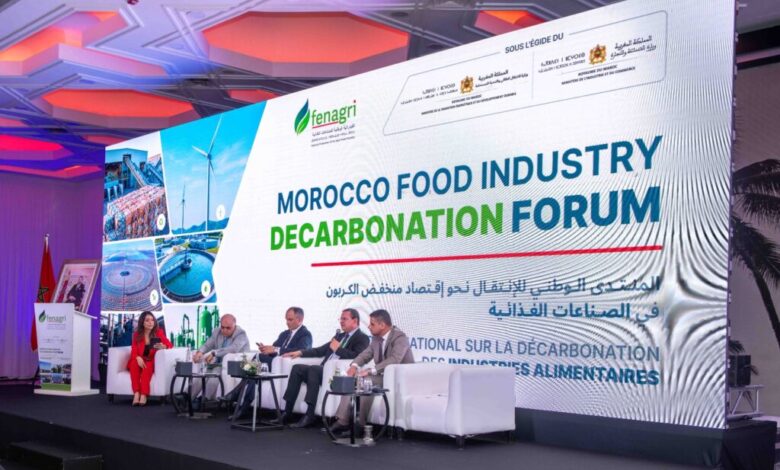
The transition to a low-carbon agri-food industry is emerging as a strategic priority in Morocco. During the National Forum on the Decarbonization of Food Industries held in Rabat, key public and private stakeholders underscored the urgency of supporting the sector in light of energy, climate, and trade challenges, while also preparing a national roadmap aimed at 2040.
Decarbonization at the Heart of Agri-Food Industry Priorities
The National Federation of Agri-Food Industries (FENAGRI) organized the National Forum on the Decarbonization of Food Industries in Rabat, under the auspices of the Ministry of Industry and Trade as well as the Ministry of Energy Transition and Sustainable Development.
This event brought together representatives from public authorities, industrialists, financial institutions, experts, and technical partners to accelerate the ecological transition of the Moroccan agri-food sector.
The goal is to foster the emergence of a more competitive, resilient industry that meets the new environmental standards of international markets.
A Strategic Sector for the National Economy
The agri-food industry occupies a vital place in the economic fabric of the Kingdom.
The sector generates nearly 191 billion dirhams in annual revenue, encompasses around 2,600 companies spread across the country, and employs more than 206,000 people.
It also contributes 44 billion dirhams in exports and satisfies nearly 77% of the national demand for processed food products, confirming its crucial role in food security and industrial development in the country.
An Indispensable Energy Transition
In light of rising energy costs, pressure on water resources, and increasing international environmental standards, decarbonization is becoming an essential lever for preserving the competitiveness of Moroccan companies.
The sector consumes nearly 380,000 tons of oil equivalent annually, accounting for about 20% of the national industry’s energy consumption.
This situation reinforces the need for a gradual transition towards less energy-intensive and more environmentally friendly industrial processes.
A National Roadmap in Preparation
In this context, FENAGRI, with the support of the Ministry of Industry and Trade, has launched a national study aimed at developing a decarbonization roadmap for food industries by 2040.
This study will identify key sources of greenhouse gas emissions, assess available technological solutions, define various transition scenarios, and propose the conditions necessary for their implementation.
The ambition is to sustainably support companies in the sector towards a model of production that is more carbon-efficient, while simultaneously enhancing their competitiveness in both national and international markets.