Morocco Plans to Connect the Sebou and Oum Er-Rbia Basins to Transfer 800 Million Cubic Meters of Water Annually
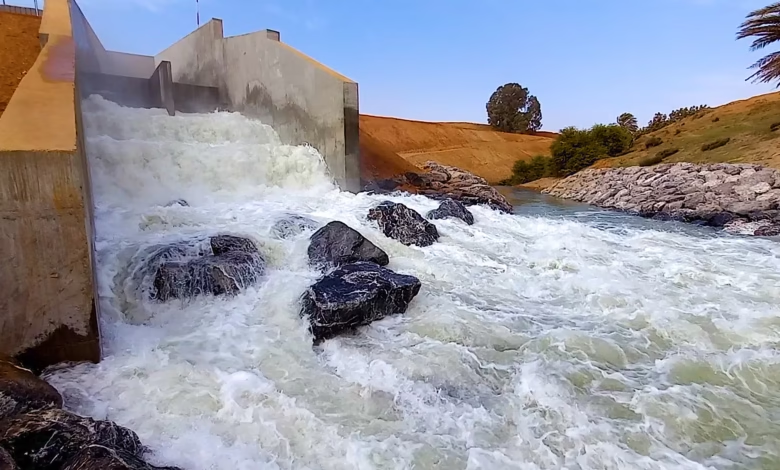
Morocco is preparing to enhance its hydraulic basin interconnection network with a new project aimed at transferring a portion of the resources from the Sebou Basin to the Oum Er-Rbia Basin. This initiative is part of the Kingdom’s efforts to address the increasing pressure on water resources and bolster the country’s water security.
The project is expected to span nearly 300 kilometers and have a transfer capacity of approximately 800 million cubic meters of water per year. It is one of the key projects aimed at improving the distribution of water resources among regions with varying levels of availability.
This infrastructure falls under the National Drinking Water and Irrigation Supply Program, which involves investments exceeding 130 billion dirhams. The program specifically aims to strengthen hydraulic infrastructures and diversify sources for water mobilization and transfer, amid several years of drought and the impacts of climate change.
Supporting Drinking Water and Agriculture
The new interconnection is expected to enhance water supply for several urban centers, including Settat, Berrechid, and the southern areas of Casablanca. It should also increase the available resources for irrigation in the Oum Er-Rbia Basin.
According to available data, the project could help secure irrigation water for approximately 176,000 hectares of agricultural land, thereby strengthening the stability of resources allocated to the agricultural sector in the beneficiary areas.
This project represents a new phase in the national strategy for hydraulic basin interconnection, following the commissioning of the first phase of the “water highway”, launched in August 2023, which facilitates the transfer of surplus resources from the Sebou Basin to the Bouregreg Basin.
This initial link extends about 66.7 kilometers and has allowed the transfer of nearly 484 million cubic meters of water to the Bouregreg Basin since its commissioning. As a result, it has contributed to enhancing the drinking water supply for Rabat, Casablanca, and surrounding areas.
Aiming for a Capacity of 1.2 Billion Cubic Meters Per Year
The project is not expected to stop at the connection between the Sebou and the Oum Er-Rbia. Future extensions could enable the network to reach the Al Massira Dam, with the goal of progressively increasing the overall transfer capacity to about 1.2 billion cubic meters per year once all components are completed.
This development reflects Morocco’s commitment to building a more interconnected hydraulic network, capable of transferring available resources from regions with relative abundance to areas facing significant water deficits.
A Response to Water Stress
The “water highway” is part of an approach that relies on public-private partnerships for the construction of large hydraulic infrastructures, as part of a national strategy aimed at improving the distribution of water resources across the territory.
Through these projects, Morocco seeks to strengthen the resilience of its water system in the face of successive drought periods and changing precipitation patterns.
The goal is also to address the continually rising demand for water, driven by population and urban growth, as well as the development of economic and agricultural activities.
In the long term, the gradual interconnection of the basins is expected to enable the Kingdom to move from a management style based on separate hydraulic systems to an integrated approach that allows for mobilizing, transferring, and directing resources according to the needs of various regions and sectors.
This strategy is thus one of Morocco’s main levers to sustainably enhance its water security in the face of climate challenges and increasing pressure on water resources.