
Aerospace: Morocco Aims for $5 Billion in Exports
Morocco’s Aerospace Sector Aims for New Heights
The Moroccan aerospace industry aspires to reach a new milestone in the coming years. The Moroccan Aerospace and Space Industries Group (GIMAS) is targeting annual exports of approximately $5 billion—around 46 billion dirhams—within three years, up from about $3 billion (roughly 28 billion dirhams) last year.
This ambitious goal was announced by GIMAS President Mohammed Bellatig in a statement to Reuters on Thursday, October 8, during the Marrakech Airshow.
Suppliers with Higher Value Addition
According to Mohammed Bellatig, this growth is expected to be driven by the arrival of new suppliers specializing in high-value parts and components.
Currently, the Moroccan aerospace sector boasts around 160 companies and employs nearly 25,000 workers. It includes subcontractors for major international groups such as Airbus, Boeing, and Safran.
The industry now faces the challenge of taking a significant step forward in industrial integration. The focus is shifting from merely producing isolated components to gradually developing more complex aerospace systems that add greater value locally.
Moving Towards Engine and Landing Gear Assembly
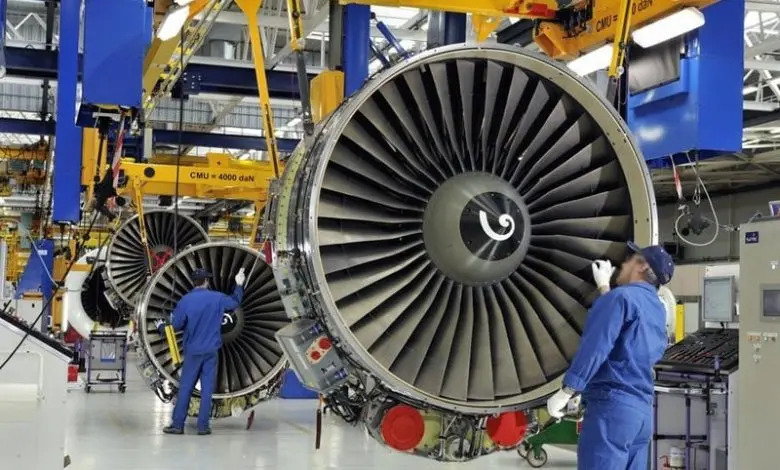
Morocco is set to position itself soon in the assembly of engines and landing gears, two activities that underscore the upgrade the national aerospace industry is pursuing.
“Delivering a significantly higher added value than that of today” is, according to GIMAS President Bellatig, one of the key objectives of this evolution.
This transformation is supported by investments already made by major international contractors in the Nouaceur area, near Casablanca, which is home to a significant part of the Moroccan aerospace ecosystem.
Safran Strengthens Its Presence in Nouaceur
French group Safran is one of the key players in this new industrial phase.
The group is establishing a factory in Nouaceur dedicated to landing gears, driven by its subsidiary Safran Landing Systems. Announced on February 13 before King Mohammed VI, the project represents an investment of over €280 million, or about 3 billion dirhams.
The site is set to produce landing gears for short and medium-haul aircraft, with operations expected to start in 2029, eventually creating nearly 500 jobs.
This establishment aligns with Safran’s strategy of developing operations in Morocco related to particularly critical aerospace systems.
Assembly Line for LEAP Engines
A few months prior, on October 13, 2025, King Mohammed VI inaugurated the construction site for a facility dedicated to LEAP engines from CFM International, a joint venture between Safran Aircraft Engines and American GE Aerospace.
The investment devoted to the assembly line is around €200 million, approximately 2.1 billion dirhams. The facility aims to produce up to 350 LEAP-1A engines per year, primarily for the Airbus A320neo.
A workshop dedicated to the maintenance of these engines will complement the industrial setup.
Having been present in Morocco for over 25 years, Safran employs more than 5,500 people across ten sites, underscoring the group’s significance in the national aerospace ecosystem.
Morocco Expands Ambitions to Drones
The upgrade in Morocco’s aerospace industry also encompasses the drone sector.
During the eighth edition of the Marrakech Airshow, held from October 7 to 10 at the Royal Moroccan Air Force base, Morocco signed a memorandum of understanding with the young French defense company Harmattan AI for the production of autonomous drones within the Kingdom.
According to Reuters, these drones are intended for deep strike missions and could reportedly have a maximum range of 2,000 kilometers. The project also includes provisions for several key technologies to be designed and produced locally.
Founded in Paris in April 2024 by Mouad M’Ghari and Martin de Gourcuff, Harmattan AI raised $200 million, approximately 1.85 billion dirhams, in a funding round led by Dassault Aviation. The company, valued at around $1.4 billion, has become the first French defense firm to reach unicorn status. In 2025, it notably won a contract from the French Directorate General of Armaments for 1,000 drones for the Army, followed by a deal for 3,000 units with the British Ministry of Defence.
Baykar and the Emergence of a Moroccan Drone Ecosystem
For Moroccan authorities, drone development can leverage the skills gradually acquired in the aerospace industry, particularly in materials, assembly, and engineering.
Several drone projects, initiated by either Moroccan stakeholders or foreign investors, have received approvals in recent years.
Turkish manufacturer Baykar, known for its Bayraktar TB2 drone, is among the companies driving this momentum. Its Moroccan subsidiary, Atlas Defence, is developing a facility in Benslimane, between Casablanca and Rabat, dedicated to the manufacture and maintenance of drones, in line with an agreement signed in December 2024.
The Royal Armed Forces acquired their first Bayraktar TB2s in 2021.
A New Phase for Morocco’s Aerospace Industry
The goal of $5 billion in annual exports reflects Morocco’s ambition to continue transforming its aerospace industry.
The anticipated growth hinges on the arrival of new suppliers, the integration of more complex production chains, and the development of higher value-added activities.
From the assembly of engines and landing gears to the production of aerospace systems and the growth of the drone sector, Morocco aims to gradually broaden its positioning within the global value chain.
If this trajectory continues, the challenge will no longer be solely to produce more but to create more complex equipment and capture a larger share of the value generated by the aerospace industry.