Water Security in Dakhla: SRM-DO Focuses on Resource Diversification and Treatment System Development
Enhancing Water Security in Dakhla-Oued Eddahab: A Multi-Faceted Approach
Faced with the limited availability of conventional water resources and the acceleration of climate change, the Dakhla-Oued Eddahab region is focusing on strengthening its water security by diversifying supply sources and developing non-conventional water resources. In this context, the Dakhla-Oued Eddahab Multi-Service Regional Company is actively working on the development of monitoring and management systems, as well as supporting desalination and water treatment projects, to ensure a continuous supply of drinking water and increase the region’s capacity to meet future needs.
Water is one of the primary determinants of sustainable development, especially in areas where natural and climatic conditions limit the availability of conventional water resources. In Dakhla-Oued Eddahab, this issue is particularly critical given the ongoing urban and demographic growth, as well as the economic dynamics in the region, which continue to escalate water-related demands.
In this context, the Dakhla-Oued Eddahab Multi-Service Regional Company is implementing a series of projects aimed at improving water system management through enhanced monitoring mechanisms, improved network efficiency, diversification of supply sources, and an increased reliance on non-conventional water resources.
From Network Monitoring to Preventive Intervention
Securing water supply does not solely rely on the availability of resources; it also depends on the capacity to monitor networks and manage their various components.
In this regard, the company has introduced a project aimed at establishing a remote monitoring core for drinking water and wastewater networks, designed to enhance ongoing surveillance and improve the speed and efficiency of technical interventions.
The system will include 19 continuous monitoring devices connected to a remote management center, enabling the monitoring of flows and pressures within the network while enhancing the control of water quality delivered to consumers.
The company’s reservoirs will also be equipped with continuous monitoring devices to provide precise data on the network’s status and various indicators related to supply.
This approach extends to pumping stations as well, which will be outfitted with gas detection and monitoring devices to improve safety conditions within these facilities and protect the employees working there. Water level monitoring systems will also be implemented at the pumping stations.
The benefits of these devices are not limited to technical monitoring. They will also create an exploitable database to anticipate interventions, reduce response times of technical teams, and direct operations more precisely to the sites that require them most.
Thus, network management is evolving from a reactive approach, responding only after an anomaly arises, to a proactive strategy based on continuous monitoring and predicting failures before they disrupt service continuity.
Conventional Resources Alone Are Not Enough
However, even with improved network performance, it is not sufficient to address the fundamental challenge of water availability.
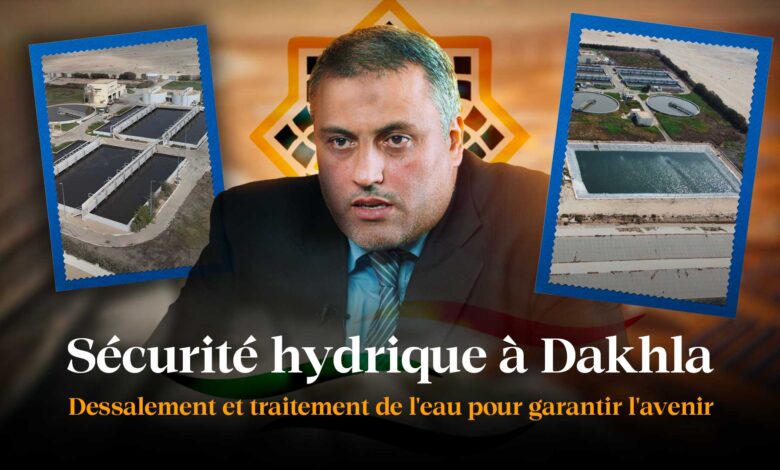
According to data presented by the company’s investment director, Khalid Mimich, the available water resources in the region, in their raw state, do not meet the sanitary standards required for human consumption. The use of non-conventional water resources thus becomes an essential element of the secure supply strategy.
Desalination of seawater is among the primary solutions being implemented. It enables the utilization of a resource that is consistently available along the coast, transforming it into usable water following the necessary treatment stages.
These projects align with the national objective of strengthening water security and diversifying water supply sources, particularly in a context marked by climate change and the increasing pressure on conventional resources.
Six Desalination and Treatment Stations in the Region
The Dakhla-Oued Eddahab region benefits from six desalination and water treatment stations spread across the different territories, reflecting the scale of investments dedicated to non-conventional water resources.
The system includes:
- A station in the city of Dakhla, already operational.
- Two stations in the Aousserd province, put into service during the last Aïd Al-Adha.
- A station in Mhiriz center, currently being commissioned.
- A station in El Argoub center, presently under construction.
- A station in Bir Gandouz center.
These infrastructures are part of a strategy intended to reduce dependence on conventional resources and enhance the region’s ability to secure its drinking water supply, especially in areas where natural and climatic conditions necessitate alternative solutions for resource mobilization.
These projects are also crucial given the extensive area of the regional territory and the distribution of its urban and rural centers. Ensuring water service security, therefore, involves developing infrastructures capable of meeting the needs of each territory according to its specific characteristics.
Treatment: An Essential Link in the Water System
Investments are not limited to desalination. Wastewater treatment represents another key component of the region’s water resource management system.
The wastewater treatment plant in Dakhla is notably one of the projects with significant environmental and strategic dimensions. It contributes to treating wastewater and enhances its quality before discharge, while also providing opportunities for reusing treated water.
The facility relies on activated sludge technology, with a current capacity of approximately 10,000 cubic meters per day.
Of this volume, about 5,000 cubic meters per day undergo tertiary treatment, producing treated water that meets quality standards compatible with uses that do not require potable water.
As part of enhancing this infrastructure, the Dakhla-Oued Eddahab Multi-Service Regional Company is implementing a rehabilitation project for the station and enhancing its tertiary treatment capacity.
This project aims to double the tertiary treatment capacity, enabling the production of approximately 10,000 cubic meters per day of treated water intended for reuse.
Treated Water: An Additional Resource for the Region
The reuse of treated water is a major element of the new approach to water security. It allows for valuing a resource that was previously primarily directed toward discharge, transforming it into a mobilizable resource for appropriate uses.
The targeted volume, estimated at about 10,000 cubic meters per day, will notably be allocated for the irrigation of green spaces, thus helping to alleviate pressure on conventional water resources and preserve groundwater.
This strategy also ensures that potable water is reserved for uses that genuinely require its quality, rather than being expended on activities that could be serviced by treated water.
From an environmental standpoint, the treatment process enhances water quality before it is discharged into the marine environment and minimizes potential impacts associated with wastewater, in accordance with principles of environmental protection and sustainable development.
An Integrated Approach to Water Security
All of these projects demonstrate that the approach to water security in the Dakhla-Oued Eddahab region no longer relies on a single solution but encompasses a system made up of several complementary levers.
From rehabilitating distribution networks and reducing water losses, to remote management and monitoring of flows and pressures, including desalination of seawater and wastewater treatment, these various initiatives converge towards one common goal: to strengthen the region’s capacity to secure its water resources while improving their utilization efficiency.
In this dynamic, the Dakhla-Oued Eddahab Multi-Service Regional Company plays a central role in implementing these projects through investments in infrastructures, the development of management and control tools, as well as facilitating the transition to non-conventional water resources.
This approach aligns with national orientations regarding water, which focus on diversifying supply sources, developing non-conventional water resources, improving water management governance, and reinforcing infrastructures to ensure the sustainability of services.
From Resource Mobilization to Water Cycle Management
The significance of this approach lies in its recognition of water as an integrated system, commencing at the source and continuing beyond the point of use.
Desalination enables the mobilization of a new resource, the rehabilitation of networks helps to reduce losses, monitoring systems facilitate more precise management, while the treatment and reuse of wastewater create pathways for recovering part of the resource and reintegrating it into the usage cycle.
For the Dakhla-Oued Eddahab region, grappling with challenges related to the limited availability of conventional water resources, the combination of these solutions represents one of the key levers to address rising demand and ensure the continuity of supply.
In this dynamic, investments in the water sector are no longer seen as isolated projects but as interconnected systems aimed at protecting resources, diversifying their sources, improving usage efficiency, and ensuring sustainability.
The challenge now is for the region to transition from a view of water management as a limited resource to an approach based on an integrated water cycle, utilizing technology, desalination, treatment, monitoring, and reuse to serve water security and sustainable development.