
Sulfur: Morocco at the Heart of Global Supply Chains
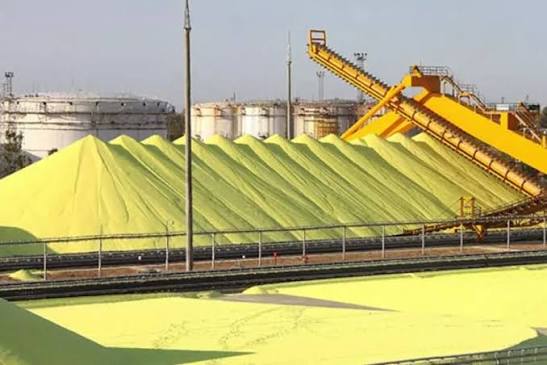
Morocco plays a significant role in the global sulfur market, both as a substantial consumer and a major destination for international exports. According to a presentation published in October 2026 by the Canadian energy group Cavvy Energy, sulfur exports from Kazakhstan to Morocco account for 7% of global trade, while shipments from the United Arab Emirates represent 6%.
These two trade routes together make up 13% of global sulfur commerce, positioning Morocco as one of the key international flows for this raw material.
Morocco accounts for 10% of global demand
The Kingdom ranks second worldwide in sulfur consumption, with an estimated share of 10% of global demand. China leads with 28%, followed by the United States at 9%.
This high level of consumption is closely linked to the magnitude of Morocco’s phosphate and fertilizer industry. The processing of phosphates requires significant quantities of sulfuric acid, the production of which is one of the main outlets for sulfur.
It is important to differentiate between these two indicators: the 10% attributed to Morocco relates to its share in global consumption, while the 13% corresponding to flows from Kazakhstan and the UAE to Morocco measures their weight in international trade.
The fertilizer industry at the heart of demand
Sulfur is a key raw material for the production of sulfuric acid, which is used in various industrial processes. Within the phosphate sector, this acid is particularly involved in transforming ore into phosphoric acid, which is then used to produce different fertilizers.
Its use is not limited to the phosphate industry; sulfur also plays a role in the extraction and processing of various ores. Globally, agriculture and the mining industry together account for over 80% of sulfur consumption, making this market particularly sensitive to the needs of agriculture and extractive activities.
For Morocco, the dynamics of the phosphate and fertilizer market are thus a determining factor in the national demand for sulfur.
Moroccan supplies dominate key corridors
The data presented by Cavvy Energy places the two main trade routes to Morocco at the top of global sulfur exchanges.
Exports from the UAE to China represent 4% of global trade, on par with flows from Kuwait to China and Canada to the United States. Shipments from Saudi Arabia to Indonesia account for 3%.
With 7% for Kazakhstan and 6% for the UAE, the two corridors to Morocco thus exhibit shares higher than those of other significant trade links highlighted in the presentation.
The Gulf remains a major center of global supply
The structure of global production partly explains this concentration of flows. The UAE accounts for approximately 10% of global sulfur supply, equal to that of the United States. They are preceded by China, with 16%, and Saudi Arabia, with 11%.
Russia, Kazakhstan, and Canada each represent 6% of global production, while Qatar accounts for about 5%.
This distribution gives the Middle East a central role in international supply, considering the weight of Gulf producers and their role in sulfur exchanges.
For Moroccan industry, this geographical concentration serves as both a major source of supply and a factor of exposure to potential disruptions in production or transport.
Geopolitical tensions may alter trade flows
Tensions in certain production areas and risks affecting trade routes could also contribute to a reorganization of international flows.
In this scenario, North American producers might benefit from redirected demand toward sources considered less exposed to geopolitical risks. Canada, in particular, has significant capacity for recovering sulfur from natural gas and oil processing.
Such a situation could enhance the role of Canadian suppliers in certain markets, should buyers seek to diversify their sources of supply.
Sulfur price surpasses $1,000 per ton
This shift in flows occurs at a time when the sulfur market is experiencing a sharp rise in prices. According to data presented by Cavvy Energy, the quoted price now exceeds $1,000 per ton, while the historical average is around $166.
Such an increase mechanically raises the costs for industries that utilize large quantities of sulfuric acid, particularly those related to phosphate processing and fertilizer production.
Conversely, this rise improves the revenue prospects for sulfur producers, whose results are more closely tied to fluctuations in international prices for this raw material.
A contract for 200,000 tons in 2027
In this context, an agreement reached in July 2026 provides for the sale in 2027 of 200,000 tons of sulfur at a fixed price of $525 per ton, before deducting transportation and handling costs.
This volume represents approximately 548 tons per day. Additional production will remain subject to market prices starting from Vancouver.
For 2026, the contractual structure varies. A third of the volumes is priced at a fixed rate of $225 per ton, another third is covered by a price ranging between $205 and $250, while the final third is sold at market conditions.
The identity of the buyers involved in the 2027 agreement, as well as the specific destinations for the contracted volumes, have not been disclosed. Thus, this information does not currently allow for attributing these 200,000 tons to the Moroccan market.