IMC 2026: Morocco Hosts Debate on the Future of Minerals and Industry in Africa
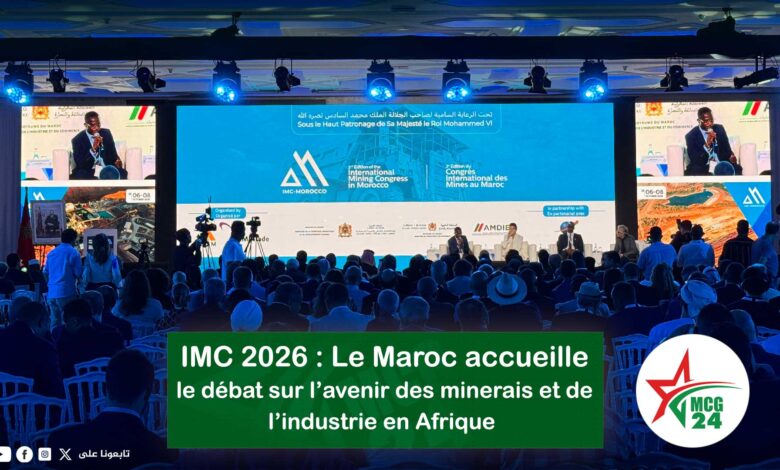
The third edition of the International Mining Conference Morocco (IMC 2026) commenced on Tuesday, October 6, in Rabat. The event gathered public officials, mining operators, investors, and experts from Morocco, Africa, and beyond to discuss the future of critical and strategic minerals and their role in the industrial development of the continent.
Running until October 8 under the theme “Towards a New Industrial Era: Africa as an Integrated Hub for the Transformation of Critical and Strategic Minerals,” this edition takes place against the backdrop of the increasing significance of mining resources for energy transition, new technologies, and the transformation of global supply chains.
The conference emphasizes the need to move beyond a narrow focus on resource extraction to foster greater local processing, added value, and integrated industrial chains in Africa.
### Morocco Highlights Its Reforms in the Mining Sector
Addressing the gathering, Leïla Benali, Morocco’s Minister of Energy Transition and Sustainable Development, underscored that IMC 2026 presents an opportunity to revisit the reforms undertaken in recent years within Morocco’s mining and mineral sectors.
The minister recalled the momentum initiated since the adoption of the “Marrakech Declaration” during the previous edition of the forum. This initiative has, according to her, allowed Morocco to strengthen its exchanges with over 40 African countries in the mining domain and to work on a framework aimed at boosting investments in the sector and related industries.
Leïla Benali particularly highlighted the example of Jerada, a former mining town known for coal extraction, which now faces various social and economic challenges. She noted that several coal cooperatives have evolved into structured companies operating in the sector, an experience that Morocco aims to present to its African partners and the international community as one of the outcomes of the reforms implemented over the past five years.
Moreover, the minister acknowledged the impact of these transformations in various regions, particularly in Jerada and Drâa-Tafilalet, while emphasizing Morocco’s commitment to strengthening partnerships at both the African and international levels.
### Industry Professionals Focus on Transformation
This momentum is also supported by representatives from Morocco’s mining industry. Abderrazak Gmira, Vice President of the Federation of Mineral Industry (FDIM), participated in discussions regarding the sector’s prospects and the challenges associated with its evolution in both the African and international contexts.
His involvement reflects the commitment of industry stakeholders to discussions centered on the sector’s development, resource transformation, and strengthening investment and cooperation prospects.
Throughout the various exchanges at the forum, sector actors underscored the importance of an approach that links mining operations more closely with related industrial activities, aiming to enhance the locally created added value.
### Betting on Local Value Addition in Africa
For his part, Mehdi Tazi, representing the General Confederation of Enterprises of Morocco (CGEM), stressed the international context in which this third edition of the forum is being held.
He noted that strategic minerals are increasingly central to global economic and industrial challenges, reminding attendees that approximately 30% of these minerals are found in Africa, making their valorization a key issue for the continent.
The goal, he explained, is not only to increase local production but also to further develop added value at the African level, rather than limiting resource exploitation to extraction and exportation.
According to Mehdi Tazi, this approach should also create more jobs on the continent and develop value chains related to mining resources. He believes that Morocco has a significant role to play, given its infrastructure and experience in the sector. These assets could, according to him, contribute to developing partnerships with African countries to advance the sector based on balanced cooperation.
### Senegal and Gabon Emphasize the African Stakes
The 2026 edition of the IMC also attracts several African officials, including Sosthène Nguema Nguema, Gabon’s Minister of Mines and Geologic Resources, and Cheikhou Oumar Seck, Senegal’s Minister of Mines and Geology.
In their official addresses, both officials highlighted the importance of mining resources and the role that Africa is poised to play in their development and enhancement.
Their participation illustrates the continental dimension of the Rabat meeting, particularly as African countries seek to reinforce their capacity to valorize their resources and develop additional mining-related activities.
Beyond resource extraction, discussions at IMC 2026 also focus on ways to develop integrated value chains, attract investments in processing and refining, and bolster the continent’s technological and human capacities.
### From Extraction to Transformation
The transition from a model centered on mineral extraction to one increasingly focused on their transformation is one of the main themes of this edition.
The IMC 2026 agenda specifically addresses exploration and mining technologies, processing and refining, project financing, legal and fiscal frameworks, as well as environmental challenges and skills development.
Several major players in the industry are participating in this edition, including the OCP Group, Managem, the Mining Company of Touissit (CMT), Aya Gold & Silver, and the National Office of Hydrocarbons and Mines (ONHYM), alongside specialized companies, institutions, experts, and investors.
The forum also includes professional networking and bilateral meetings among various sector stakeholders.
This third edition follows the “Marrakech Declaration” adopted in 2025, which notably emphasized environmental and social criteria as well as governance within the mining sector.
In Rabat, discussions now place local transformation, value creation, and African partnerships at the forefront of the issues relating to critical and strategic minerals, as the continent strives to better valorize its resources and strengthen its position in new global industrial chains.