The President of FDIM: Africa Must Create More Value from Its Mineral Resources
The Third Edition of the International Mining Congress (IMC Morocco 2026): A Call for Integrated Industrial Value Chains in Africa
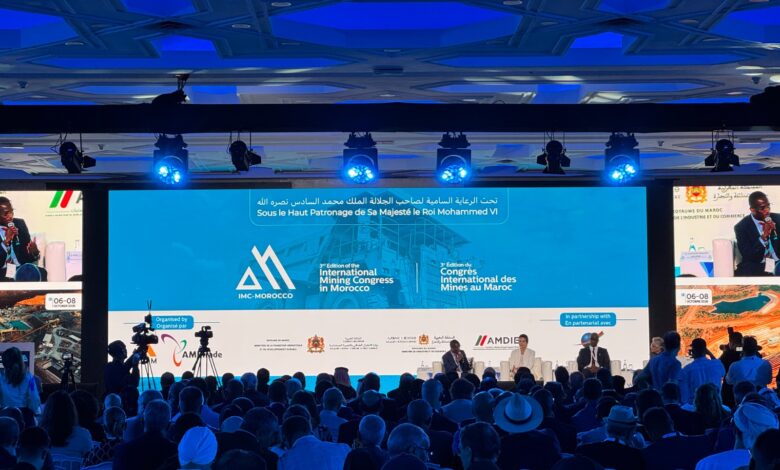
The third edition of the International Mining Congress (IMC Morocco 2026) opened in Rabat with a call to enhance the local transformation of Africa’s mining resources and develop more integrated industrial value chains across the continent. In his opening speech, the president of the Moroccan Federation of Mineral Industry (FDIM), Mohammed Cherrat, emphasized the unique significance of this edition, which is organized for the first time under the High Patronage of His Majesty King Mohammed VI, may God assist him.
President Cherrat expressed his deep gratitude to the Sovereign for this esteemed distinction, which he believes honors the Congress and commits its organizers to contribute to the Kingdom’s industrial ambitions as well as the development of the African mining sector. He also praised the King’s high solicitude toward Morocco’s economic, industrial, and sustainable development.
The speech highlighted the presence of ministerial delegations, representatives from the diplomatic corps, public and private institutions, industrialists, investors, experts, and various partners of the Congress. Special attention was paid to the delegation from the Gabonese Republic, the honorary guest of this edition. According to President Cherrat, this presence illustrates IMC Morocco’s African vocation and the desire to bring together resource-producing countries, industrial actors, investors, and holders of technologies and skills.
The stated ambition is to foster partnerships based on the complementarities of African economies, sharing expertise, and developing industrial capabilities on the continent. President Cherrat reminded attendees that critical and strategic minerals are increasingly central to transformations in the global economy, particularly due to the impact of energy transitions, new mobility solutions, digital development, and technological advancements.
He asserted a new reality: the world will require more mineral resources, while Africa possesses a considerable mineral heritage. The challenge is therefore no longer just to identify the resources available on the continent but to determine how to better value them, develop industrial capabilities, and create more value in Africa.
This focus is at the heart of the theme for this third edition: "Towards a New Industrial Era: Africa, an Integrated Hub for the Transformation of Critical and Strategic Minerals." According to the president of the FDIM, the future of the African mining industry cannot be limited to extraction alone; it also encompasses exploration, processing, refining, energy, infrastructure, technologies, skills, financing, subcontracting, and innovation—all essential components for building more comprehensive industrial ecosystems.
The goal is to ensure that a larger share of resources extracted in Africa is also transformed and valued on the continent to generate investments, skilled jobs, expertise, and companies capable of sustainably integrating into global value chains.
Gabon’s presence as the guest of honor fits perfectly within this reflection, offering an opportunity to highlight issues related to resource valorization, industrial development, and value creation in Africa. Moreover, President Cherrat emphasized the complementarities between Morocco and its African partners, particularly regarding investment, skill sharing, and the construction of better-integrated industrial chains.
He noted that no single country possesses all the resources, technologies, financing, infrastructures, and skills required for the industries of tomorrow. Therefore, cooperation is vital to realize projects that serve the interests of African economies and populations. "Our objective is not for each country to do everything alone. It is for our countries to achieve more together," he summarized.
In this dynamic, Morocco boasts several advantages, including a rich mining history, recognized expertise, leading operators, developed infrastructure, and a diversified industrial base. Its geographical position also allows it to facilitate exchanges between Africa, Europe, and international markets.
The speech further recalled that, according to the 2025 edition of the Fraser Institute’s Mining Investment Attractiveness Index, Morocco ranked 15th globally. This result underscores the importance of continuing efforts to enhance the sector’s attractiveness, encourage investment, and develop local transformation.
Morocco, therefore, can help connect the continent’s resources with industrial capacities, technologies, capital, and markets, complementing the economies of other African nations. It is in this context that IMC Morocco was launched in 2024, with the ambition of establishing an international meeting point in Morocco that could bring together the mining ecosystem, bridge public and private decision-makers, and facilitate exchanges of ideas, projects, and opportunities.
Since its inaugural edition, the Congress has gradually broadened its scope. In 2024, it welcomed over 800 participants, 48 exhibitors, and representatives from 30 countries. In 2025, it gathered over 1,000 participants, 74 exhibitors, and representatives from 40 countries. Beyond these figures, this evolution reflects, according to the FDIM, the growing mobilization of institutions, companies, and both African and international partners.
The previous edition was also marked by the adoption of the Marrakech Declaration, which focused on environmental, social, and governance principles applicable to the mining sector. This declaration notably emphasized the importance of building, in Africa and with African stakeholders, tailored responses to the continent’s challenges.
However, according to the president of the FDIM, the Congress should not merely be a forum for sharing ideas; it must also help to connect stakeholders and foster the emergence of projects. In this regard, the Mining Business Hub should facilitate meetings between project holders, companies, technology providers, investors, financial institutions, and development partners.
The development of an efficient mining industry relies on a complete ecosystem that integrates energy, infrastructure, skills, technology, suppliers, and financing, alongside a long-term vision. The president of the FDIM also highlighted the crucial role of women and men—the future of the industry’s workforce—especially in terms of training, skill development, and the integration of young talents into new value chains.
The reconfiguration of supply chains, the increasing demands for mineral resources, and technological transformations open up new perspectives while also creating new responsibilities for producing countries. For Africa, the challenge is to strengthen its capacity to explore, process, innovate, develop skills, attract investments, and generate more value within its borders.
The question is no longer simply about Africa’s place in global value chains, but about enhancing its presence where value is created. Such ambition demands sustained dialog between operators, public authorities, investors, technology and financial partners, and all actors in the ecosystem.
This is precisely the mission that the FDIM aims to fulfill through IMC Morocco: to create a dialogue space, bring stakeholders together, and contribute to transforming exchanges into partnerships and projects.
The president of the FDIM also acknowledged the commitment of various partners who contributed to organizing this third edition. He specifically thanked the Ministry of Energy Transition and Sustainable Development, the Ministry of Industry and Commerce, the Moroccan Agency for Investment and Export Development, and the General Confederation of Moroccan Enterprises for their support and collaboration.
His gratitude extended to institutional and media partners, members of the Federation of Mineral Industry, the scientific and organizing committees, speakers, and all teams mobilized to prepare this edition, as well as to partners and sponsors for their trust and contributions to the mining ecosystem’s development.
In conclusion, the president of the FDIM reminded attendees of the various stages of development for IMC Morocco: an ambition launched in 2024, international dimensions strengthened in 2025, and in 2026, a new milestone with the High Patronage of His Majesty King Mohammed VI, may God assist him, and the presence of Gabon as the guest of honor.
The goal is to make IMC Morocco a Congress that brings together, connects, and bridges actors while contributing to the emergence of partnerships, investments, and projects. The challenge now is to ensure that the continent’s resources translate into industrial capabilities, jobs, skills, expertise, and value generated in Africa. This ambition is presented as both industrial and economic and is expected to be collectively advanced by stakeholders in the sector.