Morocco-United Arab Emirates: Towards Payment Interconnection
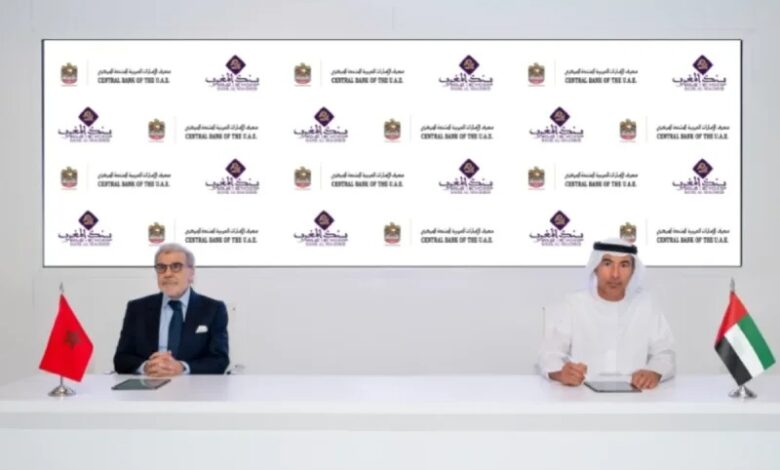
The Central Bank of the United Arab Emirates (CBUAE) and Bank Al-Maghrib are enhancing their cooperation in the financial sector. On Saturday, October 3, 2026, in Abu Dhabi, the two institutions signed two memorandums of understanding aimed at deepening their collaboration on cross-border payments, financial supervision, Islamic finance, and central bank digital currencies.
The signing took place at the CBUAE headquarters, conducted by its governor, Khaled Mohamed Balama, and the governor of Bank Al-Maghrib, Abdellatif Jouahri. The agreements particularly pave the way for a study on the interconnection of the payment infrastructures in both countries.
Cross-Border Payments at the Core of Cooperation
The first memorandum encompasses the examination of the potential interconnection of instant payment platforms, national card networks, and financial messaging systems between the two nations.
Such interconnection could eventually simplify the processing and settlement of transactions between Morocco and the United Arab Emirates. It may also allow for mutual acceptance of national cards, enabling users to make payments in the other country using their domestic cards, subject to technical and regulatory conditions that will be established.
However, the project remains in the study phase. No timeline for deployment, investment amounts, or pricing for potential interconnected transactions has been announced at this stage.
The objective is to facilitate financial exchanges between the two markets by bringing their payment infrastructures closer together and easing the processing of cross-border operations.
Digital Currencies on the Agenda
The cooperation also extends to central bank digital currencies (CBDCs), both for retail payments and wholesale transactions.
The two central banks plan to share their expertise and explore the various potential uses of these technologies in cross-border settlements. For Bank Al-Maghrib, these efforts aim to investigate ways to expedite transaction processing between the two countries.
This cooperation does not indicate that Morocco has decided to issue a central bank digital currency for the general public. The memorandum focuses on the exchange of expertise and the study of potential use cases.
Discussions will also cover various areas related to the digital transformation of finance, including financial technologies, the regulation of crypto assets, and stablecoins. Consumer protection is also among the planned areas of cooperation.
A Focus on Banking Supervision
The second focal point of the agreement concerns cooperation between financial supervisory authorities. It specifically includes the exchange of information regarding banks and financial institutions, as well as coordination on regulatory practices.
The two institutions also aim to enhance exchanges concerning compliance mechanisms related to Islamic finance and the relationships between entities responsible for such compliance.
This aspect seeks to foster a better mutual understanding of the regulatory frameworks and supervisory practices applied in both jurisdictions.
Islamic Finance for Trade and Infrastructure
Finally, the cooperation extends to cross-border Islamic financing, particularly in the realms of trade and infrastructure.
The challenge is to examine the conditions under which commercial operations or projects located within one jurisdiction can access financing compliant with Islamic finance principles from the other market.
However, no lines of credit, specific funds, or financial envelopes designated for any particular project were announced during the signing event.
Thus, these memoranda primarily establish a framework for cooperation between the two central banks. They open several pathways for work, from payment interconnection to new financial technologies, alongside banking supervision and Islamic finance.
For Morocco and the United Arab Emirates, this initiative could help bring their infrastructures and financial frameworks closer together, particularly as trade and investments between the two economies continue to grow, alongside increasing demands for cross-border payment solutions.