OCP: Two Sulfur Storage Halls Completed in Morocco
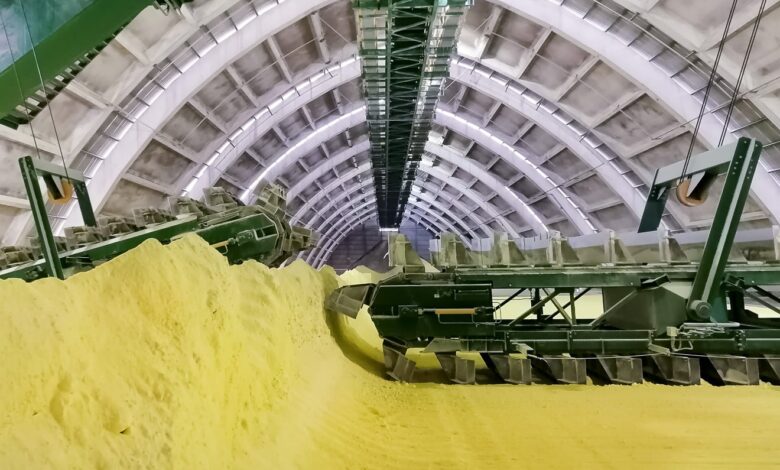
The OCP Group is strengthening its industrial infrastructure with the completion of two sulfur storage halls at its sites in Safi and Mzinda. Built by SOGEA Morocco and SOMALEV as part of the SP2M program, these facilities boast respective capacities of 20,000 and 100,000 tons.
Beyond their logistical function, these installations showcase the mobilization of Moroccan expertise in the realization of complex industrial projects. The two companies implemented construction and heavy-lifting techniques tailored to the specific constraints of the sites, employing fully Moroccan teams, according to the information provided.
These infrastructures are expected to enhance sulfur storage capacity, a crucial raw material for sulfuric acid production and, indirectly, for the manufacturing of phosphate fertilizers.
Two Complementary Capacities
The Mzinda hall, which can store up to 100,000 tons, stands out due to its dimensions and technical specifications. It features 22 vaults with an inner radius of 37 meters. In Safi, the second facility offers a storage capacity of 20,000 tons.
The two construction sites progressed simultaneously, requiring tight coordination among teams, equipment, and various assembly operations. The nature of the structures necessitated the use of high-capacity lifting equipment and installation processes that met technical demands and safety requirements.
The completion of these facilities marks a new milestone in the expansion of the OCP Group’s industrial logistical capabilities, which are primarily based on phosphate processing and fertilizer production.
Heavy Lifting Operations at Nearly 30 Meters High
The construction of the recently completed hall involved nearly 20,000 tons of high-quality precast concrete. According to data provided by the companies, teams achieved a production rate of approximately 1,800 tons of lifted and installed precast elements per week, with assembly operations performed at heights nearing 30 meters.
To carry out this work, operators utilized several specialized pieces of equipment, including Liebherr LR 1750/2 SX and Terex-Demag CC2800 crawler cranes, as well as a fleet of auxiliary machinery. Technical means specifically designed for the assembly process were also deployed to meet operational constraints.
The execution of these structures required meticulous planning and ongoing coordination between construction teams and lifting specialists.
SOGEA Morocco and SOMALEV Leverage Their Expertise
SOGEA Morocco acted as the engineering, procurement, and construction (EPC) company, while SOMALEV contributed its expertise in heavy lifting engineering.
The collaboration between the two companies focused on adapting execution methods, preparing operations, and installation procedures. The goal was to meet the technical requirements of the structures while adhering to timelines and enhancing the safety of interventions.
Simultaneously constructing both halls also required coordinated management of human and material resources, given the volume of elements to be installed and the complexity of the lifting operations.
Moroccan Expertise in Service of Industry
According to the companies, the operational design, planning, and execution of the works were carried out by fully Moroccan teams. This mobilization of national expertise highlights the role of local companies in the development of highly technical industrial infrastructures.
Leading such projects necessitates mastery of construction processes, heavy lifting operations, and quality and safety requirements. It also illustrates the importance of coordination among the various trades involved in large industrial construction sites.
For the OCP Group, the two halls enhance the storage capacity of a strategic raw material for its production chain. For the Moroccan industry, their completion reflects the involvement of national companies in executing complex structures for major industrial operators.