Bolivia-Morocco: Rabat and Dakhla at the Heart of a New Partnership
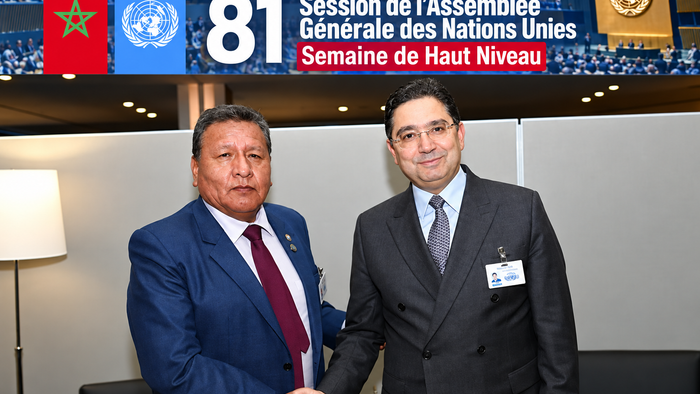
On Wednesday, September 23, Bolivia announced in New York its intention to establish a diplomatic representation in Rabat and a commercial office in Dakhla. This announcement, made official in a joint statement signed on the sidelines of the 81st session of the United Nations General Assembly, marks a new step in the rapprochement between the two countries.
The document was signed by Nasser Bourita, Morocco’s Minister of Foreign Affairs, African Cooperation, and Moroccans Living Abroad, and Héctor Francisco Huanca Gutiérrez, Bolivia’s Minister of Foreign Affairs, following their discussions in New York.
Bolivia Supports Morocco’s Autonomy Proposal
In their joint statement, the two countries reaffirm their commitment to respecting the sovereignty and territorial integrity of states, as well as the principle of non-interference in internal affairs.
Bolivia also acknowledged the autonomy proposal presented by Morocco in 2007. According to the text, this initiative “can constitute a pathway to advance negotiations towards a just, durable, and mutually acceptable political solution.”
This position comes in the context of strengthening diplomatic relations between Rabat and La Paz, while the issue of the Moroccan Sahara continues to hold a significant place in international discussions.
Dakhla, Future Gateway for Bolivian Products in Africa
The announcement of the establishment of a Bolivian commercial office in Dakhla represents one of the main economic components of the new agreement. The city is set to play an increasingly significant role in trade with Africa, particularly with the development of the future Dakhla Atlantic Port.
Under construction since 2021 on an area of 1,650 hectares, approximately 40 kilometers north of Dakhla, this project represents an investment of 12.5 billion dirhams. It is expected to handle around 2.2 million tons of goods and 950,000 tons of seafood during its first years of operation.
The completion of the works is scheduled for the end of 2028, with the port’s commissioning announced for 2029.
For Bolivia, a landlocked country since the Pacific War, this infrastructure could offer a new perspective for developing its trade with African markets.
Bolivian Urea at the Center of Trade Exchanges
Economic cooperation may particularly involve the fertilizer sector. Bolivia produces granulated urea through Yacimientos Petrolíferos Fiscales Bolivianos (YPFB), the state hydrocarbon company, at its ammonia and urea plant in Bulo Bulo.
Between January and July 2026, Bolivian urea exports reached 250,400 tons, valued at 102.7 million dollars, representing a 21% increase year-on-year.
In 2024, Bolivia exported 507,324 tons of urea, with 96% going to Brazil, Argentina, Paraguay, Peru, and Chile. The two countries also have different fertilizer production capabilities: Bolivia specializes in nitrogen fertilizers, while Morocco has a well-developed phosphate fertilizer industry. This complementarity could facilitate the exploration of new cooperation avenues.
Towards a Renewal of Political Dialogue
Rabat and La Paz have also decided to revive their bilateral political consultation mechanism, established in 1999, which had not convened for years.
Both parties committed to deepening their high-level political dialogue based on “political pragmatism, mutual respect, solidarity, and reciprocal interests.”
Two additional agreements were signed in New York. The first pertains to the elimination of visas for holders of diplomatic, official, service, and special passports. The second involves a memorandum of understanding between the diplomatic academies of the two countries.
Bolivia Ends Relations with the SADR
The rapprochement between Rabat and La Paz comes after a significant shift in Bolivia’s position on the Sahara issue.
On February 24, Bolivia announced the suspension of its diplomatic relations with the Sahrawi Arab Democratic Republic (SADR), as well as the cessation of official contacts with this entity.
This decision has paved the way for the resumption of relations with Morocco and the establishment of resident diplomatic missions in both capitals. Agriculture, food security, fertilizers, and security are among the sectors identified to strengthen bilateral cooperation.
This development also comes a few months after the adoption of United Nations Security Council Resolution 2797 on October 31, 2025.
A Rapprochement Beyond Diplomatic Framework
The government of President Rodrigo Paz, who took office in November 2025, has thus altered a diplomatic position that dated back to 1982. However, this decision has sparked internal criticism, notably from former President Evo Morales, who described it as unilateral and contrary to what he deems constitutional principles and Bolivia’s diplomatic tradition.
The announcements from La Paz come during a diplomatic sequence marked by several initiatives regarding Morocco during the current session of the UN General Assembly.
Chile, for instance, signed on September 21 terms of reference paving the way for negotiating a free trade agreement with Morocco and announced its intention to promote economic and trade cooperation in the Sahara region. Jamaica also expressed its support for the Moroccan autonomy proposal and acknowledged the adoption of Resolution 2797.
With the announced establishment of a diplomatic representation in Rabat and a commercial office in Dakhla, Bolivia aims to give a concrete economic dimension to its rapprochement with Morocco and explore new opportunities for access to African markets.