London: Abdellatif Mâzouz Highlights the Moroccan Approach to Water Security at the EBRD Green Cities Program Meeting
Moroccan Water Resource Management Highlighted at London Conference
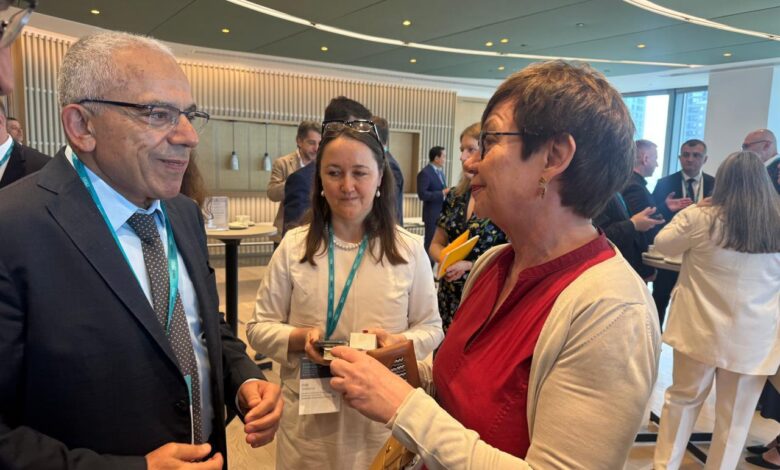
Abdellatif Mâzouz, the President of the Casablanca-Settat Regional Council, presented Morocco’s experience in sustainable water resource management during a meeting organized by the European Bank for Reconstruction and Development (EBRD) under the theme “Investing in Tomorrow: Building Green and Resilient Cities for All.”
Participating in a high-level panel dedicated to water, titled “From Systems Thinking to Investment: The Case for Water,” Mr. Mâzouz outlined the key points of the national strategy aimed at enhancing the Kingdom’s water security in the face of climate change effects and the increasing pressure on water resources.
Morocco Facing Structural Water Stress
Addressing an audience of local officials, international experts, and private sector stakeholders, Abdellatif Mâzouz reminded attendees that recent precipitation levels should not obscure the reality of structural water stress that has affected Morocco for several years.
He emphasized that for decades, the Kingdom has chosen to invest heavily in hydraulic infrastructure to ensure resilience against recurring drought episodes and irregular rainfall.
An Integrated Approach Based on Three Pillars
The President of the Casablanca-Settat Region highlighted the systemic approach adopted within the National Drinking Water Supply and Irrigation Program (PNAEPI 2020-2027), which is based on three major levers.
The first focuses on mobilizing and diversifying water resources, notably through dams and desalination plants. The second aims at valuing and reusing treated wastewater. Finally, the third pillar is centered on strengthening water solidarity between territories through the interconnection of hydraulic basins.
Casablanca-Settat Accelerates Water Investments
Addressing the situation in the Casablanca-Settat region, Abdellatif Mâzouz highlighted the importance of existing operational infrastructures, especially dams and the 28 monobloc stations distributed across the eight provinces of the region, which have enabled the production of nearly 2.5 million cubic meters of water.
He also emphasized the Jorf Lasfar desalination plant, which has been contributing to the drinking water supply for Southern Casablanca since late 2024, with a capacity of 60 million cubic meters annually, along with providing 30 million cubic meters annually for the city of El Jadida.
Future Casablanca Desalination Plant at the Center of Regional Strategy
Among the most ambitious projects is the future desalination plant in Casablanca. Once completed, it will have a production capacity of around 300 million cubic meters of water per year.
Of this volume, 250 million cubic meters will be allocated for the drinking water supply of nearly 7.5 million residents in Casablanca, Settat, Berrechid, and surrounding areas, while 50 million cubic meters will be dedicated to agricultural irrigation.
Reusing Treated Wastewater as a Strategic Resource
Abdellatif Mâzouz also stressed the growing importance of reusing treated wastewater within the Kingdom’s water policy.
The region currently has two large wastewater treatment plants supported by a network of 45 kilometers, allowing for the irrigation of green spaces in Casablanca, Médiouna, and several golf courses. A vast regional program to generalize this practice is underway, with an estimated investment of 1.6 billion dirhams.
Water Highway: A Symbol of National Water Solidarity
The President of the Casablanca-Settat Region finally highlighted the strategic role of projects interconnecting hydraulic basins, akin to the Water Highway linking the Sebou, Bouregreg, and Oum Er-Rbia basins.
This infrastructure illustrates Morocco’s commitment to enhancing water solidarity among regions to ensure a more balanced distribution of water resources nationwide.
A Sustainable Vision for Future Generations
In conclusion, Abdellatif Mâzouz reaffirmed that Morocco’s water security strategy hinges on a combination of investments in storage, seawater desalination, reuse of treated wastewater, and interconnection of hydraulic basins.
This integrated approach aims to sustainably enhance the resilience of territories, guarantee access to water for populations, and prepare the Kingdom for the climatic challenges of the coming decades.