Morocco-Italy: Trade Exchanges Reach Nearly 5 Billion Euros
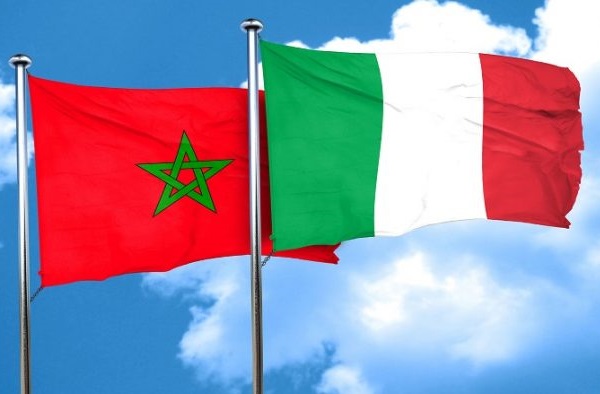
Economic relations between Morocco and Italy continue to progress, approaching a symbolic threshold. In 2025, the volume of trade between the two countries reached 4.752 billion euros, confirming the strengthening of bilateral economic ties.
According to data from the Economic Observatory of the Italian Ministry of Foreign Affairs and International Cooperation (MAECI), Italian exports to Morocco amounted to 2.995 billion euros in 2025. Morocco accounted for 14.8% of Italy’s goods exports to Africa.
Morocco: Italy’s Third Largest African Client
With nearly 3 billion euros in purchases of Italian products, Morocco has established itself as the third largest African client of Italy, following Tunisia and Algeria.
Thus, the Kingdom surpasses Egypt, Libya, and South Africa, confirming its growing importance in Italy’s trade strategy on the continent.
In the reverse direction, Moroccan exports to Italy reached 1.757 billion euros in 2025. Morocco represents 5.1% of Italy’s imports from Africa and ranks sixth among Africa’s suppliers to Italy.
This trade structure resulted in a trade surplus of 1.238 billion euros in favor of Italy.
Morocco Attracts Italian Companies
However, the economic relationship between Rabat and Rome is not limited to the trade of goods. Morocco is increasingly viewed by Italian companies as a high-potential market, as well as an industrial and logistical hub for access to other African markets.
This evolution promotes the development of partnerships in several sectors, including energy, transportation, infrastructure, logistics, and mechanical engineering.
The Italian ambassador to Morocco, Pasquale Salzano, particularly highlights the attractiveness of Morocco’s investment climate and the opportunities presented by these various sectors.
Italian Industrial Presence in Africa
The rapprochement between the two countries is part of a broader Italian strategy aimed at strengthening Rome’s economic presence in Africa.
As of the end of 2023, more than 1,600 Italian companies were established on the African continent, employing over 90,000 people and generating a cumulative turnover of 25.1 billion euros.
The stock of Italian direct investments in Africa reached 30.835 billion euros by the end of 2025.
In this context, Morocco benefits from its geographical position, infrastructure, and its increasingly important role as an industrial and commercial platform between Europe and Africa.
World Cup 2030 Could Accelerate Investments
Large projects related to preparations for the 2030 World Cup, which will be jointly organized by Morocco, Spain, and Portugal, could open a new phase in Moroccan-Italian economic relations.
The planned investments in infrastructure present opportunities for Italian companies with expertise in stadium construction and design, public transportation, urban mobility, logistics, and urban space regeneration.
For Italian companies, the stakes go beyond merely organizing a sporting event. Investments made by Morocco are also expected to contribute to the sustainable modernization of its infrastructure and to strengthen its economic positioning on the continent.
Strong Growth in Italy-Africa Trade
This bilateral dynamic coincides with an acceleration in trade between Italy and the entire African continent.
In the first half of 2026, trade between Italy and Africa grew by 10% year-on-year, reaching 30.391 billion euros.
Italian exports to the continent increased by 17% to 11.338 billion euros, while imports from Africa rose by 6.3% to 19.053 billion euros.
Within this African strategy, Morocco occupies an increasingly important place. With nearly 15% of Italian exports to Africa being absorbed by the Moroccan market in 2025, the Kingdom now stands as much more than just a trading partner.
Its industrial development, infrastructure, and openness to African markets gradually make it a key anchor point for Italian economic presence in Africa.