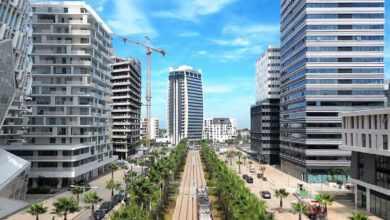
Real Estate: Actual Housing Prices Decline by 1% in Morocco
Real Estate Prices in Morocco Experience a 1% Decline
Residential real estate prices in Morocco recorded a 1% decrease year-on-year in the first quarter of 2026, according to the latest data from the Bank for International Settlements (BIS).
Published on Thursday, August 27, the study from the Basel-based institution reports an overall decline of 1.2% in real housing prices during the same period. Thus, Morocco is among the real estate markets that have contracted, in contrast to several major emerging economies such as Brazil, Mexico, and South Africa.
The BIS clarifies that its real price figures represent nominal prices adjusted for inflation using the consumer price index. Globally, nominal prices, on the other hand, have increased by 1.7% year-on-year.
Morocco Among Declining Countries
With a 1% decrease, Morocco occupies a middle position among the economies analyzed by the BIS.
Turkey experienced a real decline of 3%, while Brazil saw a growth of 5%, Mexico 4%, and South Africa 3%.
The decline observed in Morocco occurs within an international context marked by a worsening trend. Following a decrease of 0.5% in the previous quarter, global real housing prices fell by 1.2% year-on-year in the first quarter of 2026.
This progression marks the end of the nearly stable conditions noted during the second half of 2025.
Advanced Economies Also Begin to Decline
The downturn is no longer restricted to emerging markets. In advanced economies, real housing prices have also slightly decreased.
The BIS reports a decline of 0.2%, the first recorded in this group since the third quarter of 2024.
Conversely, emerging economies have intensified their decline, worsening from –1.2% in the previous quarter to –2% year-on-year.
This change is primarily linked to emerging Asia, where real prices have dropped by 4.3%. Latin America followed an opposite trajectory, with a growth of 5%, while other emerging economies recorded an increase of 3.2%.
Significant Disparities Between Different Markets
Behind the global index decline lies a wide disparity between countries.
According to the BIS, the median growth rate of real prices even increased from 2.3% to 2.6% year-on-year. Therefore, the decline in the global aggregate is mainly attributable to a few large economies that heavily influence the calculations.
The most notable increases were recorded in Portugal (+15%), North Macedonia (+13%), and Bulgaria (+11%).
In contrast, China and Canada reported the most significant declines, each with –7%. New Zealand experienced a 4% drop.
In the United States and the United Kingdom, real prices decreased by 2%.
Europe Demonstrates Better Resilience Than Other Regions
Overall, the European real estate market exhibits a better resilience.
In the Eurozone, real housing prices increased by 2.6%, while other European countries saw a rise of 0.8%.
Several markets stood out notably. Spain showed a 10% increase, followed by Italy with 4%.
France and Germany, however, each experienced a decline of 1%.
Outside of Europe, Australia distinguished itself with a 6% increase in real housing prices.
China Continues to Weigh on Asian Markets
China remains a significant factor behind the decline observed in emerging Asia.
Chinese real estate prices fell by 7% year-on-year in the first quarter of 2026, while Indonesia also saw a decrease of 3%.
Conversely, Thailand and the Philippines increased by 2%, while India recorded a rise of 1%.
The BIS notes that its regional aggregates are calculated from quarterly averages weighted by GDP and purchasing power parity exchange rates. This method inherently gives more weight to larger economies.
Global Prices Remain Slightly Higher Since the Pandemic
Over a longer period, however, the figures reflect a different situation.
Since the fourth quarter of 2019, just before the outbreak of the COVID-19 pandemic, global real housing prices have increased by only 2.7%.
Within the G20, Turkey stands out dramatically with a staggering 105% increase, followed by Australia (+23%), Mexico (+22%), and the United States (+18%).
In contrast, China has experienced a decline of 22% compared to its pre-pandemic levels. Canada is down by 9%, and Indonesia by 8%.
A 20% Increase Over Two Decades
Over the past twenty years, however, the trend appears much more favorable.
According to the BIS, global real residential property prices are now approximately 20% higher than those observed following the 2007-2009 global financial crisis.
Turkey has seen the most substantial growth during this period, with an increase of 117%, followed by India (+62%) and the United States (+56%).
Conversely, Italy has seen a 24% decline, while China is down by 15% compared to the levels recorded after the financial crisis.
For Morocco, the 1% decrease recorded in the first quarter of 2026 reflects a real decline but is part of an international environment characterized by highly contrasting developments across different markets.