Southern Provinces: Significant Investments to Strengthen Connections with Africa
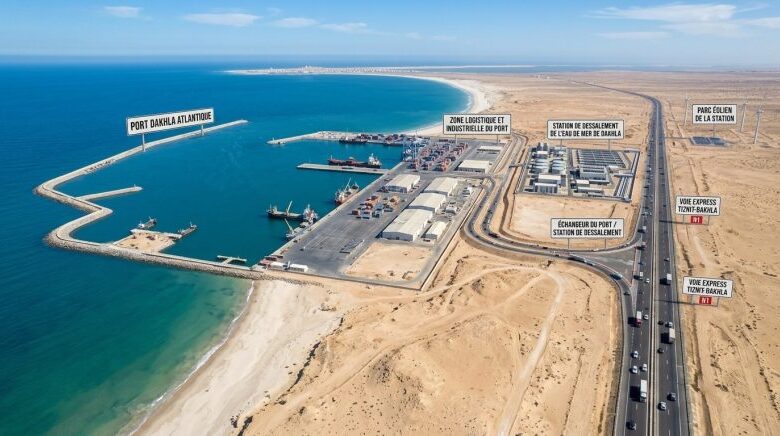
On the occasion of the 51st anniversary of the Green March, the southern provinces of Morocco are continuing their economic transformation through major projects focused on port infrastructure, water, energy, and logistics. From the future Dakhla Atlantic port to desalination facilities, these investments aim to enhance the attractiveness of these regions and position them as trade platforms with African markets.
### Dakhla Atlantic: A Port Project Worth 15.06 Billion Dirhams
Among the major projects is the Dakhla Atlantic port, with an updated cost of 15.06 billion dirhams, compared to an initial estimate of 13.61 billion dirhams. This revision incorporates notable expansion works for the project.
As of mid-September 2026, the physical progress of the construction was estimated at 70%, while financial execution reached 54%. According to the projected timeline, work is expected to be completed by the end of 2028, with operations anticipated to begin in 2029.
Beyond its port function, this infrastructure aims to strengthen the logistical capacities of Morocco’s Atlantic seaboard and promote the development of activities related to maritime transport, industrial services, and international trade. However, its impact will largely depend on its connection to transport networks and the gradual establishment of economic operators.
### €100 Million for Port Infrastructure Modernization
Investment dynamics also extend to other port infrastructures. On November 3, 2026, the National Ports Agency (ANP) and the French Development Agency (AFD) signed a joint declaration in Rabat regarding a third funding phase of their strategic partnership, amounting to €100 million.
Granted as a soft loan over a 13-year period, without state guarantees, this financing will support the ANP’s investment program for the period from 2023 to 2030.
The planned operations include the rehabilitation and modernization of port facilities, strengthening their resilience, developing renewable energy resources, desalination, and decarbonization efforts. Several ports in the southern provinces are involved in this program, specifically those in Tan-Tan, Tarfaya, Laâyoune, Boujdour, Dakhla, and Lamhiriz.
It should be noted that this funding is part of a broader port program and is not exclusively allocated to the six mentioned ports.
### Dakhla: 2.6 Billion Dirhams for Water and Agriculture
The mobilization of water resources represents another key axis of this transformation. In the municipality of Bir Anzarane, a project combining seawater desalination with agricultural development involves an investment of approximately 2.6 billion dirhams.
According to data provided during a ministerial visit on October 30, 2026, the desalination station had reached a progress rate of 97%, while the associated irrigation network achieved 99%. The 60 MW wind farm planned as part of the project was reported as completed.
This facility is expected to produce 37 million cubic meters of water annually, of which 30 million will be allocated for irrigation and 7 million for drinking water supply. The project also includes a 130-kilometer irrigation network and plans for a 5,000-hectare agricultural area.
These infrastructures are intended to secure water resources and support the development of new agricultural activities in the region.
### Private Investments Set to Take Over
The completion of large public projects is merely the first step. Their economic impact will also rely on their ability to attract private investors and foster the emergence of new productive activities.
In a statement released on November 2, 2026, the General Confederation of Moroccan Enterprises (CGEM) reaffirmed its commitment to developing investments in the southern provinces. The employers’ organization highlighted the role of transport infrastructures and the prospects for economic cooperation with African countries.
Sectors such as construction, building materials, engineering, logistics, and industry could benefit from the needs generated by the new facilities. However, the creation of value will depend on the effective execution of projects, the availability of infrastructures, investor engagement, and the integration of local businesses into production chains.
### Regional Investment Centers Strengthen Support for Investors
This dynamic is also reflected in the vigorous activity of Regional Investment Centers (CRI). In Dakhla-Oued Eddahab, interim CRI director Faysal Sahmani stated in an interview with MAP published on November 2, 2026, that the unified regional investment commission reviews between 25 and 30 projects from various economic sectors each week.
The center is also working towards establishing a sector-specific project bank intended to facilitate the identification of investment opportunities.
In Laâyoune, a meeting organized on November 3 by the Laâyoune-Sakia El Hamra CRI provided an overview of the region’s economic prospects. According to center officials, the regional gross domestic product rose from 15 to 33 billion dirhams over ten years. The CRI’s project bank currently includes more than 84 sectoral proposals.
These initiatives aim to facilitate investors’ access to support mechanisms and encourage the development of private projects. However, the proposals listed or reviewed do not necessarily represent approved or realized investments.
### The Southern Provinces: A Lever for Economic Cooperation with Africa
Thanks to their geographical position along the Atlantic coast, the southern provinces hold significant importance in Morocco’s ambitions to strengthen trade relations with the African continent.
The future Dakhla Atlantic port, associated with the Tiznit-Dakhla expressway and the development of logistical infrastructures, could help enhance commercial connections with African markets, particularly those in West Africa.
This direction aligns with the Royal Initiative aimed at facilitating Sahel countries’ access to the Atlantic Ocean. It also fits within the broader framework of regional cooperation discussions surrounding the Africa Atlantic Pipeline project.
However, realizing these ambitions will require operational infrastructures, complementary investments, and effective economic partnerships.
Fifty-one years after the Green March, the challenge for the Southern provinces thus extends beyond the completion of major projects. It now involves transforming these infrastructures into sustainable economic activities capable of creating value, attracting businesses, and strengthening Morocco’s integration into African trade networks.