Starting a Business in Morocco: What Still Holds Back Project Leaders
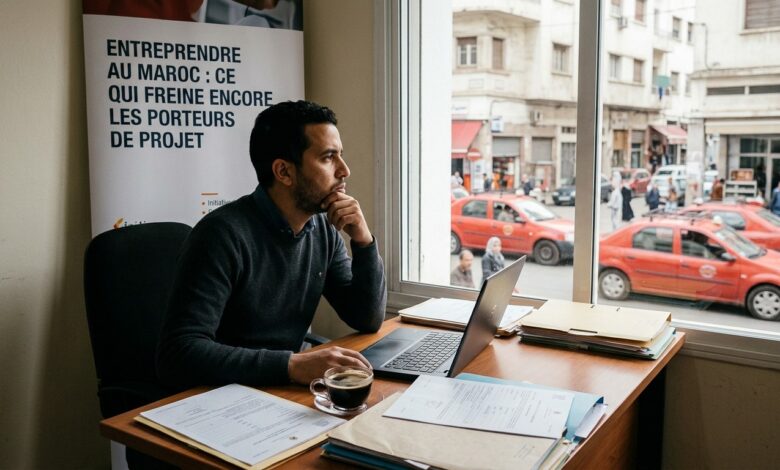
Overcoming Hurdles in Entrepreneurship: The Struggles of Project Leaders in Morocco
Difficult financing, complex administrative procedures, market access challenges, and a lack of support: despite public initiatives and the rise of entrepreneurship, many project leaders in Morocco still struggle to turn their ideas into viable businesses.
Starting a business today is no longer just about having a good idea. In Morocco, as in many African markets, the real challenge often begins after the project conception phase. From financing needs and administrative procedures to accessing first customers and mastering digital tools, the journey of an entrepreneur remains fraught with obstacles.
Nonetheless, entrepreneurial dynamism is evident. Young entrepreneurs, SMEs, and startups are actively investing in diverse sectors such as services, industry, agriculture, digital technology, and renewable energy. Yet behind this vibrant activity lies a crucial question: what prevents some projects from progressing from idea to sustainable economic activity?
Financing: The Primary Obstacle
For many project leaders, the foremost challenge is access to funding.
A project may have a potential market and a coherent business model but can find itself stalled due to insufficient equity or collateral needed to obtain credit. Young entrepreneurs, in particular, often face a paradox: they require funding to demonstrate their business’s viability, but must sometimes prove that viability before securing the necessary resources to launch.
Moreover, this issue does not only pertain to the startup phase. Once a business is established, cash flow needs can quickly become critical: purchasing equipment, hiring, communication, customer payment delays, or business development all require financial resources that smaller enterprises may not always possess.
From Idea to Market: A Complex Transition
Another challenge is transforming a good idea into a product or service that is genuinely in demand in the market.
Some projects are built around innovation or technical expertise without giving sufficient consideration to the actual customer demand. In a competitive landscape, the quality of an idea does not guarantee its commercial success.
Therefore, the project leader must excel in multiple dimensions: market research, positioning, pricing, sales strategy, communication, and customer retention.
At this stage, proper support can make a significant difference. An entrepreneur who is well-supported can identify weaknesses in their business model sooner and adjust their project before committing substantial resources.
Administrative Complexity: A Stumbling Block
Administrative issues remain a core concern for entrepreneurs.
Starting a business today is more accessible than it was a few years ago, particularly due to the digitization of many processes. However, for a new entrepreneur navigating the business world, the multitude of procedures and fiscal, social, accounting, and regulatory obligations can quickly become overwhelming.
Adding to this is the cost of time. For a small business, dedicating days to administrative processes translates into time that could have been spent on prospecting, production, or commercial development.
Thus, the challenge is not only to simplify the business creation process but also to make the entrepreneur’s journey more navigable after the business is established.
The Client Gap: The Ultimate Test
A business may be well-funded, legally established, and staffed with a competent team; however, without clients, it remains vulnerable.
Accessing the market is one of the main challenges for small businesses. Large buyers have structured purchasing procedures, while newly established SMEs often must persuade without possessing a sufficient portfolio of references.
For project leaders, securing that first contract can sometimes be more challenging than legally forming the business.
This difficulty illustrates the growing importance of professional networks, partnerships, tenders, incubators, and initiatives that help young businesses access their initial markets.
Support: A Crucial Link
Beyond financing, entrepreneurs need skills.
Financial management, human resources, marketing, digital communication, taxation, commercial negotiation, and international development are areas where business leaders must quickly become versatile.
However, not all project leaders possess this experience.
Entrepreneurial support can thus play a decisive role, provided it transcends mere theoretical advice. What entrepreneurs often need is practical support tailored to their sector and stage of development.
Digital Transformation: Redefining the Landscape
Digital transformation presents both an opportunity and a new requirement.
Social media, e-commerce, digital advertising, and artificial intelligence tools now allow small structures to reach customers with means that were previously exclusive to large companies.
Yet, this democratization has created new competition. Simply being online is no longer sufficient; businesses must produce content, build a brand identity, analyze performance, and maintain ongoing customer relationships.
For entrepreneurs, mastering digital tools is becoming a prerequisite for competitiveness rather than just an advantage.
Beyond Creation: The Survival Question
Ultimately, the true indicator of entrepreneurial success should not solely be the number of businesses created.
The central question is their ability to survive, create jobs, invest, and grow.
This necessitates looking at entrepreneurship over a longer timeline. Initial funding is important, but it must be complemented by market access, a clear regulatory environment, appropriate skills, and mechanisms that support businesses through various stages of growth.
For project leaders, the challenge is no longer merely to establish a business. It is to build an enterprise capable of enduring.
And this is likely where the next phase of entrepreneurship in Morocco lies: shifting from a mindset focused on project creation to one oriented toward establishing sustainable and competitive businesses.