The CGEM Aims to Revitalize Industry and Private Investment
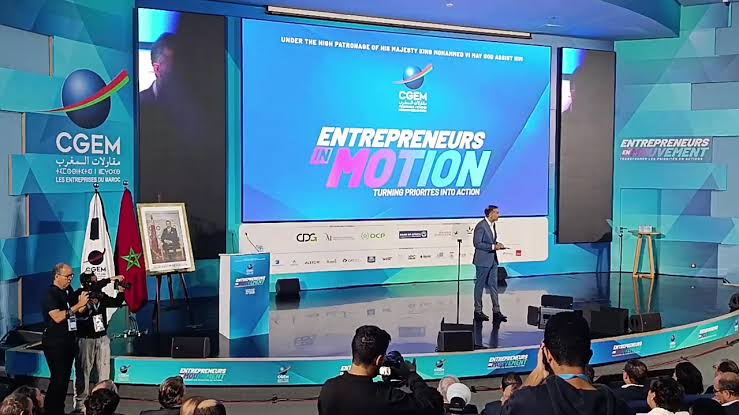
The General Confederation of Enterprises of Morocco (CGEM) aims to rejuvenate private investment and local production. Its president, Mehdi Tazi, announced the reactivation of the industrial project bank and presented several proposals intended to enhance company financing, reduce administrative constraints, and strengthen the competitiveness of Moroccan industry.
During the forum “Entrepreneurs in Motion,” dedicated to realizing economic priorities, the head of Moroccan enterprises called for a new phase in the Kingdom’s industrial development, one that relies more on innovation, technological mastery, and national value creation.
Reviving the Industrial Project Bank
Among the key announcements was the revival of the industrial project bank, initially developed by the Ministry of Industry during the 2010s and 2020s. The CGEM seeks to reactivate this tool to identify investment opportunities, connect them with investors, and facilitate their realization.
The goal is to encourage the emergence of new industrial activities in Morocco and to develop local manufacturing of products that are still largely imported. This approach aligns with a strategy aimed at enhancing the country’s productive sovereignty and expanding its industrial capabilities.
Mehdi Tazi believes that the private sector must now play a more significant role in national investment. According to estimates presented during the forum, private enterprises represent about one-third, or slightly more, of the investments made in Morocco.
After several decades marked by the development of public infrastructure, the CGEM wishes to see companies accelerate their projects and contribute more to the economic transformation of the Kingdom.
Moroccan Industry: Focusing on Technology and Added Value
To illustrate the progress achieved, Mehdi Tazi reminded attendees that Morocco’s GDP has quadrupled in twenty-five years, while exports have increased sevenfold. He also highlighted institutional stability, port, road, and airport infrastructure, as well as investments made in the energy sector.
However, he argues that these achievements must be accompanied by an upgrading of national production. The CGEM president urges industrialists to gradually move beyond the advantages of just production costs by developing activities that rely more on technology, skills, and Moroccan expertise.
The automotive and aeronautical sectors illustrate this evolution well. Based on figures presented at the forum, the local integration rate exceeds 60% in the automotive industry and could reach 65%. In aeronautics, this rate stands at over 40% and may approach 50%.
The CGEM aims to extend this dynamic to other industrial branches to increase the share of components and products manufactured in Morocco.
Energy Costs at the Core of Competitiveness
The price of energy is another lever identified by business leaders. Mehdi Tazi believes that the development of renewable energy could enable Morocco to achieve a cost of 0.50 dirham per kilowatt-hour.
Such a goal, if achieved, could help reduce energy costs for industrialists and enhance the Kingdom’s attractiveness to investors. The availability of competitive energy is indeed a significant factor in decisions regarding establishment and production capacity development.
The energy question is also related to investment prospects in new sectors, including data centers, which have particularly high electricity needs.
SME Financing: Diversifying Capital Sources
Financing for very small, small, and medium enterprises (TPMEs) is also among the priorities advocated by the CGEM. Despite mechanisms already in place, such as the Mohammed VI Fund for Investment, Mehdi Tazi believes companies need more diversified financial solutions.
He advocates for increased mobilization of the banking sector, as well as the development of debt funds and private equity mechanisms tailored to the needs of SMEs.
These instruments could enable companies to finance modernization of their equipment, the development of new technologies, and the expansion of their production capacities. The challenge is to facilitate access to capital, particularly for businesses looking to take a significant leap in their development.
Professional training is another focal point of this strategy. For the CGEM, the upgrading of the Moroccan economy requires expanding qualification opportunities for young people, experienced workers, and women across all regions of the Kingdom.
Streamlining Procedures to Accelerate Investments
On the administrative front, Mehdi Tazi advocates for a review of the procedures faced by investors. He proposes replacing certain prior authorizations with specifications that clearly define the obligations of companies, whenever the nature of the activity allows it.
In this model, operators would be able to start their activities as long as they comply with established rules, while the administration would retain its powers of oversight and sanction.
The CGEM president also calls for better oversight of adverse administrative decisions. He believes that insufficiently justified or late refusals can delay investment projects and jeopardize job creation.
He calls for justified decisions to be made within specified timeframes, which can be challenged according to established procedures.
Taxation and Customs: Correcting Imbalances
The proposals from business leaders also address taxation. Mehdi Tazi requests prompt restitution of funds improperly collected by the administration, particularly regarding withholding taxes.
According to him, retaining these amounts in the administration’s accounts deprives companies of liquidity that they could dedicate to their investments, operations, or development.
Customs policy is another area of focus. The CGEM president wishes to avoid the scenario where imported raw materials and components are subject to higher customs duties than those applied to corresponding finished products.
Such a situation could penalize local producers and favor imported goods. The advocated goal, therefore, is to improve competitive conditions between Moroccan manufacturers and foreign suppliers.
Exports: Strengthening European and African Markets
Developing exports remains a priority for Moroccan enterprises. In Europe, Mehdi Tazi encourages operators to consolidate their positions despite changing regulations and re-industrialization policies in several countries.
Morocco’s geographical proximity to the European Union and the already established industrial relationships are, according to him, assets for Moroccan suppliers looking to strengthen their presence in this market.
In Africa, the CGEM aims to promote increased exchanges between the continent’s economies. Mehdi Tazi noted that intra-African trade accounts for approximately 15% of the continent’s trade, compared to 57% in Europe and nearly 60% in Asia.
The African Continental Free Trade Area (AfCFTA) is seen as a lever for developing exchanges and multiplying opportunities between businesses. The announced participation of representatives from employers’ organizations of fifteen African countries at the forum reflects this willingness to strengthen economic relations on the continental scale.
Railway, Defense, and Data Centers: New Growth Drivers
The CGEM also aims to encourage investments in sectors that could lead to new industrial fields.
The railway sector is among the activities mentioned, particularly regarding projects developed in Benguerir. The development of this sector could, according to Mehdi Tazi, pave the way for a national industrial ecosystem comparable to those of the automotive and aeronautics industries.
The defense industry is also cited as a sector to be explored, while data centers could benefit from the availability of land and the potential of renewable energies, especially in the southern regions.
Artificial intelligence is also among the technologies expected to transform production methods, work organization, and business management. For the business community, these developments present possibilities for modernization and value creation, provided that the necessary skills and infrastructure are in place.
World Cup 2030 as an Investment Accelerator
Finally, Mehdi Tazi views the preparations for the 2030 World Cup as an opportunity to accelerate investments in Morocco. Projects related to transportation, airports, ports, and hospitality are subject to deadlines that could encourage companies to anticipate their decisions and enhance their capacities.
Beyond the sporting event, these investments could help improve infrastructure and create new opportunities for Moroccan enterprises.
With the revival of the industrial project bank and its proposals regarding financing, taxation, and administrative simplification, the CGEM aims to strengthen the role of the private sector in the national economy. The ambition is to support a more competitive industry, focused on local production, innovation, and high value-added activities.