Water Security in Dakhla: SRM-DO Focuses on Resource Diversification and Treatment System Development
Strengthening Water Security in Dakhla-Oued Eddahab: Embracing Non-Conventional Water Resources Amid Climate Change
In light of the limited availability of conventional water resources and the accelerating impacts of climate change, the Dakhla-Oued Eddahab region is steering towards enhancing its water security by diversifying supply sources and developing non-conventional water resources. In this context, the Regional Multi-Service Company of Dakhla-Oued Eddahab is actively working on establishing monitoring and management systems and supporting desalination and water treatment projects to ensure a continuous supply of potable water and to bolster the region’s capacity to meet its future needs.
Water is one of the primary determinants of sustainable development, particularly in areas where natural and climatic conditions restrict the availability of conventional water resources. In the Dakhla-Oued Eddahab region, this equation is especially significant, given the ongoing urban and population growth as well as the economic dynamics within the area, which are driving an ever-increasing demand for water.
In this regard, the Regional Multi-Service Company of Dakhla-Oued Eddahab continues to implement a series of projects aimed at improving the management of the water system by developing control mechanisms, enhancing network efficiency, diversifying supply sources, and increasingly tapping into non-conventional water resources.
From Network Monitoring to Preventive Intervention
Securing the water supply does not solely rely on the resource’s availability; it also depends on the capacity to monitor the networks and control their various components.
In this framework, the company has proposed a project for setting up a remote management system for drinking water and wastewater networks, aimed at enhancing continuous monitoring and improving the speed and effectiveness of technical interventions.
This system plans to install 19 continuous monitoring devices linked to a remote management center, which will allow for real-time tracking of flows and pressures within the network while also strengthening the control of the quality of the distributed water.
Additionally, the company’s reservoirs will be outfitted with continuous monitoring devices to provide precise data on the network’s status and on various indicators related to supply.
This approach extends to pumping stations as well, which will feature gas detection and monitoring systems to improve safety conditions within these facilities and protect the personnel working there. Systems for tracking water levels will also be implemented at the pumping stations.
The significance of these devices goes beyond technical control; they will also establish a useful database for anticipating interventions, reducing technical team response times, and directing field operations more accurately to the sites that truly need assistance.
Thus, network management evolves from a reactive approach after anomalies arise to a proactive stance based on continuous monitoring and anticipating failures before they disrupt service continuity.
Conventional Resources Alone Are Not Enough
However, improving network performance, as crucial as it is, cannot single-handedly address the fundamental challenge of water resource availability.
According to data provided by the company’s Director of Investments, Khalid Mimich, the available raw water resources in the region do not directly meet the sanitary standards required for human consumption. Thus, the use of non-conventional water resources becomes an essential component of the supply security strategy.
Desalination of seawater is among the primary solutions being utilized. It facilitates the valuation of a resource available along the coastline by converting it into usable water after undergoing the necessary treatment stages.
These projects align with the national direction to strengthen water security and diversify sources of water supply, particularly against a backdrop of climate change and increasing pressure on conventional resources.
Six Desalination and Treatment Stations in the Region
The Dakhla-Oued Eddahab region is equipped with six desalination and water treatment stations, distributed across its various territories, underscoring the significant investments made in non-conventional water resources.
The system includes:
- One operational station in the city of Dakhla.
- Two stations in the Aousserd province, operational during the last Eid al-Adha.
- One station in the Mhiriz center, currently being commissioned.
- One station in the El Argoub center, presently under construction.
- One station in the Bir Gandouz center.
These infrastructures are part of a strategy aimed at reducing reliance on conventional resources and enhancing the region’s capacity to secure its drinking water needs, especially in areas where natural and climatic conditions necessitate the adoption of alternative resource mobilization solutions.
These projects hold particular significance given the vastness of the regional territory and the distribution of its urban and rural centers. Ensuring reliable water services thus involves developing infrastructures that meet the needs of each area according to its specificities.
Treatment: A Crucial Link in the Water System
Investments extend beyond desalination. Wastewater treatment also represents a vital link in the water resource management system in the region.
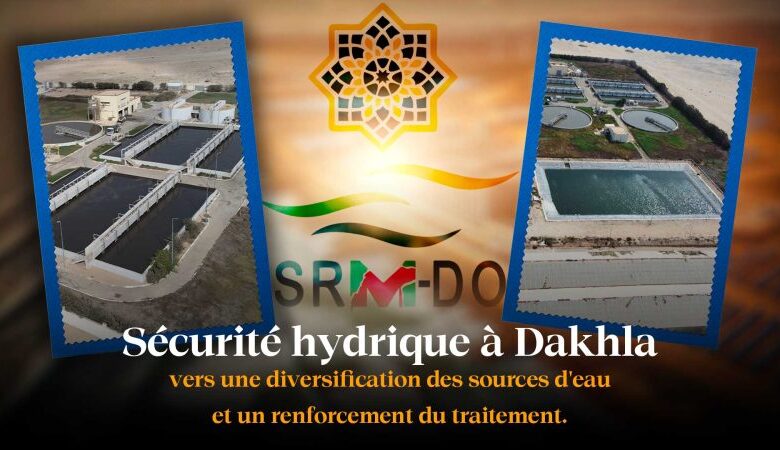
The wastewater treatment plant in the city of Dakhla stands out as a significant environmental and strategic project. It contributes to the treatment of wastewater, enhancing its quality before discharge while also enabling the reuse of treated water.
The plant operates on activated sludge technology, with a current capacity of approximately 10,000 cubic meters per day.
Of this volume, about 5,000 cubic meters per day undergo tertiary treatment, resulting in treated water of a quality level compatible, according to prevailing standards, with uses that do not require potable water.
As part of strengthening this infrastructure, the Regional Multi-Service Company of Dakhla-Oued Eddahab is implementing a project to rehabilitate the plant and enhance its tertiary treatment capacities.
The project aims to double the tertiary treatment capacity, enabling the production of approximately 10,000 cubic meters per day of treated water designated for reuse.
Treated Water: An Additional Resource for the Region
The reuse of treated water is a key element in the new approach to water security. It allows for the valuation of a resource that was previously primarily oriented towards discharge, transforming it into a mobilizable resource for appropriate uses.
The targeted volume, estimated at around 10,000 cubic meters per day, will primarily be allocated for irrigating green spaces, thereby reducing pressure on conventional water resources and preserving groundwater.
This approach also ensures that potable water is reserved for uses that truly demand potable quality rather than being used for activities that could be satisfied by treated water.
Environmentally, treatment helps to improve water quality before its discharge into the marine environment and mitigates potential impacts associated with wastewater, aligning with environmental protection and sustainable development principles.
An Integrated Approach to Water Security
All these projects demonstrate that the approach to water security in the Dakhla-Oued Eddahab region no longer relies on a singular solution but rather on a system composed of various complementary levers.
From rehabilitating distribution networks and reducing water losses to remote management and monitoring flows and pressures, and from desalinating seawater to treating wastewater, these projects converge toward a common goal: to enhance the region’s capacity to secure its water resources while improving the efficiency of their use.
Within this dynamic, the Regional Multi-Service Company of Dakhla-Oued Eddahab plays a central role in implementing these projects through investment in infrastructure, developing management and control tools, and facilitating the transition to non-conventional water resources.
This approach aligns with national water management directives, based on the diversification of supply sources, development of non-conventional water resources, improvement of water governance, and strengthening of infrastructure to ensure the sustainability of services.
From Resource Mobilization to Water Cycle Management
The merit of this approach lies in its consideration of water as an integrated system, beginning at the source and not stopping at the point of use.
Desalination allows for mobilizing a new resource, the rehabilitation of networks helps reduce losses, monitoring systems enable more precise management, and wastewater treatment and reuse pave the way for recovering part of the resource and reintegrating it into the usage cycle.
For the Dakhla-Oued Eddahab region, facing challenges related to the limited availability of conventional water resources, the combination of these solutions represents a primary lever to meet increasing demand and ensure a continuous supply.
In this dynamic, investments in the water sector are no longer viewed as isolated projects but as an interconnected system aimed at protecting the resource, diversifying its sources, improving its utilization efficiency, and ensuring its sustainability.
The challenge now rests on the region’s ability to transition from treating water as a limited resource to managing it based on an integrated hydrological cycle, leveraging technology, desalination, treatment, monitoring, and reuse in the service of water security and sustainable development.