CASA-ANFA, NEW FACTORY OF THE FUTURE – MCG24 FR
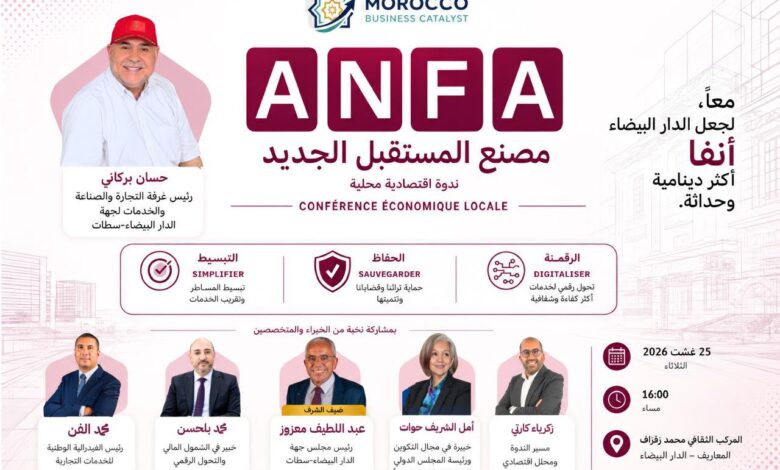
As part of the “Casa-Anfa, New Future Factory” initiative, Morocco Business Catalyst is organizing a Local Economic Conference on Tuesday, August 25, 2026, starting at 4:00 PM at the Zefzafi Theatre in Maârif, Casablanca.
Centered around the theme “SSD: Simplify, Preserve, Digitalize,” this meeting aims to create a real dialogue space among citizens, economic actors, merchants, entrepreneurs, professionals, experts, and institutions around a central question: how can we concretely improve the experience of those who live, work, invest, or visit Casablanca?
The “Casa-Anfa, New Future Factory” approach derives from real-world situations, aiming to identify everyday challenges and generate practical, achievable, and measurable solutions.
1. SIMPLIFY – Making the relationship with the city simpler and more efficient
Simplification primarily involves facilitating the relationship between residents, economic actors, and all institutions and organizations involved in economic and territorial life: municipal, regional, investment centers, chambers of commerce, agencies, and business support organizations.
The conference will specifically address issues surrounding administrative procedures and economic operating licenses, which can sometimes be complex for entrepreneurs, merchants, and investors. The goal is to reduce delays, misunderstandings, and repetitive processes.
However, simplification also relates to everyday life. When a citizen notices a pothole in a street, a lighting issue, a faulty cable, or an anomaly in their neighborhood, they should be able to immediately identify the appropriate contact, report the problem, and quickly track its resolution. The ambition is to transition from a logic where the citizen seeks out the administration to one where the city directs them straight to the right service and solution.
2. PRESERVE – Safeguarding the economic, commercial, cultural, and urban heritage
A metropolis cannot build its future by neglecting the neighborhoods that have shaped its history. Preservation means safeguarding and revitalizing the economic, commercial, cultural, and urban heritage of Casablanca while adapting historical neighborhoods to new uses and expectations.
The Prince Moulay Abdellah area is a prime example. For decades, it has been a major commercial destination for both Casablancans and visitors from across the Kingdom. It is part of the city’s economic memory. Today, the challenge is to restore its attractiveness through cleanliness, quality public spaces, aesthetic facades and signage, organized commerce, dynamic activities, and improved visitor experiences.
Similarly, Maârif must retain and strengthen its role as a commercial and service hub. The development of new poles like Casablanca Finance City or new peripheral centers presents an opportunity for Casablanca, but creating new neighborhoods should not signify abandoning the old ones.
Every neighborhood can develop a strong identity—be it in commerce, services, craftsmanship, historic cafés, culture, tourism, gastronomy, or the creative economy. Modernizing Casablanca also means knowing how to preserve what defines its identity.
3. DIGITALIZE – Transitioning from mere dematerialization to a genuine digital experience
Digitalization should not merely consist of replacing a paper file with an online form. It should allow for a rethinking of the user experience from start to finish, making services faster, more transparent, more accessible, and better interconnected.
The conference will open dialogue about accelerating the digitalization of documents and procedures, as well as creating a true digital experience of Casablanca. In the future, a resident or visitor should be able to access a genuine urban wallet from their phone, granting them access to transportation, taxis, restaurants, hotels, monuments, tourist circuits, events, ticketing, and practical information.
The objective is twofold: to facilitate the user experience and better structure the economic, tourist, and service offerings of the city. As Morocco prepares to host major international events, this transformation becomes a crucial issue for attractiveness and competitiveness.
4. TRAINING AND EMPLOYMENT – Putting skills at the heart of transformation
Simplifying, preserving, and digitalizing cannot yield sustainable results without individuals capable of driving this transformation. Therefore, the conference will place significant emphasis on training, employment, and upskilling competencies.
Taxi drivers, servers, tour guides, artisans, electricians, plumbers, carpenters, technicians, and service professionals directly contribute to the quality of the experience offered by a major metropolis. These professions need to be better valued, better trained, and more prepared to meet the quality standards expected both in Morocco and internationally.
The day’s discussions will focus on the creation of specialized professional academies: an academy for restaurant and service trades, an academy for plumbers, electricians, carpenters, and professions related to tourism and hospitality. These training programs could combine technical excellence, professional soft skills, digital competencies, and foreign language learning, particularly English or German, depending on the targeted markets.
The goal is to ensure that vocational training is not just a response to unemployment but a genuine tool for social mobility, economic competitiveness, and the enhancement of Moroccan know-how.
5. FROM CONSULTATION TO SOLUTIONS
The Local Economic Conference on August 25 aims not to merely present observations but to confront experiences, identify what is already working, understand the blockages, and, above all, to produce operational proposals that can be presented to the relevant stakeholders.