Copper Imports: Morocco Heavily Relies on Spain and Belgium
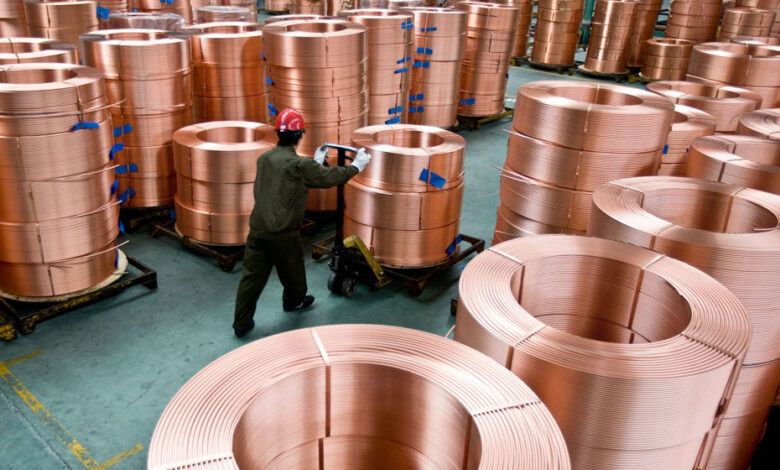
Morocco’s Copper Imports Reach $2.37 Billion in 2025
According to data from World Integrated Trade Solution (WITS), a World Bank platform fueled by statistics from UN Comtrade, Morocco imported $2.37 billion worth of copper and copper products in 2025. The supply appears particularly concentrated, as Spain and Belgium alone account for 85.8% of Morocco’s copper imports listed under Chapter 74 of the Harmonized System.
Spain Dominates Morocco’s Copper Suppliers
Spain leads significantly as Morocco’s main supplier of copper and copper products, exporting $1.207 billion, which represents 50.9% of Morocco’s total imports in this category.
Belgium ranks second with $826.5 million, accounting for 34.9% of the total. Far behind these two are France with $158.2 million, followed by Germany at $37.6 million and the United Arab Emirates with $35.8 million.
The concentration of suppliers becomes even more pronounced when considering the top four European providers. Together, Spain, Belgium, France, and Germany make up approximately 94% of Morocco’s imports listed under Chapter 74.
Italy follows with $25.6 million in exports, ahead of Portugal at $14 million and China at $9.7 million. Meanwhile, imports from India total around $1.98 million, Japan’s reach approximately $1.66 million, and South Korea contributes nearly $102,000.
Strong Dependence on Two European Suppliers
The 2025 figures highlight Morocco’s strong reliance on Spain and Belgium. These two countries provided a combined total of $2.034 billion worth of products from Chapter 74, representing 85.8% of the total value of imports reported by Morocco.
This structure reflects an exceptional concentration of external supplies from a limited number of partners, primarily located in Europe.
It’s important to clarify that the data does not pertain solely to raw copper. Chapter 74 encompasses all "copper and articles thereof," covering various forms of the metal as well as products and items made from copper.
The data utilized by WITS is based on the HS classification from 1988/92, which categorizes "Copper and articles thereof" under code 74.
Morocco Also Exports Copper
Morocco’s trade is not limited to imports. In 2025, the Kingdom reported approximately $388 million in exports from the same category.
Spain and China emerged as the primary markets, followed by France and Belgium.
The difference between imports and exports indicates a trade deficit of nearly $1.98 billion for this category of products, underscoring the significance of foreign supplies in meeting Morocco’s copper and derived products needs.
Significant Discrepancies Between Moroccan and Supplier Statistics
A comparison between the figures reported by Morocco and the so-called "mirror" statistics reveals significant discrepancies.
According to WITS data from supplier countries, exports to Morocco are estimated at $641.2 million from Spain, $478.2 million from Belgium, $110.4 million from France, and $59.6 million from Germany.
These amounts should not be added to Morocco’s imports, as they represent the statistical counterpart of the same exchanges.
Nevertheless, the gap is substantial. Morocco accounts for $1.207 billion in imports from Spain, while only $641.2 million has been reported as Spanish exports to the Kingdom. For Belgium, the figures stand at $826.5 million and $478.2 million respectively.
Why Such Statistical Differences?
Disparities between a country’s import data and that of its trading partners are not unusual in international statistics.
Several factors can contribute to these inconsistencies, including different valuation methods for goods, choice of partner country in the statistics, timing discrepancies in recording transactions, re-exports, or customs classification rules.
The confidentiality of certain trade data may also contribute to the observed divergences.
Despite these caveats, the primary takeaway from the available figures remains clear: Morocco’s imports of copper and copper products continue to be heavily concentrated among a few European suppliers, with Spain and Belgium in dominant positions.