
Morocco-Russia: Rabat Advocates for a Concrete Partnership in Africa
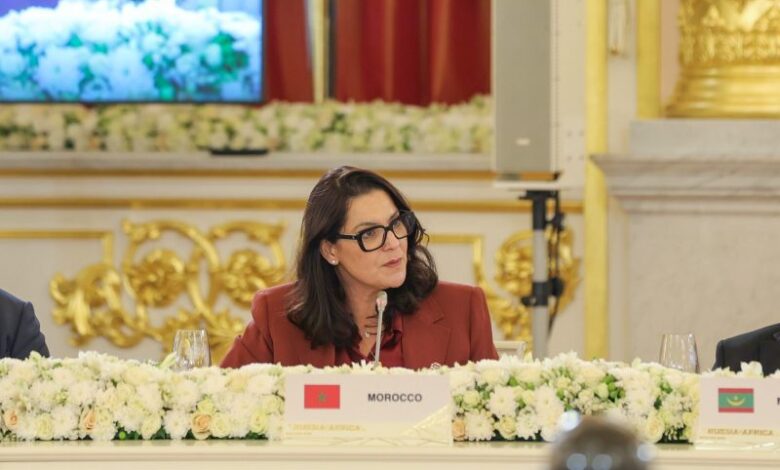
Morocco Reaffirms Commitment to Concrete Projects in Russia-Africa Partnership
Morocco has reiterated its dedication to a Russia-Africa partnership built on tangible projects, mutual respect, and the development priorities of the continent. In Moscow, government leader Fatima Ezzahra El Mansouri, representing King Mohammed VI at the third Russia-Africa Summit, highlighted royal initiatives aimed at regional integration, unlocking the Sahel, and strengthening economic cooperation among African countries and their international partners.
Royal Initiatives at the Heart of Morocco’s African Vision
During the summit’s plenary session, Fatima Ezzahra El Mansouri emphasized that Africa is a major priority in Morocco’s foreign policy, guided by King Mohammed VI. This direction is reflected through several key initiatives designed to enhance connectivity, economic integration, and regional stability.
The government leader cited the Atlantic African States Initiative, the royal initiative to facilitate Sahel countries’ access to the Atlantic Ocean, and the Nigeria-Morocco Atlantic Gas Pipeline project.
These projects are part of a vision for regional cooperation focused on infrastructure development, opening new economic prospects, and strengthening ties among African nations. The aim is to promote the decongestion of the Sahel and foster a collaborative development dynamic across West Africa.
Moving from Planning to Implementation in Russia-Africa Partnership
For Fatima Ezzahra El Mansouri, the partnership between Russia and African countries must now advance to a new level, transitioning from planning to the actual realization of projects. Action plans adopted during previous summits in Sochi and St. Petersburg have laid the groundwork for structured cooperation, yet their implementation must better align with the continent’s priorities.
The government official specifically stressed four strategic areas: food security, energy security, industrialization, and technology transfer.
She underscored the necessity for Africa to engage all its international partners, with the condition that various cooperation frameworks are complementary, based on mutual respect, and lead to concrete actions. In this context, Morocco aims to contribute to the emergence of new cooperation avenues between Russia and the African continent.
Africa: A Strategic Partner for the World
In her address, Fatima Ezzahra El Mansouri also highlighted Africa’s potential, driven by its natural resources, human capital, geographic position, and diverse historical, cultural, and political landscape.
She noted that relationships between Africa and its international partners should not be viewed solely through the lens of the continent’s needs. Global economies are increasingly interested in developing their relations with Africa due to its economic weight and development prospects.
The third Russia-Africa Summit occurs against a backdrop where African nations’ expectations regarding development, energy security, food security, and economic sovereignty are growing. For Rabat, strengthening the institutional framework of this partnership must lead to tangible results that benefit African populations and economies.
Russia-Africa Trade Exceeds $27.7 Billion
According to the government leader, seven years after the Sochi summit and three years after the St. Petersburg summit, the Russia-Africa partnership has made significant strides. These include institutionalizing meetings, enhancing political dialogue, adopting action plans, and opening channels of cooperation in infrastructure, health, education, training, energy, and technology transfer.
Trade between Russia and the African continent has reportedly exceeded $27.7 billion in 2025, as cited by Fatima Ezzahra El Mansouri.
However, the Moroccan official stressed the need to identify the next steps for this cooperation to turn strategic orientations into operational projects that better meet the expressed priorities of African countries.
Morocco-Russia Relations Strengthened Since 2002
Touching on bilateral relations, Fatima Ezzahra El Mansouri remarked that the ties between Morocco and Russia are grounded in a long history of friendship. These ties have been notably strengthened by the establishment of a Strategic Partnership in 2002, and further deepened during King Mohammed VI’s visit to Moscow in 2016.
Today, according to the government leader, Morocco ranks among Russia’s top three economic partners in Africa. Trade between the two nations reached $630 million in 2025, with Moroccan exports to the Russian market increasing by 18%.
Cooperation is also evident in higher education, with over 7,000 Moroccan students pursuing their studies in Russia during the 2024-2025 academic year, illustrating the human dimension of relations between the two countries.
Despite a complex geopolitical environment, bilateral exchanges have remained at levels deemed satisfactory by the government leader.
New Avenues for Cooperation to Explore
Beyond trade and academic collaboration, Morocco and Russia still have opportunities for cooperation in the energy, science, and technology sectors.
This desire to deepen political dialogue and explore new cooperation areas has been underscored by the recent establishment of a working committee between the foreign ministries of both countries. Its inaugural meeting took place in September 2026.
By participating in the third Russia-Africa Summit, Morocco reaffirms its commitment to international cooperation based on the complementarity of partnerships and the realization of commitments. Rabat intends to continue promoting an approach where African initiatives and international collaborations directly contribute to the continent’s development, regional integration, and economic sovereignty.


