Regional Integration: Can Morocco Really Bypass the Dollar and the Euro?
Bank Al-Maghrib’s Strategic Moves: Morocco Enters Regional Financial Infrastructure Competition
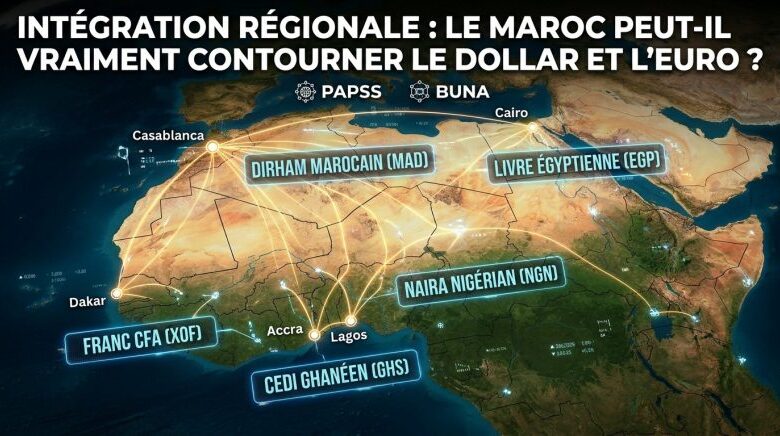
By joining the Pan-African Payment and Settlement System (PAPSS) and completing its membership in the Arab Buna platform, Bank Al-Maghrib is positioning Morocco in a discreet yet crucial competition within regional financial infrastructures. The stakes extend beyond merely reducing banking fees; they touch upon monetary sovereignty, Casablanca’s role in African and Arab financial flows, and the Kingdom’s ability to decrease its dependency on payment circuits dominated by foreign currencies.
Over a year ago (June 2025), Bank Al-Maghrib officially signed its membership agreement with PAPSS, becoming the 17th member in this pan-African network. Developed by Afreximbank in collaboration with the African Continental Free Trade Area (AfCFTA) secretariat, the platform aims to facilitate cross-border payments in local currencies, enabling instantaneous transfers. For Moroccan businesses focused on West Africa, the Sahel, or East Africa, the necessity to reduce delays, limit successive conversions, and secure payments—often reliant on banking correspondents outside the continent—is very real.
Bank Al-Maghrib has also completed its membership with Buna, the Arab system for compensating and settling cross-border payments, with a similar goal: to ease the use of local currencies in trade between Arab countries.
The Dollar and Euro: Still Present, but Receding
PAPSS does not aim to displace the dollar and euro; its ambition is more targeted: to make African currencies the standard medium for intra-African trade, where currency conversions into third-party currencies were previously the norm. Practically speaking, a Moroccan importer can pay in dirhams while their African supplier receives naira, cedis, or CFA francs, depending on the available corridors. Thus, commercial transactions are processed in local currencies, with transfers executed instantly.
However, the system retains a compensation step among national systems. The daily net settlement results in residual positions settled in a strong currency by Afreximbank. Hence, the dollar and euro do not disappear; they are merely moved from the level of commercial transactions to that of central interbank compensation.
This is where the strategic challenge lies. Each dirham that can be settled directly against an African currency decreases reliance on correspondent banking circuits, lowers foreign exchange costs, and shortens the settlement cycle. Morocco does not seek to replace global reserve currencies; it aims to stop using them as a default for payments to its economic neighbors.
The Real Benefits: Cost and Timing
Currently, a transaction between Morocco and several African markets might involve multiple conversions, correspondent fees, and longer settlement timelines. PAPSS promises to deliver local currency payments that are fast and traceable, accessible through banks and providers connected to the network.
For an exporting SME, the difference can be significant. A shorter settlement time reduces the need for operational financing. A direct conversion minimizes currency exchange costs. Enhanced traceability facilitates documentary compliance.
Yet, the impact will hinge on a decisive factor: the number of Moroccan banks truly connected to the system, the depth of available corridors, and the volume of bilateral exchanges. Central bank membership opens the door; it does not automatically create a liquid market.
Key Challenges Remain
The first challenge is regulatory. The dirham is not fully convertible in the capital account, and currency operations remain regulated by the Office des Changes. Any regional interconnection must therefore reconcile fluid commercial payments with the prevention of capital flight.
The second challenge is compliance. PAPSS imposes controls for validating payment instructions and requires a compliance architecture among jurisdictions with heterogeneous AML/CFT frameworks. As the network expands, harmonizing standards becomes increasingly critical.
The third challenge is financial. African currencies exhibit varying levels of liquidity, volatility, and foreign exchange risk. Consequently, Moroccan banks must build capacities for hedging, managing positions, and understanding local counterparties.
Casablanca: Hub or Simple Node?
Morocco boasts significant advantages: a structured financial center, banks present in about twenty sub-Saharan African countries, a geographical position between the Atlantic, the Sahel, and Europe, and an actively engaged economic diplomacy toward the continent.
However, mere membership in PAPSS and Buna is insufficient to establish Casablanca as a hub. Achieving this will require liquid corridors, operational commercial banks, deep exchange infrastructures, and a regulatory framework capable of managing flows without opening doors to speculative arbitrage.
It remains to be seen whether Morocco can become one of the most effective transit points between Africa, the Arab world, and Europe while maintaining control over its monetary framework.
The Decryptor