Throne Day in Barcelona: The Moroccan Consul General Highlights the Kingdom’s Reforms and the Excellence of Moroccan-Spanish Partnership
Celebrating the Throne Day: Acknowledging Morocco’s Transformation and Strategic Partnership with Spain
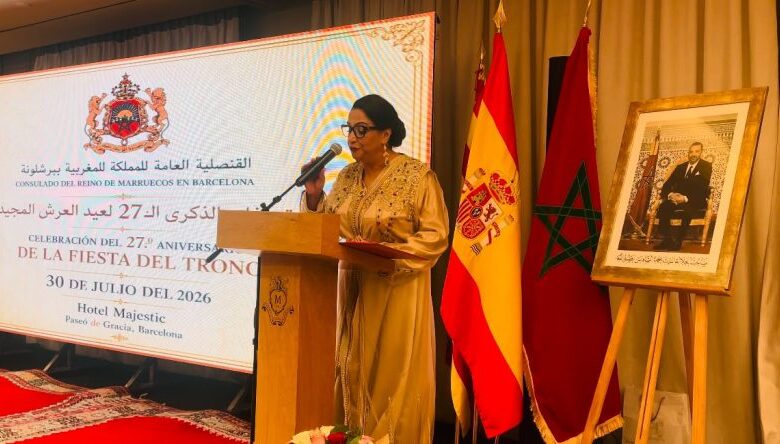
In a ceremony held on Thursday evening in Barcelona to celebrate Throne Day, Morocco’s Consul General, Nezha Tahar, spotlighted the profound transformations the Kingdom has undergone under the leadership of His Majesty King Mohammed VI. She emphasized the outstanding relations between Morocco and Spain, alongside the strategic role played by the Moroccan community in Catalonia.
Addressing a gathering of political, diplomatic, economic, and academic figures, the Moroccan diplomat asserted that Throne Day "transcends mere historical commemoration," embodying "the permanence of the monarchical institution, the continuity of the state, the stability of institutions, and the centuries-old bond between the Alaouite Throne and the Moroccan people."
Reflecting on the twenty-seven years of His Majesty King Mohammed VI’s reign, Nezha Tahar highlighted that Morocco has experienced "a profound transformation" driven by "a clear strategic vision and a governance model based on initiative and rigorous oversight." She recalled the Sovereign’s words in his National Speech, noting that the Kingdom’s achievements "are not the result of chance or circumstances," but rather the outcome of a proactive policy that has positioned Morocco as "one of the most robust centers of stability in the Euro-Mediterranean and African regions."
The Consul General reviewed the key institutional reforms undertaken in recent years, particularly the adoption of the 2011 Constitution, which she described as a significant milestone in consolidating the rule of law, enhancing freedoms, ensuring judicial independence, and advancing good governance and regionalization. She also underscored the constitutional recognition of Morocco’s cultural diversity, illustrated by the official status awarded to the Amazigh language alongside Arabic.
Economically, Nezha Tahar noted that Morocco has established itself as one of the most dynamic economies on the African continent, thanks to a strategy focused on openness, investment, and industrial diversification. She pointed out that Morocco has become Africa’s leading automotive manufacturer, producing over a million vehicles annually, with the automotive and aerospace sectors now accounting for more than 40% of national exports.
The diplomat also highlighted the achievements in Moroccan infrastructure, citing the Tangier Med port, now the largest port in the Mediterranean and Africa, along with the expansion of the high-speed rail network and investments made in preparation for hosting the FIFA World Cup 2030, co-organized with Spain and Portugal.
Discussing energy transition, Nezha Tahar reminded the audience of Morocco’s ambitions in developing renewable energy and green hydrogen. She particularly praised the launch of the "Moroccan Green Hydrogen Initiative," aimed at establishing the country as a global leader in this strategic sector.
Beyond economic indicators, the Consul General stressed the social dimension of Morocco’s development model. She mentioned the National Initiative for Human Development (INDH), the expansion of social protection, the extension of mandatory health insurance, and the reforms aimed at improving citizens’ living conditions. These advancements, she emphasized, have enabled Morocco to join the category of countries with high human development according to the 2025 United Nations Development Programme report.
The diplomat also spotlighted the progress made in promoting women’s rights and ongoing discussions regarding the revision of the Family Code, which she presented as efforts to reconcile Moroccan societal values, constitutional principles, and the tenets of Islam.
On the international stage, Nezha Tahar praised Morocco’s growing influence under the guidance of His Majesty King Mohammed VI. She reiterated the Kingdom’s commitment to peace, international cooperation, and sustainable development, alongside its efforts for the Palestinian cause, its strong African ties through South-South cooperation, and major infrastructural projects like the Africa-Atlantic Pipeline and the Royal Atlantic Initiative.
Addressing the issue of the Moroccan Sahara, the Consul General reaffirmed that the Moroccan autonomy initiative represents "the only serious, credible, and realistic basis" for achieving a durable political solution under United Nations auspices. She noted that the opening of 31 consulates in the Southern provinces reflects the international community’s trust in the Moroccan approach.
Regarding relations between Rabat and Madrid, Nezha Tahar described the Moroccan-Spanish partnership as "a model of strategic collaboration," rooted in mutual respect, trust, and a shared vision of the Mediterranean as a space for peace and prosperity. She highlighted that Spain remains Morocco’s largest trading partner, with trade volume nearing 22.7 billion euros in 2024, along with over a thousand Spanish companies operating in Morocco.
The Consul General expressed her view that the joint organization of the 2030 World Cup by Morocco, Spain, and Portugal is a concrete illustration of this exemplary cooperation and an opportunity to strengthen ties between both shores of the Mediterranean. She also congratulated the Spanish people on their triumph in the 2026 World Cup.
In her remarks about Catalonia, Nezha Tahar paid a heartfelt tribute to the Moroccan community, which she called a "true human bridge between the two shores of the Mediterranean." She applauded its integration and contribution to the region’s economic, academic, cultural, and entrepreneurial vitality while thanking the Spanish and Catalan authorities for their quality cooperation with the Moroccan Consulate, particularly in matters of regularization.
In conclusion, the diplomat called for deepening relations between Morocco and Barcelona by enhancing economic, academic, cultural, and migratory cooperation. She advocated for turning Barcelona and Moroccan cities into "platforms for co-development and innovation," affirming that the Moroccan community is ready to play its full role as a link between the two countries.
The ceremony concluded with prayers for His Majesty King Mohammed VI and the Royal Family, and a moving homage to Moroccan-Spanish friendship.