Morocco-Canada: An International Laboratory Dedicated to Medical Innovation
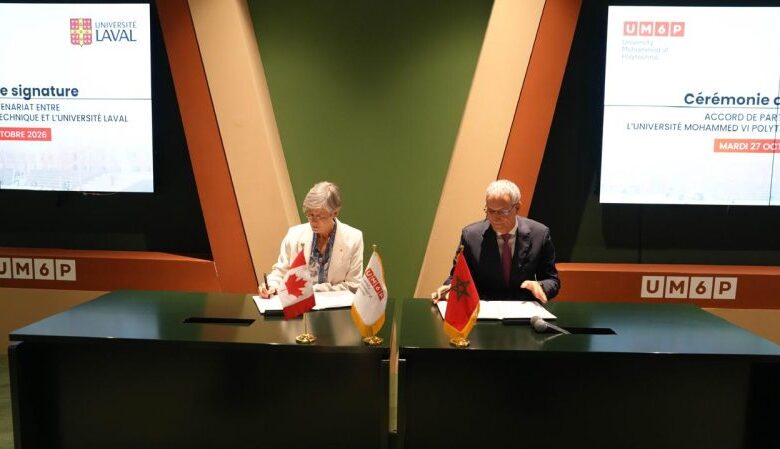
Morocco and Canada Strengthen Scientific Cooperation with New International Laboratory for Advanced Medical Technologies
On October 27, 2026, in Benguerir, Morocco, Mohammed VI Polytechnic University (UM6P) and Laval University signed two agreements aimed at structuring their academic partnership and developing joint projects in research, health, and technological innovation. This initiative comes as a continuation of a collaboration initiated in 2018, reflecting the commitment of both institutions to pool their scientific expertise and contribute to the development of innovative solutions to major medical and technological challenges.
The agreements were signed on the UM6P campus during the visit of Sophie D’Amours, the rector of Laval University. The first accord establishes an expanded cooperation framework that encompasses several disciplines, including science and engineering, agriculture, health, education, as well as the humanities and social sciences.
This agreement outlines plans to enhance academic mobility, facilitate exchanges between researchers and educators, develop joint training programs, and implement research initiatives involving teams from both universities. Through this collaboration, the partners aim to promote knowledge exchange, strengthen scientific capabilities, and create sustainable bridges between the Moroccan and Canadian academic ecosystems.
The second agreement focuses on the establishment of an Associated International Laboratory (LIA), dedicated to multidisciplinary research at the intersection of physics, optics, electrophysiology, and medical biology. This lab aims to explore new approaches to better understand the biological and molecular mechanisms involved in certain diseases, while also developing innovative pathways for diagnosis and treatment.
Research will particularly emphasize neuroscience and oncology, fields where advancements in imaging, cellular analysis, and biomedical technologies unveil new horizons. The laboratory will draw on the expertise of the College of Physics and Engineering (CPSE) and the Faculty of Medical Sciences (FMS) at UM6P, as well as the Center for Optics, Photonics, and Lasers (COPL) and the CERVO Research Center at Laval University.
The complementarity of these teams is expected to facilitate the integration of perspectives from physics, engineering, biology, and medical sciences to better investigate the mechanisms behind certain diseases. Among the laboratory’s key aims is the development of research that could contribute to precision medicine—a strategy that tailors diagnostic and treatment approaches to the biological characteristics of patients.
Researchers will also focus on advanced imaging technologies and functional characterization of cells and tissues. Studying their electrical activity may provide new insights into certain mechanisms associated with neurological diseases and examined pathological processes. Concurrently, the teams will explore gene therapy strategies and modulation of molecular and cellular mechanisms to identify new therapeutic avenues.
One of the collaboration’s significant advantages lies in bridging scientific disciplines that have typically been developed in isolation. By bringing together physicists, engineers, biologists, and specialists in medical sciences, the partners seek to facilitate the transition from fundamental research to technological, and ultimately medical, applications. However, these prospects are contingent upon the outcomes of scientific work, necessary validations, and applicable regulatory procedures before any clinical use.
This partnership also aligns with the dynamics of the Canada-Africa Scientific Corridor, supported by UM6P Global Hubs Canada. This initiative aims to bolster knowledge exchanges and structure collaborations between scientific communities across both continents. It notably aims to promote researcher mobility, share infrastructures, and develop joint programs addressing health, technology, and development challenges.
For Morocco, this cooperation is an opportunity to bolster national competencies in strategic areas such as biotechnology, biomedical engineering, photonics, and diagnostic technologies. It could also enhance the utilization of research outcomes, encourage the emergence of innovative start-ups, and promote the development of technologically advanced medical solutions.
In a landscape marked by accelerating biomedical innovations and international competition in health technologies, developing advanced scientific capabilities is a strategic imperative. For Morocco, strengthening ties between fundamental research, specialized training, innovation, and industrial applications is a crucial development axis. The cooperation between UM6P and Laval University fits this vision by uniting the scientific capabilities of both institutions around common projects.
The impact of this alliance will largely depend on the continuity of programs, securing necessary funding, and the ability to transform scientific discoveries into innovations that can be transferred to the medical and industrial sectors. With these two agreements, the Moroccan and Canadian universities are taking a significant step forward in their partnership. This collaboration could help enhance Morocco’s position in international research networks and foster new expertise to support medical innovation and healthcare system needs.